
APPSC ASWO Syllabus: The Andhra Pradesh Public Service Commission (APPSC) recruits for the post of Assistant Social Welfare Officer (ASWO) in the A.P. Social Welfare Service. This post is typically notified along with related positions such as Assistant B.C. Welfare Officer and Assistant Tribal Welfare Officer. The scheme and syllabus are standardized (Degree standard, objective type) and have remained consistent across notifications. Candidates should always verify the latest details on the official website psc.ap.gov.in, as a fresh 2026 notification (if released) may include minor updates.
APPSC ASWO Selection Process 2026
The selection process generally consists of:
- Screening Test (Objective type) – for shortlisting candidates for the Main Examination.
- Main Examination (Objective type – three papers).
- Interview (Personality Test).
Final merit is prepared based on marks in the Main Examination + Interview (total 500 marks). Negative marking of 1/3rd of the marks prescribed for the question applies for each wrong answer (as per G.O.Ms.No.235, Finance Department).
APPSC ASWO Exam Pattern 2026
Screening Test
- Subject: General Studies & Mental Ability and Welfare Measures
- Number of Questions: 150
- Duration: 150 minutes
- Maximum Marks: 150
- Type: Objective (Degree standard)
Main Examination
| Paper | Subject | No. of Questions | Duration | Maximum Marks |
|---|---|---|---|---|
| Paper-I | General Studies & Mental Ability | 150 | 150 minutes | 150 |
| Paper-II | Subject (Compulsory) | 150 | 150 minutes | 150 |
| Paper-III | Subject (Compulsory) | 150 | 150 minutes | 150 |
| Part-B | Interview | – | – | 50 |
| Total | – | – | – | 500 |
All written papers are objective type. Negative marking of 1/3rd mark applies.
APPSC ASWO Syllabus 2026 Paper–1: General Studies & Mental Ability
| Section | Topics Covered |
|---|---|
| Current Affairs | National & International events, Andhra Pradesh current affairs |
| History | Indian History, Social & Economic History, AP History |
| Geography | India & Andhra Pradesh Geography |
| Polity | Indian Constitution, Governance, Public Policy, AP Administration |
| Economy | Indian Economy, Economic Development of AP |
| Science & Tech | General Science, IT developments, Everyday science |
| Environment | Ecology, Biodiversity, Climate Change |
| Mental Ability | Reasoning, Analytical Ability, Problem Solving |
| Data Interpretation | Charts, Graphs, Tables |
| Language Ability | Comprehension, Vocabulary, Grammar |
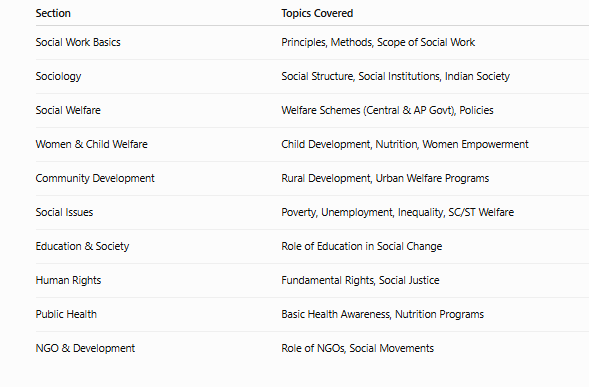
Paper–2: Concerned Subject (Social Welfare / Social Work)
| Section | Topics Covered |
|---|---|
| Social Work Basics | Principles, Methods, Scope of Social Work |
| Sociology | Social Structure, Social Institutions, Indian Society |
| Social Welfare | Welfare Schemes (Central & AP Govt), Policies |
| Women & Child Welfare | Child Development, Nutrition, Women Empowerment |
| Community Development | Rural Development, Urban Welfare Programs |
| Social Issues | Poverty, Unemployment, Inequality, SC/ST Welfare |
| Education & Society | Role of Education in Social Change |
| Human Rights | Fundamental Rights, Social Justice |
| Public Health | Basic Health Awareness, Nutrition Programs |
| NGO & Development | Role of NGOs, Social Movements |
APPSC ASWO Syllabus 2026 for Screening Test in Detail
Section-I: General Studies & Mental Ability (75 Questions / 75 Marks)
- Events of national and international importance.
- Current affairs – international, national and regional.
- General Science and its applications to day-to-day life; contemporary developments in Science & Technology and Information Technology.
- Social, economic and political history of modern India with emphasis on the Indian National Movement.
- Indian polity and governance: constitutional issues, public policy, reforms and e-governance initiatives.
- Economic development in India since independence.
- Geography of India with focus on Andhra Pradesh.
- Disaster management: vulnerability profile, prevention and mitigation strategies; application of Remote Sensing and GIS in disaster assessment.
- Sustainable Development and Environmental Protection.
- Logical reasoning, analytical ability and data interpretation.
- Data Analysis: Tabulation of data; visual representation of data; basic data analysis (summary statistics such as mean, variance, coefficient of variation, etc.) and interpretation.
- Bifurcation of Andhra Pradesh and its administrative, economic, social, cultural, political and legal implications/problems (including loss of capital city, division of institutions/employees, impact on commerce, etc.).
Section-II: Welfare Measures (75 Questions / 75 Marks)
- Programmes of the State Government for the welfare and economic development of SC/STs.
- Nature of the Indian Constitution – Constitutional Development, Salient features, Preamble, Fundamental Rights, Directive Principles of State Policy, Fundamental Duties.
- Legislative Acts for eradication of social evils and practices.
- Social and cultural history of Andhra Pradesh and welfare programmes.
- General overview of the Indian Constitution and welfare/protection measures for weaker sections.
APPSC ASWO Syllabus 2026 for Main Examination
Paper-I: General Studies & Mental Ability (150 Questions / 150 Marks) This paper largely covers the topics listed under Screening Test Section-I (Events of national/international importance, Current affairs, General Science & Technology, Modern Indian History with emphasis on National Movement and Andhra Pradesh, Indian Polity & Governance with focus on AP, Economic development, Geography of India & AP, Disaster Management, Sustainable Development & Environment, Logical Reasoning & Data Interpretation/Analysis, and Bifurcation of Andhra Pradesh).
Paper-II & Paper-III: Subject (Compulsory Papers) These papers focus on History, Culture, Polity, Economy, Social Issues, and Welfare-related topics with special emphasis on Andhra Pradesh and weaker sections. Key areas include:
History and Cultural Heritage of India (with emphasis on 20th Century)
- Indus and Vedic Civilizations; evolution of Varna/Jati system; religious movements (Jainism, Buddhism); Magadha Imperialism; Mahayana and art schools (Gandhara, Mathura).
- Advent of Islam and its impact; Bhakti Movements; growth of vernacular languages, literature, fine arts and architecture; Vijayanagara Empire; Mughals; rise of Shivaji.
- Stages of colonialism; Revolt of 1857; rise of Indian Nationalism and Freedom Struggle (three phases: 1885-1905, 1905-1920, 1920-47) with significance of the Gandhian Era.
- Socio-religious, anti-caste, Dalit and non-Brahmin movements; contributions of reformers (Raja Ram Mohan Roy, Dayanand Saraswati, Jyotiba Phule, Narayana Guru, Gandhi, Ambedkar, etc.).
Indian Constitution and Polity
- Nature of the Constitution, constitutional developments, salient features, Preamble, Fundamental Rights, DPSPs and their relationship, Fundamental Duties, distinctive features of Indian Federation.
- Distribution of legislative powers; administrative and financial relations between Union and States; powers and functions of constitutional bodies.
- Unicameral/Bicameral legislatures; delegated legislation; judicial review; amendment of the Constitution; Basic Structure Theory; Emergency Provisions.
- Decentralisation – Community Development, 3-tier Panchayati Raj, 73rd and 74th Amendments and their implementation.
Planning in India & Indian Economy
- National and per capita income, human development, sectoral changes in GDP and workforce.
- Indian Planning – objectives, priorities, recent Five-Year Plans, experience and problems; role of public-private sectors before and after economic reforms.
- Poverty and unemployment – magnitude and measures.
- Monetary policy, structure of banking and non-banking financial institutions, reforms since 1990s, RBI credit regulation.
- Pattern of revenue, expenditure and public debt.
Land Reforms & Social Changes in Andhra Pradesh after Independence
- Historical background of land reforms; intermediaries abolition, tenancy reforms, ceilings on holdings and land issues in AP.
- Structure of AP economy – sectoral and regional distribution, extent of poverty; agricultural inputs and technology.
- Demographic features, social backwardness, literacy, occupation structure; changes in sectoral distribution of income and employment; socio-political and economic empowerment of women.
- State finances and budgetary policy; tax structure; public debt.
- Five-Year Plans of AP – outlays, financing and resource allocation.
Andhra Pradesh Economy – Present Status, Strengths and Weaknesses
- Growth and structure of industries (factories, small and tiny sectors).
- Structure of agricultural outputs; administered prices; Public Distribution System.
- Regional disparities in income, industrial output, rainfall, irrigation, health and education.
- Institutional and non-institutional sources of rural credit; cooperatives.
- Service sector – transport, communication, tourism and information technology.
Welfare-specific Topics (covered across subject papers and screening)
- Programmes of the State Government for welfare and economic development of SC/STs and other weaker sections.
- Legislative Acts for eradication of social evils.
- Social justice measures, protection of rights of weaker sections, and related constitutional provisions.
Preparation Tips
- Thoroughly cover Andhra Pradesh-specific topics (history, economy, geography, bifurcation issues, and welfare schemes).
- Focus on current affairs (especially regional) and government welfare programmes for SCs/STs/BCs.
- Practice previous year questions and mock tests under timed conditions with negative marking awareness.
- Strengthen data interpretation, logical reasoning, and basic statistics.
- Refer to standard books for Indian Polity (e.g., Laxmikanth), Modern History, Economy, and AP-specific materials.
- Regularly check the official APPSC website for any updated syllabus PDF, notification, or scheme changes for 2026.
About The Author
