
BHEL Artisan Syllabus 2026: BHEL (Bharat Heavy Electricals Limited) is one of India’s leading public sector engineering and manufacturing companies. The company recruits various skilled employees, including artisans, for its different plants across the country. The recruitment for the position of Artisan typically involves a written examination and a trade test. The 2026 BHEL Artisan Recruitment will follow a specific syllabus and exam pattern that candidates must thoroughly understand to excel.
In this guide, we will provide a detailed discussion of the BHEL Artisan syllabus and exam pattern, offering an in-depth analysis to help candidates prepare effectively.
Overview of BHEL Artisan Recruitment 2026
BHEL recruits artisans in several categories such as:
- Electrician
- Fitter
- Machinist
- Welder
- Turner
- Other trade-specific categories
Each year, BHEL issues an official notification regarding the recruitment process, which includes details about eligibility criteria, application process, exam pattern, syllabus, and other important instructions.
The BHEL Artisan Recruitment will likely include a combination of two main stages:
- Written Examination
- Trade Test
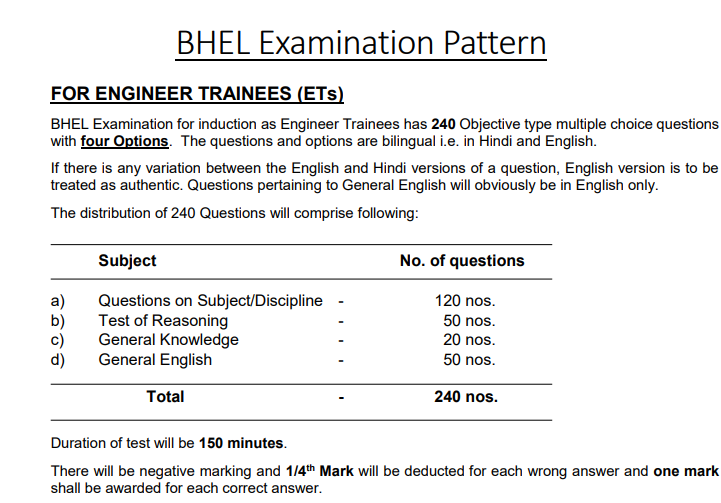
BHEL Artisan Recruitment Exam Pattern 2026
The exam pattern for BHEL Artisan Recruitment generally consists of the following stages:
Written Examination
- Duration: The written exam typically lasts for 2 hours.
- Type of Questions: Multiple Choice Questions (MCQs)
- Total Marks: 100 marks (subject to change, check official notification)
- Sections: The written test is divided into two main sections:
- Section 1: General Knowledge, Aptitude, and Reasoning
- Section 2: Technical Knowledge based on the trade-specific syllabus (e.g., Electrician, Fitter, etc.)
Marking Scheme:
- Each Correct Answer: 1 mark (standard MCQ marking)
- Negative Marking: There may be negative marking (typically 1/4th of the marks for each wrong answer)
Trade Test
After clearing the written examination, candidates are called for a Trade Test, which is a practical examination based on the candidate’s specific trade (e.g., Fitter, Machinist). The trade test is designed to assess the candidate’s practical knowledge and skills in their respective trade.
- Duration: Typically, around 2 hours.
- Test Type: Practical and Hands-on
- Total Marks: Varies depending on the post, but it’s crucial to perform well in this section.
Final Selection
The final merit list is usually prepared based on the combined score of the written examination and the trade test. The weightage of the written exam and trade test may vary depending on the recruitment notice for a specific year.
BHEL Artisan Syllabus 2026
The syllabus for the BHEL Artisan Recruitment is divided into two main parts:
- General Knowledge, Aptitude, and Reasoning (Section 1)
- Technical Knowledge (Section 2)
Let’s explore these sections in detail.
Section 1: General Knowledge, Aptitude, and Reasoning
This section assesses the candidate’s general awareness, logical reasoning, and mathematical ability. The topics covered in this section include:
- General Knowledge
- Current Affairs (National and International)
- Indian Economy
- Geography
- History and Culture
- Sports
- Science and Technology
- Aptitude
- Number Series
- Simplification
- Time and Work
- Profit and Loss
- Percentage
- Average
- Speed, Distance, and Time
- Simple and Compound Interest
- Ratio and Proportion
- Reasoning
- Number and Alphabetical Series
- Coding-Decoding
- Blood Relations
- Syllogism
- Directions and Distances
- Verbal and Non-verbal Reasoning
- Odd One Out
This section typically evaluates a candidate’s general awareness and ability to handle numerical problems. The questions are often designed to be of moderate difficulty.
Section 2: Technical Knowledge (Trade-specific)
This section evaluates the candidate’s technical knowledge based on their specific trade. Here is an overview of the syllabus for common trades:
- Electrician
- Electrical Circuits and Principles
- Electrical Machines (AC and DC)
- Power Transformers
- Switchgear and Protection
- Electrical Installations and Wiring
- Control Systems and Automation
- Electrical Measurements and Instruments
- Electrical Safety
- Fitter
- Engineering Materials and Properties
- Workshop Technology
- Basic Engineering Drawing
- Measuring Instruments and Tools
- Welding and Fabrication
- Power Transmission Systems
- Machine Tools and Operations
- Gear Cutting and Machining
- Machinist
- Machine Tools and Operations
- Turning, Milling, Grinding, and Drilling Operations
- Cutting Tools and Tool Geometry
- Engineering Materials
- Measurement and Gauging
- CNC Machines and Operations
- Maintenance and Troubleshooting of Machines
- Welder
- Welding Techniques (Arc, MIG, TIG, etc.)
- Welding Materials
- Gas Cutting and Welding
- Metallurgy and Heat Treatment
- Welding Safety Practices
- Blueprint Reading and Interpretation
- Turner
- Lathe Operations
- Milling Operations
- Measuring Instruments
- Engineering Materials
- Workshop Practices
- Machine Tools Maintenance
- Tolerances and Fits
This section is generally more difficult and requires in-depth knowledge of the specific trade. Candidates should focus on both theoretical concepts and practical applications.
Preparation Tips for BHEL Artisan Recruitment 2026
- Understand the Exam Pattern: Knowing the structure and marking scheme of the exam will help you manage time effectively during the written test.
- Focus on Technical Knowledge: The majority of the marks in the written exam will come from the trade-specific technical section. Candidates should focus on understanding key concepts and practical skills related to their respective trade.
- Solve Previous Year Papers: Practice previous year question papers to get a feel for the exam pattern and to improve speed and accuracy.
- Stay Updated with Current Affairs: Read newspapers and follow news related to India and the world to stay updated for the general knowledge section.
- Revise Aptitude and Reasoning: Regular practice of reasoning and aptitude problems is essential. Solve problems from books or online platforms to build problem-solving skills.
- Mock Tests: Taking mock tests can help simulate the real exam environment and improve time management.
Best Books to Cover the BHEL Artisan Recruitment Syllabus
For the BHEL (Bharat Heavy Electricals Limited) Artisan Recruitment exam, it’s crucial to cover both the technical and general aptitude sections. Here are some recommended books based on the syllabus:
General Aptitude and Reasoning
These sections typically include topics like quantitative aptitude, logical reasoning, and verbal ability.
-
“Quantitative Aptitude for Competitive Examinations” by R.S. Aggarwal
A comprehensive guide that covers all essential topics for the aptitude section. -
“A Modern Approach to Verbal and Non-Verbal Reasoning” by R.S. Aggarwal
Useful for improving both verbal and non-verbal reasoning skills. -
“Fast Track Objective Arithmetic” by Rajesh Verma
A book that helps in understanding quick methods and shortcuts for solving quantitative problems.
General Knowledge/General Awareness
These sections include topics related to current affairs, history, geography, politics, and general knowledge.
-
“General Knowledge” by Lucent
Covers all the important topics for general awareness, updated regularly with the latest developments. -
“Manorama Yearbook”
This is a good source for current affairs, as it is updated annually.
Technical Knowledge (Relevant to the Post)
Depending on the artisan trade you are applying for, the technical syllabus will focus on specific areas such as electrical, mechanical, or instrumentation.
For Electrical and Mechanical Engineering Trades:
-
“Electrical Engineering: Objective Type” by J.B. Gupta
A detailed book that covers electrical engineering concepts and has a wide variety of objective questions. -
“Mechanical Engineering: Objective Type” by R.S. Khurmi
It covers various mechanical engineering concepts, focusing on objective-type questions. -
“Basic Electrical Engineering” by Nagrath and Kothari
This book covers the fundamentals of electrical engineering and is excellent for concept clarity.
For Instrumentation and Control:
-
“Instrumentation and Control Engineering” by S.K. Singh
A comprehensive book for understanding the basics of instrumentation and control. -
“Principles of Electrical Instrumentation” by B.K. Bose
This book provides a deep dive into electrical instrumentation concepts.
Trade-Specific Books
If you are applying for a specific trade, you should refer to books that are dedicated to that field:
For Fitter/Mechanic/Boiler Operator:
-
“Welding Technology” by R.S. Parmar
For those applying for a fitter or welding artisan position.
For Electricians:
-
“Electrical Machines” by Nagrath and Kothari
Excellent for covering electrical machines and power systems.
For Machinists:
-
“Manufacturing Processes” by R.K. Jain
This book is particularly useful for machinists, covering various manufacturing processes.
Previous Years’ Question Papers and Model Papers
-
“BHEL Artisan Trainee Exam (Electrical/Mechanical/Instrumentation)” by Arihant Experts
This book contains previous years’ question papers and model tests that will give you a good understanding of the exam pattern. -
“BHEL Artisan (Electrical, Mechanical) Recruitment Exam” by RPH Editorial Board
This book includes model papers with detailed solutions.
Conclusion
BHEL Artisan Recruitment 2026 is a competitive process, and to succeed, candidates must be well-prepared in both the theoretical and practical aspects of their respective trades. A thorough understanding of the syllabus, consistent practice, and effective time management during the exam will help you excel in both the written exam and the trade test.
FAQs
1. What is the selection process for BHEL Artisan Recruitment?
The selection process generally includes:
- Computer-Based Test (CBT)
- Skill Test / Trade Test (qualifying in nature)
- Document Verification
2. What subjects are included in the BHEL Artisan syllabus?
The syllabus mainly includes:
- Trade/Technical Subject (core subject)
- Reasoning Ability
- General English
- General Knowledge
3. Which section carries the highest weightage in the exam?
The Trade/Technical section carries the highest weightage, usually around 70–80% marks, making it the most important section.
4. Is there negative marking in the BHEL Artisan exam?
Yes, in most cases:
- 1/4th mark is deducted for each wrong answer
(However, candidates should verify from the official notification)
5. What is the level of questions asked in the exam?
The question level is generally:
- ITI level (for technical/trade subjects)
- Basic to moderate level for reasoning, English, and GK
6. What topics are covered under the Technical section?
It depends on the trade, such as:
- Electrician: Electrical circuits, machines, wiring
- Fitter: Tools, measurements, fitting operations
- Welder: Welding techniques, safety
- Turner/Machinist: Lathe operations, cutting tools
7. How many questions are asked in the exam?
Typically:
- Around 100–120 questions (may vary by notification)
8. What is the duration of the BHEL Artisan exam?
The exam duration is usually:
- 90 minutes to 2 hours
9. Is the Skill Test important for final selection?
Yes:
- The Skill Test is qualifying in nature
- Final merit is usually based on CBT marks
10. Is General Knowledge section important?
Yes, but:
- It carries less weightage compared to the technical section
- Still important for scoring extra marks
11. What is the best strategy to prepare for the BHEL Artisan exam?
- Focus mainly on Trade subjects
- Practice previous year questions
- Improve speed and accuracy
- Revise basic concepts regularly
12. Are previous year papers useful for preparation?
Yes, they:
- Help understand exam pattern
- Improve time management
- Highlight important topics
13. Is the syllabus same for all trades?
No:
- The technical syllabus varies by trade
- Other sections (Reasoning, English, GK) remain common
14. What is the eligibility qualification for BHEL Artisan posts?
Generally:
- ITI in relevant trade + apprenticeship (as per notification)
15. Can final-year ITI students apply?
Usually:
- No, candidates must have completed ITI before applying
About The Author
