Bihar STET Syllabus: The Bihar Secondary Teacher Eligibility Test (STET) 2026 is a crucial gateway for aspiring teachers aiming to join Bihar’s government schools. Conducted in two papers—Paper I for Classes 9–10 and Paper II for Classes 11–12—the exam tests both subject knowledge and teaching aptitude. Each paper features 150 MCQs, worth one mark each, with no negative marking. Beyond core subjects like Hindi, English, Science, and Mathematics, candidates must also demonstrate competence in pedagogy, general knowledge, logical reasoning, and environmental science. Understanding this structure is essential for effective preparation.
The updated Bihar STET (Secondary Teacher Eligibility Test) 2026 syllabus for both Paper 1 and Paper 2, covering all subjects:
Bihar STET 2026: Overview
-
Paper 1: For candidates aiming to teach Classes 9–10.
-
Paper 2: For those targeting Classes 11–12.
-
Each paper contains 150 objective questions to be completed in 2½ hours (150 minutes). No negative marking.
STET Exam Pattern 2026 Breakdown (Both Papers)
Both papers follow a similar structure:
| Particulars | Details |
|---|---|
| Mode | Online (CBT) |
| Type of Questions | Multiple Choice Questions (MCQs) |
| Total Questions | 150 |
| Total Marks | 150 |
| Duration | 150 minutes (2 hours 30 minutes) |
| Marking Scheme | +1 for each correct answer |
| Negative Marking | None |
| Language | Primarily Hindi |
Section-wise distribution (common to both papers):
| Section | Questions | Marks |
|---|---|---|
| Specified Subject (Subject Knowledge) | 100 | 100 |
| Teaching Arts & Other Competencies | 50 | 50 |
| – Art of Teaching | 30 | 30 |
| – General Knowledge | 5 | 5 |
| – Environmental Science | 5 | 5 |
| – Mathematical Aptitude | 5 | 5 |
| – Logical Reasoning | 5 | 5 |
| Total | 150 | 150 |
- Paper 1 (Classes 9-10 / Secondary level): Subject knowledge is generally at graduation + higher secondary level.
- Paper 2 (Classes 11-12 / Senior Secondary level): Subject knowledge is generally at post-graduation / graduation honours level (aligned with state university syllabi), with Class 11-12 foundations also relevant for some subjects.
Subjects Covered
Paper 1 (Class 9-10) Hindi, Urdu, Bangla, Maithili, Sanskrit, Arabic, Persian/Farsi, Bhojpuri, English, Mathematics, Science, Social Science, Physical Education, Music, Fine Arts, and Dance (and related codes such as Special Education in some references).
Paper 2 (Class 11-12) Hindi, Urdu, English, Sanskrit, Bangla, Maithili, Magahi, Arabic, Persian/Farsi, Bhojpuri, Pali, Prakrit, Mathematics, Physics, Chemistry, Zoology, Botany, History, Geography, Political Science, Sociology, Economics, Philosophy, Psychology, Home Science, Commerce, Computer Science, Agriculture, and Music.
Full Bihar STET Syllabus 2026
Full Bihar STET Syllabus 2026 presented in a clear tabular format (Paper 1 & Paper 2). This is based on the latest pattern released by the Bihar School Examination Board (BSEB).
Paper 1 (Class 9–10 Teacher / TGT)
| Section | Topics / Syllabus |
|---|---|
| Art of Teaching (Teaching Aptitude) | Teaching & Learning (meaning, process), Teaching Objectives, Bloom’s Taxonomy, Teaching Methods, Lesson Plan, Micro Teaching, Classroom Management, Teaching Aids, Evaluation & Assessment, Curriculum, Factors affecting learning |
| General Knowledge | Sports terminology, World Geography, Solar System, Indian States & Capitals, Countries & Currencies |
| Environmental Science | Natural Resources (Air, Water), Universe, Living World, Plants & Animals, Microorganisms, Environment, Natural Phenomena |
| Mathematical Aptitude | Arithmetic, Geometry, Trigonometry, Statistics, Mensuration, Data Interpretation |
| Logical Reasoning | Number Series, Alphabet Series, Coding-Decoding, Blood Relation, Direction Sense, Similarities & Differences |
| Specific Subject (Chosen Subject) | Hindi, English, Sanskrit, Urdu, Maths, Science, Social Science, etc. (based on Graduation level syllabus) |
Paper 1 is based on Graduation + Senior Secondary level topics
Paper 2 (Class 11–12 Teacher / PGT)
| Section | Topics / Syllabus |
|---|---|
| Art of Teaching (Common) | Teaching-Learning Process, Instructional Objectives, Bloom’s Taxonomy, Teaching Methods, Lesson Planning, Micro Teaching, Classroom Ecosystem, Evaluation Techniques, Teaching Aids, Curriculum Development |
| General Knowledge | Games terminology, Geography, Solar System, Indian States, Countries & Currencies |
| Environmental Science | Air, Water, Universe, Biology, Flora & Fauna, Microorganisms, Environment, Natural Events |
| Mathematical Aptitude | Arithmetic, Algebra, Geometry, Trigonometry, Statistics, Data Analysis |
| Logical Reasoning | Series (Number/Word), Coding-Decoding, Blood Relations, Direction Test, Analogy |
| Specific Subject (PG Level) | Hindi, English, Urdu, Sanskrit, Physics, Chemistry, Biology, History, Geography, Political Science, Economics, Sociology, Psychology, Commerce, Computer Science, Agriculture, Music etc. |
Paper 2 syllabus is based on Graduation + Post-Graduation level
Bihar STET Syllabus Highlights
1. Art of Teaching (for both papers)
-
Teaching and learning processes
-
Instructional objectives (including Bloom’s Taxonomy)
-
Teaching methods, lesson planning, microteaching
-
Effective classroom environment, evaluation strategies
-
Teaching aids, curriculum design, teacher qualities, assessment strategies
2. General Knowledge, Environmental Science, Aptitude & Reasoning
-
Basic GK, state/national affairs, educational policies
-
Environmental awareness, issues, and concepts
-
Mathematical aptitude (basic quantitative skills)
-
Logical reasoning: puzzles, analogies, sequences
3. Specific Subjects (100 marks)
-
Paper 1 (Classes 9–10): Core subjects such as Hindi, English, Urdu, Sanskrit, Maithili, Bengali, Arabic, Mathematics, Science, Social Science, Physical Education, Fine Arts, Music, and Dance.
-
Paper 2 (Classes 11–12): Advanced subjects including Hindi, Urdu, Bengali, Maithili, Sanskrit, Magahi, Pali, Prakrit, Physics, Chemistry, Biology, History, Geography, Political Science, Sociology, Economics, Philosophy, Psychology, Home Science, Arabic, Farsi, Bhojpuri, English, Mathematics, Commerce, Computer Science, Agriculture, and Music.
STET Paper 1 and 2 Quick Comparison
| Feature | Paper 1 (9–10) | Paper 2 (11–12) |
|---|---|---|
| Total Questions | 150 | 150 |
| Duration | 2.5 hours | 2.5 hours |
| Subject Scope | Secondary-level (HS & Grad-level basics) | Senior Secondary & graduation-level depth |
| Pedagogy + Skills | Included in Unit 2 | Included in Unit 2 |
STET Syllabus 2026
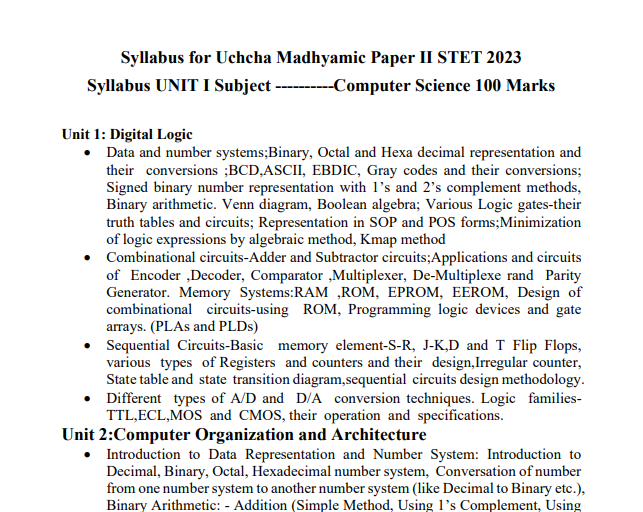
1. Specified Subject (100 Marks) This forms the core of the paper. Content is drawn from the relevant subject syllabus at the appropriate academic level (graduation for Paper 1; post-graduation/honours for Paper 2). Official subject-wise PDFs outline unit-wise topics for each subject (e.g., detailed units in Mathematics, Physics, Hindi literature/grammar, Computer Science digital logic, history periods, etc.). Candidates should download the specific PDF for their chosen subject from the official or reliable educational portals that host BSEB-linked files.
2. Art of Teaching / Teaching Aptitude (30 Marks) – Common to both papers Key topics include:
- Teaching and Learning: Meaning, process, and characteristics
- Teaching Objectives and Instructional Objectives (including Bloom’s Taxonomy)
- Teaching Methods: Types, characteristics, merits, and demerits
- Lesson Plan: Types, format, and models
- Microteaching and Instructional Analysis
- Effective classroom ecosystem / Classroom Management
- Textbook and Library
- Qualities of a Teacher
- Evaluation and Assessment for Learning
- Curriculum
- Factors affecting teaching and learning
- Teaching Aids and hands-on/practical education
3. Other Competencies (20 Marks total)
- General Knowledge: Sports terminology, world geography, solar system, Indian states & capitals, countries & currencies, and related current/basic awareness.
- Environmental Science: Natural resources (air, water), universe, living world, plants & animals, microorganisms, environment, and natural phenomena.
- Mathematical Aptitude: Arithmetic, algebra, geometry, trigonometry, statistics, mensuration, data interpretation/analysis.
- Logical Reasoning: Number/letter series, coding-decoding, blood relations, direction sense, analogies, similarities & differences.
Qualifying Marks
| Category | Minimum Qualifying Percentage |
|---|---|
| General / Unreserved | 50% |
| Backward Class (BC) | 45.5% |
| Extremely Backward Class (EBC) | 42.5% |
| SC / ST | 40% |
| PwD (Divyang) | 40% |
| Women (all categories) | 40% |
Marks may be normalised if the exam is held in multiple shifts.
How to Download Official Bihar STET Syllabus 2026 PDF
- Visit the official BSEB STET website (commonly referenced as bsebstet.org or related portals such as secondary.biharboardonline.com / stetregistration.cbrt.co.in).
- Navigate to the STET 2026 / Syllabus section.
- Select Paper 1 or Paper 2 and the relevant subject.
- Download the subject-wise PDF.
Reliable educational platforms also host the subject-wise PDFs (often linked to earlier BSEB releases that remain the reference framework for 2026). Always cross-verify with the official notification for any updates.
Preparation Tips
- Prioritise the 100-mark subject section with standard graduation (Paper 1) or post-graduation (Paper 2) textbooks and previous-year papers.
- Dedicate regular time to Art of Teaching (Bloom’s Taxonomy, methods, lesson planning, and evaluation are high-yield).
- Practise the short sections (GK, Environmental Science, Maths Aptitude, Reasoning) with daily quizzes.
- Solve previous STET papers and take full-length mock tests in CBT format under timed conditions.
- Focus on Bihar-specific or Indian education-related awareness where relevant.
- Keep eligibility documents ready (graduation/post-graduation + B.Ed. as applicable, age criteria from 1 August 2026, etc.).
Conclusion
The Bihar STET 2026 syllabus balances deep subject knowledge with essential teaching competencies. Understanding the 100 + 50 marks split, downloading the official subject-wise PDFs, and following a structured preparation plan will significantly improve chances of qualifying. Regularly check the official BSEB STET website for the detailed notification, exact syllabus PDFs, application link, and any further updates on the exam schedule.
Candidates are advised to read the full o
FAQs
1. What’s the exam structure and format for Bihar STET 2026?
The Bihar STET (Secondary Teacher Eligibility Test)—conducted by the Bihar School Examination Board (BSEB)—is split into two papers:
-
Paper I: For those aspiring to teach Classes 9–10.
-
Paper II: For those aiming to teach Classes 11–12.
Each paper is a multiple-choice format, has 150 questions worth 150 marks, and must be completed in 2.5 hours. There’s no negative marking .
Each paper divides into two parts:
-
100 questions on the chosen subject.
-
50 questions on teaching aptitude (pedagogy), general knowledge, reasoning, etc.
2. What’s included in the subject-specific syllabus?
For both papers, the subject-specific section covers content based on:
-
Paper I (Classes 9–10): Up to Grade 12 and graduate-level content.
-
Paper II (Classes 11–12): Broader coverage from Class 11–12, graduate and some post-graduate topics.
Subjects vary depending on your teaching focus. For example:
-
Paper I subjects include—among others—Hindi, English, Maths, Science, Social Science, Sanskrit, Maithili, Fine Arts, Physical Education, Music .
-
Paper II includes subjects like Physics, Chemistry, Zoology, History, Economics, Commerce, Computer Science, Home Science, Psychology, Agriculture, and more .
3. What topics are tested in the teaching aptitude and general knowledge section?
This section, common to both papers, tests:
-
Teaching methods and pedagogy, lesson planning, microteaching, Bloom’s taxonomy, classroom management, and art of teaching.
-
For language subjects especially (like Hindi and English), pedagogy elements include teaching techniques, planning, evaluation, plus language-specific skills .
4. What are the passing or qualifying marks for Bihar STET 2026?
To qualify:
-
Candidates from the General category need at least 50%.
-
Reserved categories (SC/ST/PwD/Women) require a minimum of 40% .
-
A more latest source adds that OBC category may need 45%, while SC/ST remain at 40% .
5. Where can I find the official syllabus and subject-wise PDFs?
The syllabus is officially released by BSEB on its website (e.g., bsebstet.com). You can download subject-wise PDF documents for both Paper I and Paper II for a thorough look at all topics .
About The Author
