
The BPCL Technician & Operator Recruitment 2026 is one of the most sought-after opportunities for candidates aiming to work in the oil and gas sector. Bharat Petroleum Corporation Limited conducts this recruitment to hire skilled candidates for technical and operational roles across its refineries and plants. Understanding the syllabus and exam pattern is crucial for effective preparation, as the competition level is quite high. The syllabus is designed to test both technical knowledge and general aptitude of candidates. A well-structured preparation strategy based on the official syllabus can significantly improve the chances of success. Candidates must focus equally on technical subjects and reasoning-based sections. In this article, you will find a complete breakdown of the BPCL Technician & Operator syllabus along with the latest exam pattern.
BPCL Technician & Operator Exam Pattern 2026
The BPCL exam pattern provides a clear idea about the structure of the examination, types of questions, and marking scheme. The selection process generally consists of a written examination followed by skill test, interview, or document verification depending on the post. The written exam is objective in nature and includes multiple-choice questions. The duration of the exam is usually 2 hours, and the total number of questions ranges between 100 to 120. Each correct answer carries equal marks, and there may be a negative marking for wrong answers as per BPCL guidelines. The exam tests candidates on technical knowledge, reasoning ability, quantitative aptitude, and general awareness. Understanding the exam pattern helps candidates manage time effectively and prioritize important sections during preparation.
Exam Pattern: Overview
| Section | No. of Questions | Marks | Details |
|---|---|---|---|
| Technical Subject | 60 | 60 | Core trade/engineering topics |
| English Language | 10 | 10 | Basic grammar & comprehension |
| Quantitative Aptitude | 15 | 15 | Numerical ability |
| Reasoning Ability | 15 | 15 | Logical thinking |
| Total | 100 | 100 | Duration: 120 Minutes |
The exam consists of objective-type questions with equal weightage per question.
BPCL Technician & Operator Syllabus 2026 Overview
The syllabus for BPCL Technician and Operator posts is divided into two major sections: Technical Subjects and Non-Technical Subjects. The technical section varies depending on the engineering discipline such as Mechanical, Electrical, Chemical, or Instrumentation. The non-technical section remains common for all candidates and includes reasoning, aptitude, and general awareness. Candidates must prepare thoroughly for both sections to score well in the examination. The syllabus is designed to evaluate both theoretical knowledge and practical understanding of concepts. A proper understanding of the syllabus helps candidates avoid unnecessary topics and focus only on relevant areas. Below is a detailed subject-wise syllabus for better clarity.
BPCL Technician Syllabus 2026 (Technical Subjects)
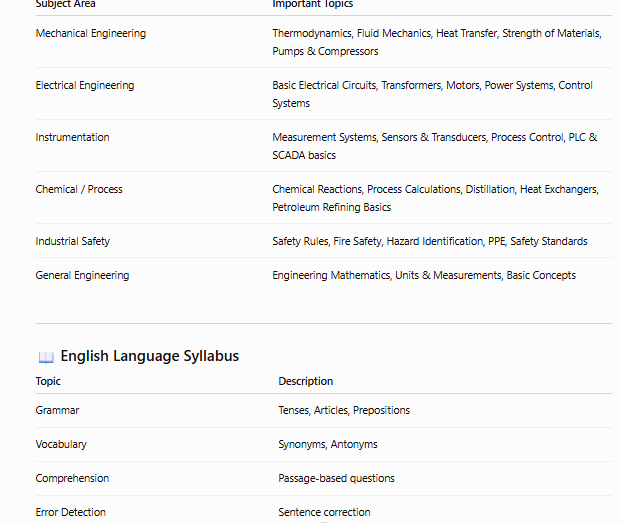
| Subject Area | Important Topics |
|---|---|
| Mechanical Engineering | Thermodynamics, Fluid Mechanics, Heat Transfer, Strength of Materials, Pumps & Compressors |
| Electrical Engineering | Basic Electrical Circuits, Transformers, Motors, Power Systems, Control Systems |
| Instrumentation | Measurement Systems, Sensors & Transducers, Process Control, PLC & SCADA basics |
| Chemical / Process | Chemical Reactions, Process Calculations, Distillation, Heat Exchangers, Petroleum Refining Basics |
| Industrial Safety | Safety Rules, Fire Safety, Hazard Identification, PPE, Safety Standards |
| General Engineering | Engineering Mathematics, Units & Measurements, Basic Concepts |
The technical syllabus for BPCL Technician posts focuses on core engineering concepts relevant to the candidate’s discipline. It is important to have a strong grasp of fundamentals as questions are often conceptual and application-based. Candidates should revise standard textbooks and practice numerical problems regularly. The syllabus generally aligns with diploma or ITI-level technical knowledge. Below are the key topics covered under major disciplines:
Mechanical Engineering Syllabus
Mechanical engineering candidates need to focus on core subjects that form the foundation of engineering principles. Topics include Thermodynamics, which covers laws of energy and heat transfer concepts. Strength of Materials focuses on stress, strain, and mechanical properties of materials. Fluid Mechanics includes concepts of fluid flow, pressure, and hydraulics. Theory of Machines and Machine Design are essential for understanding mechanical systems and components. Manufacturing processes such as welding, casting, and machining are also included. Industrial Engineering concepts like production planning and quality control may also be asked. A strong conceptual understanding is required to solve numerical and theoretical questions.
Electrical Engineering Syllabus
Electrical engineering syllabus includes fundamental topics related to electrical systems and machines. Basic Electrical Engineering concepts such as Ohm’s Law, Kirchhoff’s Laws, and circuit analysis are important. Electrical Machines like transformers, motors, and generators are frequently asked. Power systems, including transmission and distribution, are also part of the syllabus. Control systems and measurements help in understanding system stability and instrumentation. Candidates should also focus on electrical circuits, network theory, and power electronics. Numerical problem-solving plays a key role in this section. Practical knowledge of electrical components can give an added advantage.
Chemical Engineering Syllabus
For chemical engineering candidates, the syllabus revolves around process engineering and chemical reactions. Topics include Chemical Reaction Engineering, which deals with reaction kinetics and reactors. Thermodynamics focuses on energy balance and phase equilibrium. Fluid Mechanics covers flow of liquids and gases in pipelines and equipment. Mass Transfer operations like distillation, absorption, and extraction are important. Heat Transfer concepts such as conduction, convection, and radiation are also included. Process control and instrumentation are crucial for industrial applications. Candidates must understand both theoretical and practical aspects of chemical processes.
BPCL Operator Syllabus 2026 (Non-Technical Subjects)
The non-technical section is common for all candidates and plays a crucial role in overall scoring. It tests logical thinking, numerical ability, and awareness of current events. Candidates should practice regularly to improve speed and accuracy. The syllabus includes reasoning, quantitative aptitude, English language, and general awareness. These sections are scoring if prepared well with consistent practice. Below is the detailed breakdown:
Reasoning Ability
Reasoning ability tests logical thinking and problem-solving skills of candidates. Topics include verbal reasoning such as analogy, classification, and coding-decoding. Non-verbal reasoning includes pattern recognition and figure-based questions. Logical reasoning topics such as syllogism, blood relations, and seating arrangement are frequently asked. Puzzles and series-based questions require analytical thinking. Candidates must practice mock tests to improve speed. Accuracy is important as negative marking may be applicable. Regular practice helps in mastering this section.
Quantitative Aptitude
Quantitative aptitude evaluates numerical ability and mathematical skills. Topics include arithmetic such as percentage, profit and loss, and ratio and proportion. Algebra and basic equations are also included in the syllabus. Data interpretation questions based on tables and graphs are common. Time, speed, and distance along with time and work are important topics. Candidates should focus on shortcut techniques to save time. Regular practice of numerical problems is essential. Accuracy and speed are key to scoring high in this section.
General Awareness
General awareness tests knowledge of current events and general knowledge. Topics include current affairs related to national and international events. Questions may be asked from Indian economy, history, geography, and polity. Awareness about the oil and gas industry is also important for BPCL exams. Candidates should read newspapers and follow reliable news sources. Static GK topics such as important days, awards, and books are also included. Regular revision is necessary to retain information. This section can be highly scoring with proper preparation.
English Language Syllabus: Imp Topics
| Topic | Description |
|---|---|
| Grammar | Tenses, Articles, Prepositions |
| Vocabulary | Synonyms, Antonyms |
| Comprehension | Passage-based questions |
| Error Detection | Sentence correction |
| Fill in the Blanks | Word usage |
Quantitative Aptitude Syllabus: Imp Topics
| Topic | Description |
|---|---|
| Arithmetic | Percentage, Profit & Loss, Ratio & Proportion |
| Algebra | Basic equations |
| Data Interpretation | Charts, Tables |
| Time & Work | Pipes & Cistern |
| Speed & Distance | Trains, Boats |
Reasoning Ability Syllabus: Imp Topic
| Topic | Description |
|---|---|
| Logical Reasoning | Coding-Decoding, Analogies |
| Series | Number & Alphabet Series |
| Puzzle | Seating Arrangement |
| Direction Sense | Distance & Direction |
| Analytical Reasoning | Syllogism, Blood Relation |
BPCL Selection Process 2026
The BPCL selection process consists of multiple stages to assess candidates thoroughly. The first stage is the written examination, which is the primary screening round. Candidates who qualify the written test may be called for a skill test or interview depending on the post. Document verification is conducted to check eligibility and qualifications. Medical examination may also be required for final selection. The final merit list is prepared based on performance in all stages. Candidates must prepare well for each stage to secure a position. Understanding the selection process helps in planning preparation effectively.
Preparation Tips for BPCL Technician & Operator Exam 2026
Preparing for the BPCL exam requires a strategic approach and consistent effort. Candidates should start by understanding the complete syllabus and exam pattern. Creating a study plan helps in covering all topics systematically. Focus more on technical subjects as they carry significant weightage. Practice previous year papers to understand question trends. Mock tests are essential for time management and performance analysis. Regular revision is important to retain concepts. Candidates should also stay updated with current affairs. A disciplined and focused approach can ensure success in the BPCL exam.
Conclusion
The BPCL Technician & Operator Syllabus 2026 is comprehensive and requires a balanced preparation strategy. Candidates must focus on both technical and non-technical sections to maximize their scores. Understanding the exam pattern helps in effective time management during the exam. Regular practice and revision are key to success in this competitive examination. With proper planning and dedication, candidates can secure a position in BPCL. Make sure to follow a structured study plan and stay consistent in your preparation journey.
About The Author
