
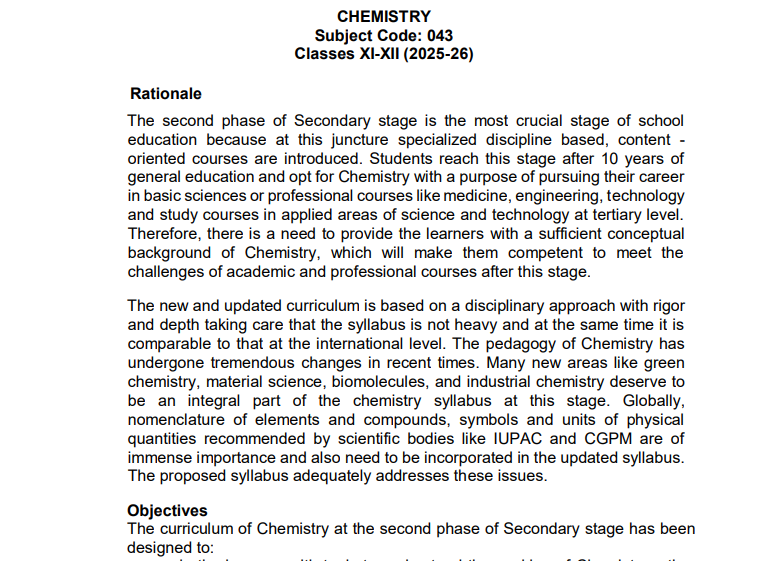
CBSE Class 12 Chemistry Syllabus 2026
CBSE Class 12 Chemistry Syllabus 2026-27
The CBSE Class 12 Chemistry syllabus 2026-27 is designed to provide students with a comprehensive understanding of various concepts in chemistry. The syllabus includes theoretical concepts, practical experiments, and project work, all of which are essential for students to excel in their exams.
Class 12 Chemistry Theory Syllabus
| S.No. | Title | No. of Periods | Marks |
|---|---|---|---|
| 1 | Solutions | 10 | 7 |
| 2 | Electrochemistry | 12 | 9 |
| 3 | Chemical Kinetics | 10 | 7 |
| 4 | d-and f-Block Elements | 12 | 7 |
| 5 | Coordination Compounds | 12 | 7 |
| 6 | Haloalkanes and Haloarenes | 10 | 6 |
| 7 | Alcohols, Phenols, and Ethers | 10 | 6 |
| 8 | Aldehydes, Ketones, and Carboxylic Acids | 10 | 8 |
| 9 | Amines | 10 | 6 |
| 10 | Biomolecules | 12 | 7 |
| Total | 70 Periods | 70 |
Unit-Wise Description
Unit II: Solutions (10 Periods)
- Types of solutions
- Expression of concentration of solutions of solids in liquids
- Solubility of gases in liquids
- Solid solutions
- Raoult’s law
- Colligative properties: relative lowering of vapor pressure, elevation of boiling point, depression of freezing point, osmotic pressure
- Determination of molecular masses using colligative properties
- Abnormal molecular mass, Van’t Hoff factor
Unit III: Electrochemistry (12 Periods)
- Redox reactions
- EMF of a cell, standard electrode potential
- Nernst equation and its application to chemical cells
- Relation between Gibbs energy change and EMF of a cell
- Conductance in electrolytic solutions, specific and molar conductivity, variations of conductivity with concentration
- Kohlrausch’s Law, electrolysis, and laws of electrolysis (elementary idea)
- Types of cells: dry cells, electrolytic cells, Galvanic cells
- Lead accumulator, fuel cells, corrosion
Unit IV: Chemical Kinetics (10 Periods)
- Rate of a reaction (average and instantaneous)
- Factors affecting the rate of reaction: concentration, temperature, catalyst
- Order and molecularity of a reaction
- Rate law and specific rate constant
- Integrated rate equations and half-life (only for zero and first-order reactions)
- Concept of collision theory (elementary idea), activation energy, Arrhenius equation
Unit VIII: d- and f-Block Elements (12 Periods)
- General introduction, electronic configuration, occurrence and characteristics of transition metals
- General trends in properties of the first-row transition metals: metallic character, ionization enthalpy, oxidation states, ionic radii, color, catalytic properties, magnetic properties
- Interstitial compounds, alloy formation
- Preparation and properties of K₂Cr₂O₇ and KMnO₄
- Lanthanoids: electronic configuration, oxidation states, chemical reactivity, lanthanoid contraction, and its consequences
- Actinoids: electronic configuration, oxidation states, and comparison with lanthanoids
Unit IX: Coordination Compounds (12 Periods)
- Introduction to coordination compounds: ligands, coordination number, color, magnetic properties, shapes
- IUPAC nomenclature of mononuclear coordination compounds
- Werner’s theory, Valence Bond Theory (VBT), and Crystal Field Theory (CFT)
- Structure and stereoisomerism
- Importance of coordination compounds (in qualitative analysis, extraction of metals, and biological systems)
Unit X: Haloalkanes and Haloarenes (10 Periods)
- Haloalkanes: nomenclature, nature of the C-X bond, physical and chemical properties, optical rotation, mechanism of substitution reactions
- Haloarenes: nature of the C-X bond, substitution reactions
- Uses and environmental effects of compounds like dichloromethane, trichloromethane, tetrachloromethane, iodoform, freons, and DDT
Unit XI: Alcohols, Phenols, and Ethers (10 Periods)
- Alcohols: nomenclature, methods of preparation, physical and chemical properties (of primary alcohols), identification of primary, secondary, and tertiary alcohols, mechanism of dehydration, uses (with special reference to methanol and ethanol)
- Phenols: nomenclature, methods of preparation, physical and chemical properties, acidic nature of phenol, electrophilic substitution reactions, uses of phenols
- Ethers: nomenclature, methods of preparation, physical and chemical properties, uses
Unit XII: Aldehydes, Ketones, and Carboxylic Acids (10 Periods)
- Aldehydes and Ketones: nomenclature, nature of the carbonyl group, methods of preparation, physical and chemical properties, mechanism of nucleophilic addition, reactivity of alpha hydrogen in aldehydes, uses
- Carboxylic Acids: nomenclature, acidic nature, methods of preparation, physical and chemical properties, uses
Unit XIII: Amines (10 Periods)
- Amines: nomenclature, classification, structure, methods of preparation, physical and chemical properties, uses
- Identification of primary, secondary, and tertiary amines
- Diazonium salts: preparation, chemical reactions, and importance in synthetic organic chemistry
Unit XIV: Biomolecules (12 Periods)
- Carbohydrates: classification (aldoses and ketoses), monosaccharides (glucose and fructose), D-L configuration, oligosaccharides (sucrose, lactose, maltose), polysaccharides (starch, cellulose, glycogen), importance of carbohydrates
- Proteins: elementary idea of amino acids, peptide bonds, polypeptides, proteins, structure of proteins (primary, secondary, tertiary, quaternary structure), denaturation of proteins, enzymes
- Hormones: elementary idea excluding structure
- Vitamins: classification and functions
- Nucleic Acids: DNA and RNA
Practical Syllabus (60 Periods)
Evaluation Scheme for Practical Examination
| S.No. | Title | Marks |
|---|---|---|
| 1 | Volumetric Analysis | 08 |
| 2 | Salt Analysis | 08 |
| 3 | Content-Based Experiment | 06 |
| 4 | Project Work | 04 |
| 5 | Class Record and Viva | 04 |
| Total | 30 |
Practicals
- Surface Chemistry
Preparation of one lyophilic and one lyophobic sol
Dialysis of the sol
Study of emulsifying agents - Chemical Kinetics
Study the effect of concentration and temperature on reaction rates - Thermochemistry
Measure the enthalpy of dissolution and neutralization - Electrochemistry
Study the variation of cell potential with electrolyte concentration - Chromatography
Separation of pigments and constituents in mixtures - Preparation of Inorganic Compounds
Double salts and potassium ferric oxalate - Preparation of Organic Compounds
Synthesis of compounds like acetanilide, dibenzalacetone - Tests for Organic Functional Groups
Identify unsaturation, alcohol, phenol, aldehyde, ketone, carboxylic, and amino groups - Qualitative Analysis
Identify one cation and one anion in a salt
Suggested Projects
- Study of oxalate ions in guava fruit at different ripening stages
- Study of casein quantity in different milk samples
- Preparation of soybean milk and comparison with natural milk
- Effect of potassium bisulphate as a food preservative
- Study of starch digestion by salivary amylase
- Comparative study of fermentation rates of different materials
- Extraction of essential oils from aniseed, carum, cardamom
- Study of food adulterants in fat, oil, butter, sugar, turmeric, chili powder, and pepper
CBSE Class 12 Chemistry Syllabus 2026-27 PDF Download
To access the detailed CBSE Class 12 Chemistry syllabus for 2025-26 in PDF format, students can visit the official CBSE website or download it from the link given below. The PDF will include all units, practical experiments, and projects that are part of the curriculum.
Best Books to Cover CBSE Class 12 Chemistry Syllabus
hand-picked list of the best books to fully cover the **CBSE Class 12 Chemistry syllabus for the 2026 board exams, including core textbooks, reference books for concepts, and practice & solved papers to maximize your preparation and scores:
Core Textbooks (Must-Read)
These are essential as per the CBSE syllabus and exam pattern:
NCERT Chemistry Part I & Part II
-
Publisher: NCERT (Class 12 Chemistry)
-
Why: This is the primary book for the CBSE board exam, clear theory, examples & in-text questions directly from the syllabus.
-
Tip: Complete these thoroughly before moving to other books.
Best Reference & Concept Books
Great for deeper understanding, extra examples & competitive exam exposure:
Pradeep’s New Course Chemistry (Vol I & II)
-
Good for: Detailed conceptual coverage & explanations across all three chemistry sections (Inorganic, Organic, Physical).
-
Use: After NCERT theory.
Modern’s ABC of Chemistry (Part 1 & 2)- S. P. Jauhar
-
Good for: Clear explanations + wide variety of solved & unsolved questions.
-
Use: Excellent for both boards and CUET/NEET basics.
Concise Inorganic Chemistry – J. D. Lee
-
Good for: In-depth inorganic chemistry (especially useful for competitive exams).
-
Use: Optional extra once basics are clear.
Modern Approach to Chemical Calculations- R. C. Mukherjee
-
Good for: Physical chemistry numericals & problem-solving practice.
-
Use: Very useful for mastering calculations.
SC Chemistry Class XII OP Tandon
-
Good for: Additional theory and example problems aligned with CBSE topics.
-
Use: As a supplementary reference.
Practice & Question Paper Books
Practicing questions as per board pattern is key to scoring high:
CBSE Chapter-wise Question Bank: MTG / Oswaal / Arihant
-
These books provide chapter-wise practice with marked scheme answers, competency-based and case questions (as per the latest pattern).
-
Good options include:
-
MTG CBSE Chapterwise Question Bank — Chemistry for 2026
-
Oswaal CBSE Question Bank (Chemistry)
-
MTG or Arihant 10-year solved papers book
-
CBSE Chapter-wise Solved Papers (Purnima Sharma / Bhagwat / Others)
-
Past-year solved papers give excellent insight into actual board trends & frequently asked questions.
4. Strategy Tip
-
Finish NCERT thoroughly first — it’s the backbone of the board exam.
-
Use reference books for deeper understanding and extra solved examples.
-
Practice extensively with PYQs and question banks to build speed and accuracy.
CBSE Class 12 Chemistry Syllabus 2026: FAQs
1. What is the structure of the CBSE Class 12 Chemistry syllabus for 2025-26?
The syllabus is based on the rationalised curriculum with 10 core units/theory topics plus a 30-mark practical/internal assessment. It covers key areas such as Physical, Organic, and Inorganic Chemistry.
2. How many marks is the Chemistry board exam?
-
Theory: 70 marks
-
Practical/Internal Assessment: 30 marks
Total = 100 marks.
3. Is there a practical exam? What does it include?
Yes, practical exams include volumetric analysis, salt analysis, content-based experiments, project work, and viva, among others.
Deleted & Revised Syllabus FAQs
4. Have any chapters been removed from the 2025-26 syllabus?
Yes. Several chapters from the NCERT textbook have been deleted as part of ongoing syllabus rationalisation:
Solid State
Surface Chemistry
General Principles and Processes of Isolation of Elements
The p-Block Elements
Polymers
Chemistry in Everyday Life
Also, some topics under Organic Compounds Containing Nitrogen (e.g., cyanides and isocyanides) are removed.
5. Does this mean we don’t study these deleted chapters at all?
For CBSE board exams 2026, you should not prepare deleted chapters or topics, they will not be evaluated in the board theory paper.
Content & Exam Pattern FAQs
6. How many units are there in the syllabus after deletion?
After deletions, the detailed syllabus consists of 10 key units focusing on core and exam-relevant chemistry concepts.
7. What are some examples of units still included?
Some of the important continuing units include:
-
Solutions
-
Electrochemistry
-
Chemical Kinetics
-
d- and f-Block Elements
-
Coordination Compounds
-
Haloalkanes & Haloarenes
-
Alcohols, Phenols & Ethers
-
Aldehydes & Ketones
-
Amines
-
Biomolecules
8. What is the exam question pattern?
The theory paper typically includes:
-
Multiple-Choice Questions (MCQs)
-
Short Answer Questions
-
Long Answer Questions
There is often an internal choice in some sections.
Preparation & Strategy FAQs
9. Should students refer only to NCERT books?
Yes, strictly follow the latest NCERT textbook that reflects the rationalised syllabus and ignore deleted content to avoid studying irrelevant material.
10. What’s the best way to plan revision?
Students should:
Create a timetable covering all core units
Prioritise high-weightage topics (like Electrochemistry & Organic Chemistry)
Practice past board papers and sample questions
Do all practical experiments and viva questions thoroughly
Practical Projects FAQs
11. Is a project part of the internal assessment?
Yes, students must complete one investigatory project, e.g., analysis of oxalate ions in fruits, casein content in milk, study of food adulterants, etc.
12. How important are practical marks?
Practical work contributes 30 marks; strong performance here can significantly boost overall scores.
Quick Summary
| Component | Marks |
|---|---|
| Theory (Board Exam) | 70 |
| Practical & Internal Assessment | 30 |
| Total | 100 |
Deleted chapters should not be studied for board purposes. Stick to the revised core units and complete all practical components.
Related Articles:
About The Author
