
ISC Class 12 Biology Syllabus 2026
The ISC Class 12 Biology Syllabus 2026–27 prescribed by the Council for the Indian School Certificate Examinations is divided into five major units covering theoretical and practical aspects of Biology.
The syllabus includes Reproduction (plant and human reproduction, reproductive health), Genetics and Evolution (Mendelian inheritance, molecular basis, evolution theories), Biology and Human Welfare (human diseases, immunity, microbes, food production), Biotechnology and its Applications (genetic engineering, biotechnology tools, applications in medicine and agriculture), and Ecology and Environment (ecosystems, biodiversity, conservation, environmental issues). The exam consists of theory, practical, and project work. Emphasis is placed on diagrams, experiments, and application-based understanding for board exams and competitive exams like NEET.
ISC Class 12 Biology Syllabus 2026-27
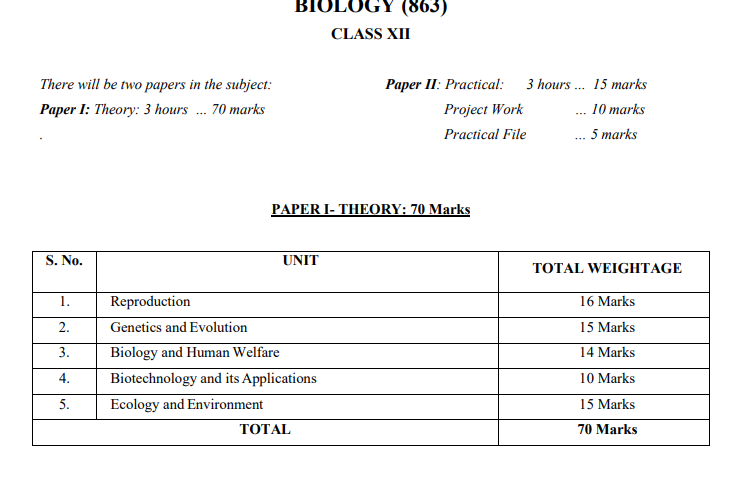
The ISC Class 12 Biology Syllabus for 2026-27 includes two papers: Paper I (Theory) and Paper II (Practical). Paper I focuses on theoretical concepts, while Paper II involves hands-on experiments, project work, and practical files. Below is the detailed breakdown.
Paper I: Theory (70 Marks)
Units and Weightage
| S. No. | Unit | Marks |
|---|---|---|
| 1. | Reproduction | 16 |
| 2. | Genetics and Evolution | 15 |
| 3. | Biology and Human Welfare | 14 |
| 4. | Biotechnology and its Applications | 10 |
| 5. | Ecology and Environment | 15 |
| Total | 70 |
ISC Class 12 Biology Syllabus 2026-27: Topics-wise
1. Reproduction
- In Plants: Flower structure, gametophyte development, types of pollination, double fertilization, seed formation, apomixis, parthenocarpy, fruit classification (true and false), and seed dispersal.
- In Humans: Male and female reproductive systems, spermatogenesis, oogenesis, menstrual cycle, fertilization, embryo development, parturition, and lactation.
- Reproductive Health: Birth control methods, sexually transmitted diseases (STDs), infertility, and assisted reproductive technologies (IVF, GIFT, ICSI).
2. Genetics and Evolution
- Principles of Inheritance: Mendel’s laws, co-dominance, multiple alleles, polygenic inheritance, chromosomal theory of inheritance, sex determination, linkage, and sex-linked inheritance.
- Molecular Basis of Inheritance: Structure of DNA and RNA, DNA replication, transcription, translation, gene regulation (lac operon), Human Genome Project, and DNA fingerprinting.
- Evolution: Origin of life, evidence for biological evolution, natural selection, Hardy-Weinberg Principle, adaptive radiation, and human evolution.
3. Biology and Human Welfare
- Human Health and Diseases: Pathogens causing diseases (viruses, bacteria, protozoa), immunology, cancer, HIV/AIDS, drug and alcohol abuse.
- Microbes in Human Welfare: Use of microbes in food production, industrial applications, sewage treatment, biogas production, and as biocontrol agents and biofertilizers.
4. Biotechnology and its Applications
- Principles and Processes: Genetic engineering, recombinant DNA technology, and cloning vectors.
- Applications: Production of insulin and vaccines, gene therapy, stem cell technology, genetically modified organisms (GMOs), and biosafety concerns.
5. Ecology and Environment
- Organisms and Populations: Population interactions (mutualism, competition, predation), population attributes, and growth models.
- Ecosystems: Energy flow, ecological pyramids, and productivity.
- Biodiversity and Conservation: Types of biodiversity, reasons for biodiversity loss, in-situ and ex-situ conservation methods, hotspots, Ramsar sites, and Red Data Book.
Paper II: Practical Work – 15 Marks
Practical Assessment Breakdown
| Assessment Type | Marks |
|---|---|
| Project Work | 10 |
| Practical File | 5 |
Practical Work Guidelines
- Taxonomy: Dissect flowers from various families (Malvaceae, Leguminosae, Solanaceae, Liliaceae), draw floral diagrams, and identify floral characteristics.
- Biochemical and Physiological Experiments: Study stomata distribution, soil composition, enzyme action on starch, and DNA isolation from plant material.
- Slide Preparation: Prepare slides for pollen grain germination, ovary sections, hydrophyte stems, and seeds.
- Spotting: Identify and comment on slides such as mammalian ovary and testis, germinating pollen, and ecological adaptations of plants and animals.
Project Work and Practical File
Students must complete one project related to any biological topic such as genetic disorders, gene therapy, human genome project, DNA fingerprinting, cancer, or AIDS. Projects should be creative, preferably handwritten, and must follow the structure:
- Content
- Introduction
- Presentation (graphs, tables, diagrams, etc.)
- Conclusion
- Bibliography
ISC Class 12 Biology Syllabus 2026-27 PDF Download
Students can download the detailed ISC Class 12 Biology Syllabus 2026-27 in PDF format from the official CISCE website. This document includes comprehensive guidelines for both theory and practical work, along with suggested project topics and assessment criteria.
ISC Class 12 Biology Syllabus-Click Here To Download PDF
Related Post:
| ISC Class 12 Legal Studies Syllabus | ISC Class 12 Biology Syllabus |
| ISC Class 12 Chemistry Syllabus | ISC Class 12 Physics Syllabus |
| ISC Class 12 Maths Syllabus | ISC Class 12 English Syllabus |
FAQs based on ISC Class 12 Biology Syllabus
1. What is the syllabus for ISC Class 12 Biology 2026-27?
The ISC Class 12 Biology syllabus is divided into five major units:
-
Reproduction
-
Genetics and Evolution
-
Biology and Human Welfare
-
Biotechnology and its Applications
-
Ecology and Environment
Each unit contains key topics students must study, like plant and human reproduction, Mendelian genetics, DNA structure and gene expression, biotechnology applications, ecology, etc.
2. Where can I find the official detailed syllabus?
You can download the official ISC Class 12 Biology syllabus PDF from the Council for the Indian School Certificate Examinations (CISCE) website under “Regulations and Syllabuses” / “Library (Publications)”. This official document contains all topics and scope for teaching.
3. Has the syllabus changed recently for 2026-27?
Yes — the CISCE revised the Class 12 Biology syllabus for the 2026-27 board exams. The board updated or clarified some topics (aligned with modern biology trends), and this version will remain for the next exam cycle.
4. How is the Biology examination structured?
The ISC Class 12 Biology exam consists of:
-
External Theory (Paper 1) — 70 marks
-
Internal Assessment (Practical + Project Work) — 30 marks
Theory Exam Pattern (70 marks):
-
Section A: Objective/Short questions
-
Section B: Short answer questions
-
Section C: Long answer questions
-
Section D: Essay/Applied questions
Total duration is typically 2 hours.
5. What is the unit-wise weightage?
Approximate mark allocation (Theory out of 70):
-
Reproduction — ~16 marks
-
Genetics & Evolution — ~15 marks
-
Biology & Human Welfare — ~14 marks
-
Biotechnology & Its Applications — ~10 marks
-
Ecology & Environment — ~15 marks
6. Are practicals and project work included?
Yes. Apart from theory:
-
Practical Work — 15 marks
-
Project Work + Practical File — 15 marks
These assessments form the 30 marks of internal assessment and are evaluated by teachers/examiners.
7. Do I need to study external resources (like NCERT)?
ISC and NCERT syllabuses overlap, but NCERT alone may not cover all detailed ISC topics (e.g., biotechnology, human welfare in biology). ISC schools often recommend ISC-specific books to match the board syllabus fully. Many students also use NCERT for strong conceptual grounding. (Based on student discussions.)
8. Are there specimen/sample papers available?
Yes. CISCE releases specimen/sample question papers that help students understand question formats and difficulty. Practising these improves confidence for board exams.
9. How should I prepare for ISC Class 12 Biology?
Preparation tips:
-
Understand unit-wise fundamentals thoroughly.
-
Practice diagram labeling, especially for reproduction and ecology.
-
Solve past board questions and sample papers.
-
Maintain a practical file with clear observations and diagrams.
Focus on both concept clarity and answer presentation (diagrams + keywords), as ISC values both.
10. How is the difficulty level of the ISC Biology board exam?
Students and experts generally find the Biology paper moderate to slightly challenging, with diagrams and application-based reasoning questions included. Good preparation of core topics and practice of past papers improves scoring potential.
11. Is the syllabus the same for English and Hindi mediums?
Yes, the content and topics remain identical across mediums; only the language of instruction/exam differs (English/Hindi). This is typical for CISCE exams.
12. Can I prepare for competitive exams (like NEET) with the ISC Biology syllabus?
The ISC Biology syllabus covers many topics relevant to NEET, but NEET requires deeper application and medical entrance-level questions. Using ISC + NCERT + NEET-oriented books is usually recommended for the best preparation.
About The Author

2 thoughts on “ISC Class 12 Biology Syllabus 2026-27, Download PDF”