
CDS Eligibility 2026: The Combined Defence Services (CDS) Examination, conducted by the Union Public Service Commission (UPSC), is the primary route for graduates to join the officer cadres of the Indian Armed Forces. It recruits for the Indian Military Academy (IMA), Indian Naval Academy (INA), Air Force Academy (AFA), and Officers’ Training Academy (OTA). The exam is held twice a year (CDS I and CDS II). Eligibility is strict and academy-specific; candidates must satisfy conditions of nationality, age, educational qualification, marital status, and physical/medical standards. Always verify the exact criteria in the official UPSC notification for the specific cycle, as date-of-birth windows shift slightly between CDS I and CDS II.
CDS Eligibility 2026 for Nationality Criteria
A candidate must be:
- A citizen of India, or
- A subject of Nepal, or
- A person of Indian origin who has migrated from Pakistan, Burma, Sri Lanka, or certain East African countries (Kenya, Uganda, the United Republic of Tanzania, Zambia, Malawi, Zaire, Ethiopia) or Vietnam with the intention of permanently settling in India.
Candidates in the latter categories require a certificate of eligibility issued by the Government of India. Provisional admission is possible pending the certificate.
Age Limit and Marital Status (CDS 2026)
Age limits differ by academy and are calculated with reference to the commencement of the training course (not the exam date). Exact “born not earlier than / not later than” windows are published in each notification.
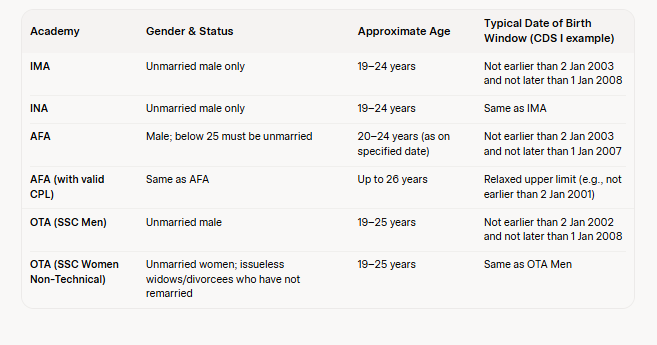
Typical ranges (based on official CDS I 2026 and related notifications; CDS II windows shift by approximately six months):
| Academy | Gender & Status | Approximate Age | Typical Date of Birth Window (CDS I example) |
|---|---|---|---|
| IMA | Unmarried male only | 19–24 years | Not earlier than 2 Jan 2003 and not later than 1 Jan 2008 |
| INA | Unmarried male only | 19–24 years | Same as IMA |
| AFA | Male; below 25 must be unmarried | 20–24 years (as on specified date) | Not earlier than 2 Jan 2003 and not later than 1 Jan 2007 |
| AFA (with valid CPL) | Same as AFA | Up to 26 years | Relaxed upper limit (e.g., not earlier than 2 Jan 2001) |
| OTA (SSC Men) | Unmarried male | 19–25 years | Not earlier than 2 Jan 2002 and not later than 1 Jan 2008 |
| OTA (SSC Women Non-Technical) | Unmarried women; issueless widows/divorcees who have not remarried | 19–25 years | Same as OTA Men |
Key marital status rules:
- IMA, INA, and AFA: Only unmarried males are eligible. Male divorcees/widowers are not treated as unmarried and are ineligible.
- OTA Men: Unmarried males.
- OTA Women: Unmarried women, or issueless widows and divorcees (with valid divorce documents) who have not remarried.
- Candidates below 25 years must generally be unmarried. Marriage is not permitted during training. Married candidates aged 25 or above (where permitted) will not receive married accommodation and cannot live with family outside the premises during training.
There is no category-based age relaxation (SC/ST/OBC etc.) for CDS; the limits are the same for all. Candidates may attempt the exam as many times as they remain within the age window.
CDS Eligibility 2026: Educational Qualifications
Final-year students can apply provisionally but must produce proof of having passed the degree before the commencement of the training course.
| Academy | Required Qualification |
|---|---|
| IMA | Degree from a recognised university or equivalent (any discipline) |
| OTA (Men & Women) | Degree from a recognised university or equivalent (any discipline) |
| INA | Degree in Engineering from a recognised university/institution |
| AFA | Degree from a recognised university with Physics and Mathematics at 10+2 level, or Bachelor of Engineering |
No minimum percentage is prescribed; a recognised degree is sufficient.
Female Eligibility
Women candidates are eligible only for the Officers’ Training Academy (OTA) Short Service Commission (Non-Technical) course. They cannot apply for IMA, INA, or AFA through CDS.
Eligibility for OTA Women:
- Age: 19–25 years (as per the specific notification’s date-of-birth window).
- Qualification: Graduation in any discipline from a recognised university.
- Marital status: Unmarried, or issueless widow/divorcee who has not remarried (with supporting documents).
- Physical standards: Minimum height 152 cm (relaxations may apply for certain categories such as Gorkhas or candidates from North-Eastern hills).
Women appear for the same written exam papers as OTA men (English and General Knowledge; Mathematics is not required for OTA). Selection lists for SSC Men and SSC Women are prepared separately.
IMA vs OTA Criteria – Key Differences
- IMA: Permanent Commission into the Indian Army. Open only to unmarried males (19–24 years). Degree in any stream. Longer training (approximately 18 months) at Dehradun leading to a permanent career.
- OTA: Short Service Commission (typically 10–14 years, with options for permanent commission later in some cases). Open to both unmarried males and eligible females (19–25 years). Degree in any stream. Training is shorter (about 49 weeks) at Chennai. OTA is the only CDS entry open to women.
Candidates often prefer IMA for the permanent commission and broader career prospects, while OTA offers a slightly wider age window and is the sole option for female aspirants.
Physical and Medical Standards
Candidates who clear the written exam and SSB Interview must meet the physical and medical standards prescribed by the respective services (detailed in the official notification’s Appendix).
Height (approximate minimums):
- Army (IMA/OTA Men): 157.5 cm
- Navy (INA): 157 cm
- Air Force (AFA): 162.5 cm
- OTA Women: 152 cm
- Relaxations of 5 cm for Gorkhas and candidates from certain North-Eastern hill regions; 2 cm for Lakshadweep candidates in some cases.
Chest (males): Minimum unexpanded chest typically around 81 cm with at least 5 cm expansion (exact figures in notification).
Weight: Must be proportionate to height and age (charts are provided in official guidelines; significant deviation can lead to temporary or permanent rejection).
Vision (varies by academy; graduate entries are somewhat more lenient than 10+2 entries):
- Army (IMA/OTA): Distant vision standards allow correction within specified limits (myopia generally up to –3.5 D, hypermetropia +3.5 D in many graduate cases); colour perception CP-II or CP-III depending on the exact standard applied.
- Navy and Air Force have stricter uncorrected and colour vision requirements, especially for flying/executive branches.
- LASIK is permitted under specific conditions for certain graduate entries (age, time since surgery, residual power, corneal thickness, etc.).
Candidates must be free from any disease or disability that could interfere with military duties. A thorough medical examination by a Service Selection Board medical board is mandatory.
Important Notes for Aspirants
- Always download and read the official UPSC notification for the exact exam cycle (available on upsc.gov.in). Date-of-birth windows, vacancy numbers, and minor details can differ between CDS I and CDS II.
- There is no upper limit on the number of attempts other than the age ceiling.
- Selection involves a written examination, SSB Interview (including psychological tests, group tasks, and personal interview), and a medical examination.
- Final-year students should ensure their results are declared in time; otherwise, candidature can be cancelled even after clearing SSB.
Meeting every eligibility condition is non-negotiable. Aspirants are advised to cross-check their date of birth, degree status, and physical measurements against the latest official notification well before applying. Preparation should also include physical fitness training, as medical and SSB standards are rigorous.
FAQs
About The Author
