
CAT Exam Syllabus 2026: The Common Admission Test (CAT) 2026, conducted by one of the Indian Institutes of Management (IIMs), remains the premier gateway to MBA/PGDM programs at the IIMs and numerous other top B-schools in India. Scheduled for November 29, 2026, the exam follows a consistent structure with no officially prescribed chapter-wise syllabus released by the IIMs. Instead, the working syllabus is derived from analysis of previous years’ papers (typically the last 8–10 years).
The test is a computer-based exam lasting 120 minutes (40 minutes per section, strictly enforced with no switching between sections). It features three sections: Verbal Ability and Reading Comprehension (VARC), Data Interpretation and Logical Reasoning (DILR), and Quantitative Ability (QA). The expected pattern includes around 66–68 questions for a total of approximately 198–204 marks. Marking is +3 for every correct answer, –1 for incorrect MCQs, and no negative marking for TITA (Type In The Answer) questions.
Success depends on mastering high-weightage topics, building conceptual clarity, and practicing under timed conditions. Below is a detailed, section-wise breakdown of the important topics, expected weightage, and strategies to ace each area.
CAT 2026 Exam Pattern
| Section | Expected Questions | Time | Approx. Marks | Key Focus |
|---|---|---|---|---|
| VARC | 24 | 40 min | 72 | Reading Comprehension (dominant) + Verbal Ability |
| DILR | 22 | 40 min | 66 | Set-based DI + LR puzzles |
| QA | 22 | 40 min | 66 | Arithmetic & Algebra heavy |
| Total | 68 | 120 min | 204 | — |
Note: Exact numbers can vary slightly by year/slot (some sources reference 66 questions). Expect a mix of MCQs and TITA questions (TITA often higher in DILR and QA).
CAT Syllabus 2026
The CAT 2026 (Common Admission Test) does not have an officially prescribed syllabus. The syllabus below is based on the topics consistently tested in previous years.
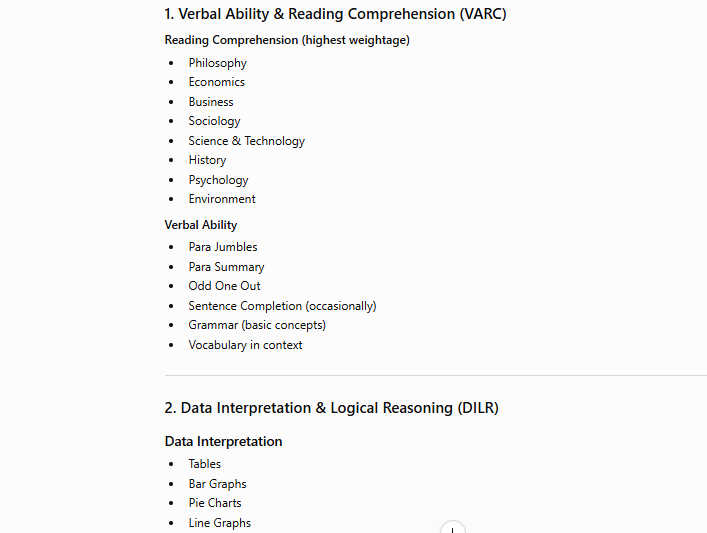
Verbal Ability & Reading Comprehension (VARC)
Reading Comprehension (highest weightage)
- Philosophy
- Economics
- Business
- Sociology
- Science & Technology
- History
- Psychology
- Environment
Verbal Ability
- Para Jumbles
- Para Summary
- Odd One Out
- Sentence Completion (occasionally)
- Grammar (basic concepts)
- Vocabulary in context
Data Interpretation & Logical Reasoning (DILR)
Data Interpretation
- Tables
- Bar Graphs
- Pie Charts
- Line Graphs
- Caselets
- Mixed Graphs
Logical Reasoning
- Seating Arrangement
- Puzzles
- Games & Tournaments
- Venn Diagrams
- Binary Logic
- Scheduling
- Network & Routes
- Arrangements
- Distribution
Quantitative Ability (QA)
Arithmetic (Most Important)
- Percentages
- Profit & Loss
- Ratio & Proportion
- Averages
- Time, Speed & Distance
- Time & Work
- Simple & Compound Interest
- Mixtures & Alligations
Algebra
- Linear & Quadratic Equations
- Inequalities
- Logarithms
- Functions
- Progressions (AP, GP, HP)
- Polynomials
Geometry & Mensuration
- Triangles
- Circles
- Quadrilaterals
- Polygons
- Coordinate Geometry
- Mensuration (2D & 3D)
Number System
- Divisibility
- Factors & Multiples
- Remainders
- HCF & LCM
- Base Systems
Modern Mathematics
- Permutation & Combination
- Probability
- Set Theory
CAT Exam Pattern 2026: Important Topics
1. VARC: Verbal Ability and Reading Comprehension
VARC tests reading speed, comprehension depth, logical flow of ideas, and verbal reasoning. Reading Comprehension dominates (typically 16 questions across 4 passages of 400–800 words), accounting for 65–70% of the section. Verbal Ability makes up the remaining 6–8 questions.
Important Topics:
- Reading Comprehension (Highest Priority): Passages from philosophy, economics, science & technology, social sciences, art & culture, history, abstract/literary themes, and current affairs. Question types include main idea, inference, tone/purpose, fact vs. opinion, specific details, and critical reasoning-style questions (strengthen/weaken arguments).
- Para Jumbles / Jumbled Paragraphs: Arrange 4–5 sentences into a coherent paragraph (often TITA).
- Para Summary: Choose the best summary of a short paragraph.
- Odd One Out / Odd Sentence Out: Identify the sentence that does not fit the logical flow.
- Para Completion / Sentence Completion (occasional): Complete the paragraph logically.
- Supporting areas (less frequent in recent years): Verbal reasoning, vocabulary in context, basic grammar usage.
Weightage Insights: RC ≈ 16 questions; VA (jumbles + summary + odd one out) ≈ 6–8 questions.
How to Ace VARC:
- Read extensively daily (The Hindu, The Economist, Aeon Essays, scientific magazines). Focus on diverse genres.
- Practice active reading: note main idea, author’s tone, structure, and inferences.
- For VA, master logical sequencing and elimination of options. Solve 20–30 para jumbles/summaries weekly.
- Aim for accuracy over speed initially; target 16–20 good attempts with high accuracy for a strong percentile.
- Analyze every mock: review why options were wrong, especially inference questions.
2. DILR: Data Interpretation and Logical Reasoning
DILR is often considered the most unpredictable and decisive section. Questions appear in 4–5 sets (usually 4–6 questions each). Pure standalone questions are rare; most sets blend data interpretation with logical reasoning (hybrid sets). Selection of the right sets is critical—attempt only those you can solve accurately within time.
Important Topics: Data Interpretation:
- Tables (with missing values or complex calculations)
- Bar graphs, column graphs, line charts, pie charts
- Caselets (paragraph-based data)
- Mixed/combination graphs and charts
- Data sufficiency (occasional)
Logical Reasoning:
- Seating arrangements (linear, circular, rectangular)
- Puzzles and distributions (scheduling, grouping, selection with conditions)
- Games and tournaments
- Venn diagrams and set theory
- Binary logic, truth-lie statements
- Networks/routes
- Blood relations/family trees, direction sense, clocks & calendars (less frequent but possible)
- Logical sequences, matching, and quant-based reasoning
Weightage Insights: Caselets + reasoning-based DI and puzzles typically form the bulk (8–12+ questions). Pure graphs/tables appear but hybrid sets dominate recent papers.
How to Ace DILR:
- Practice a wide variety of sets daily (aim for 4–6 sets). Focus on pattern recognition—quickly identify set type and approach.
- Develop calculation speed (percentages, ratios, averages) for DI.
- Learn to abandon tough sets early (after 2–3 minutes of assessment).
- In mocks, prioritize easier/medium sets first. Target 10–14 accurate attempts for a high percentile.
- Review solutions thoroughly to understand alternative approaches and common traps.
3. QA: Quantitative Ability
QA tests Class 8–10 level mathematics applied with speed and logical thinking. No advanced topics like calculus appear. Arithmetic and Algebra together usually account for 60–70% of the section.
Important Topics (Priority Order): Arithmetic (Highest Weightage – 8–10 questions):
- Percentages, Profit & Loss, Simple & Compound Interest
- Ratio, Proportion & Variation, Averages, Mixtures & Alligations
- Time, Speed & Distance (including races, trains, boats)
- Time & Work (pipes, cisterns)
- Partnerships
Algebra (5–7 questions):
- Linear & Quadratic Equations, Inequalities
- Functions, Graphs, Maxima-Minima
- Logarithms, Surds & Indices
- Sequences & Series (AP, GP, HP)
- Progressions
Geometry & Mensuration (3–5 questions):
- Triangles, Circles, Quadrilaterals, Polygons
- Mensuration (2D & 3D figures)
- Coordinate Geometry
- Basic Trigonometry (occasional)
Number System (2–3 questions):
- Divisibility, HCF & LCM, Factors, Remainders
- Base systems, Digits, Properties of numbers
Modern Math (2–4 questions):
- Permutations & Combinations
- Probability
- Set Theory
How to Ace QA:
- Build strong fundamentals first (especially Arithmetic). Master concepts + shortcuts + approximation techniques.
- Practice topic-wise then mixed sets. Focus on TITA accuracy (no negative marking).
- Maintain a formula sheet and revise regularly.
- In the exam, start with easier Arithmetic questions for confidence and time buffer.
- Target 12–16 accurate attempts depending on difficulty. Analyze mocks for calculation errors and conceptual gaps.
Overall Preparation Strategy for CAT 2026
- Build Fundamentals (First 2–3 months): Cover all core topics systematically. Use standard resources (previous year papers, quality coaching material).
- Practice & Mocks: Solve previous CAT papers (2017–2025). Take full-length mocks regularly (at least 20–30 before the exam). Analyze thoroughly—focus on accuracy, time management, and set/question selection.
- Sectional Balance: Do not neglect any section. VARC improves with consistent reading; DILR with variety; QA with concept clarity + speed.
- High-ROI Focus: Prioritize RC (VARC), Arithmetic + Algebra (QA), and hybrid caselets/arrangements (DILR). These cover a large portion of the paper.
- Time Management & Mindset: Strict sectional practice. Develop the habit of leaving tough questions. Maintain consistency and review weak areas weekly.
- Resources: Official CAT website for updates, previous year papers, standard books/coaching modules, and quality mock series. Daily reading is non-negotiable for VARC.
There is no fixed official syllabus PDF from the IIMs—the pattern and topics remain stable based on past trends, though difficulty and exact distribution vary by slot. Stay updated via the official CAT website (iimcat.ac.in). Consistent practice, smart prioritization of important topics, and rigorous mock analysis are the keys to acing CAT 2026 and securing a high percentile. Start early, stay disciplined, and focus on accuracy alongside speed. Good luck!
FAQs
About The Author
