
CBSE UKG Syllabus 2026-27: Upper Kindergarten (UKG), also known as KG-2, Senior KG, or Balvatika-3 under the National Education Policy (NEP) 2020 framework, is a crucial stage for children aged approximately 5–6 years. It bridges preschool and formal primary education (Class 1), focusing on foundational literacy, numeracy, socio-emotional skills, physical development, and environmental awareness through play-based and activity-oriented methods.
Unlike Classes 1–12, the Central Board of Secondary Education (CBSE) does not prescribe a rigid, uniform subject-wise syllabus for pre-primary levels. Instead, it aligns with the National Curriculum Framework for the Foundational Stage (NCF-FS 2022) and NEP 2020 guidelines. These emphasize holistic development across domains (physical, cognitive, language, socio-emotional, and ethical), joyful learning, and reduced academic pressure. Most CBSE-affiliated schools adapt similar practical outlines for English, Mathematics, Environmental Studies (EVS)/General Awareness, Hindi or regional languages, art, and physical activities.
The 2026-27 curriculum continues this approach, with no major structural overhauls reported for the foundational stage. Schools may refine content based on local needs, NIPUN Bharat goals (Foundational Literacy and Numeracy), and individual student progress. Always verify the exact syllabus with your child’s school, as variations exist.
Subjects Covered in CBSE UKG Syllabus 2026-27
Typical subjects and key topics include:
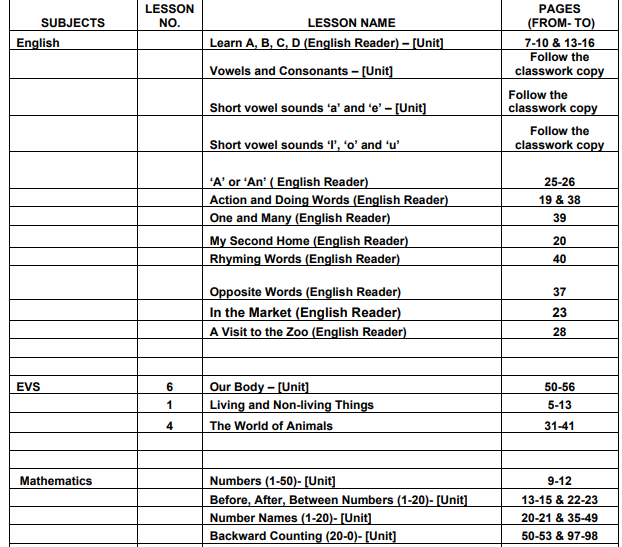
1. English Language Focuses on phonics, vocabulary, basic reading/writing, and oral communication.
- Recognition and writing of capital and small letters (Aa–Zz).
- Letter sounds, vowels, and consonants.
- Articles (a/an).
- One–many, this–that / these–those.
- Positions (in, on, under, behind, etc.).
- Rhyming words, sight words, and simple vowel words.
- Picture identification, reading short words/sentences, and basic conversation.
- Activities: Flashcards, storytelling, enactment, worksheets, and oral interaction.
2. Mathematics Builds number sense, pre-math concepts, and logical thinking through concrete objects and play.
- Pre-math concepts: Big–small, tall–short, long–short, heavy–light, more–less, full–empty, in–out, front–back, thick–thin, same–different.
- Numbers: Recognition, writing, and counting (typically 1–100 or up to 200 in some schools); number names (1–50 or higher); before/after/between; forward and backward counting.
- Shapes (circle, square, triangle, rectangle, etc.) and colours.
- Basic patterns, skip counting (by 2s or 5s in some cases).
- Simple addition and subtraction using pictures or objects.
- Comparisons and spatial understanding.
3. Environmental Science (EVS) / General Awareness Encourages observation of the self, family, surroundings, and environment.
- Myself: Parts of the body, sense organs, my home, my family, my school.
- Seasons (summer, rainy, winter) and weather.
- Animals: Wild, domestic, pet, farm, and water animals; their sounds, young ones, and homes.
- Transport: Land, water, and air; traffic rules and safety.
- Community helpers, healthy habits, hygiene, and good manners.
- Living vs. non-living things, plants, fruits, vegetables, birds, insects, and flowers.
- Basic awareness of pollution (air, water, sound), 3Rs (reduce, reuse, recycle), and festivals.
- Activities: Nature walks, projects, visits (e.g., post office or police station where feasible), and discussions.
4. Hindi (or Regional Language)
- Swar (vowels: अ–अः) and Vyanjan (consonants: क–ज्ञ).
- Introduction to matras (vowel signs) and simple word formation.
- Picture reading, matching, and basic oral practice or short poems.
- Schools may include other regional languages based on location.
5. Additional Areas
- Art & Craft / Creative Expression: Colouring, drawing, paper folding, clay modelling, finger painting.
- Rhymes, Stories & Songs: Popular nursery rhymes for language development and rhythm.
- Physical Education / Motor Skills: Running, jumping, balancing, yoga, dance, outdoor games for gross and fine motor development.
- Life Skills & Values: Good habits, discipline, sharing, emotional awareness.
Assessment is primarily observation-based, oral, through worksheets, participation, and projects rather than formal written exams, reducing stress on young learners.
Key Features of the 2026-27 Curriculum
- Strong emphasis on play-way and experiential learning (games, stories, songs, hands-on activities).
- Alignment with NEP 2020 and NCF-FS: Holistic development, multilingualism (mother tongue priority where possible), and foundational literacy/numeracy.
- Activity-based and child-centric approach to foster curiosity, creativity, and social skills.
- Integration of domains rather than isolated subjects in many progressive schools.
- Preparation for Class 1 readiness without excessive homework or rote learning.
Free PDF Download of CBSE UKG Syllabus 2026-27
Get a free PDF of the CBSE UKG Syllabus 2026 by clicking this Link: UKG syllabus 2025-26 PDF
Tips for Parents to Support UKG Learning
- Create a playful home environment: Use everyday objects for counting, read stories daily, and encourage drawing or rhymes.
- Maintain consistency between school and home routines.
- Focus on strengths and provide gentle support for areas needing practice (e.g., fine motor skills for writing).
- Limit screen time; prefer interactive, hands-on activities.
- Communicate regularly with teachers about progress.
- Celebrate small achievements to build confidence.
FAQs
Is the UKG syllabus the same in all CBSE schools?
Core goals are similar under NEP/NCF guidelines, but specific topics, books, and pacing can vary by school.
Are there formal exams in UKG?
Generally no. Assessment is continuous and activity-based.
What age is suitable for UKG?
Typically 5+ years (as on the cut-off date, often 31 March). Age criteria may align with state or school rules and NEP foundational stage norms.
Where can I find more resources?
School-provided materials, NCERT foundational resources, and reputable educational websites offering worksheets and activities.
The CBSE UKG syllabus for 2026-27 prioritizes joyful, holistic growth to equip children with essential skills for primary school and beyond. By combining school learning with supportive home practices, parents can help make this foundational year both enriching and enjoyable. For the most accurate details, contact your child’s school directly.
About The Author
