
The Chhattisgarh Professional Examination Board (CG Vyapam / CGSSB) conducts recruitment for Trained Graduate Teacher (TGT) posts in government schools under the Directorate of Public Instruction. For 2026, the Teacher (TGT) recruitment (often referred to under codes like LST26) covers subjects such as Hindi, English, Sanskrit, Mathematics, Social Science, and Agriculture, with around 1654 vacancies reported in recent notifications. Understanding the syllabus and exam pattern is essential for effective preparation, as the written exam forms the primary selection stage, followed by merit listing and document verification.
Candidates must refer to the official notification on vyapamcg.cgstate.gov.in or cgssb.cgstate.gov.in for the most accurate and updated details, as patterns can see minor adjustments. The exam generally tests teaching aptitude, subject knowledge at the graduate level relevant to classes 6–10, language proficiency, general awareness (with emphasis on Chhattisgarh), and basic computer skills. Preparation should balance content mastery with pedagogy, current affairs, and practice of objective questions under timed conditions.
Overview of CG Vyapam TGT Recruitment 2026
The recruitment aims to fill TGT positions in E-Cadre and T-Cadre schools across Chhattisgarh. Eligibility typically requires a graduation degree in the relevant subject along with a B.Ed. or equivalent professional qualification and often CG TET/CTET qualification, plus domicile requirements as per state rules. Age limits generally range from 21 to 35 years, with relaxations for reserved categories as per government norms.
The selection process centers on a written objective examination. High competition demands focused study of both core subjects and teaching methodology. Aspirants should download the official advertisement for vacancy subject-wise breakup, application deadlines (recent cycles have fallen in August–September), fee details, and exact exam dates. Regular practice with previous-year papers and mock tests helps build speed and accuracy, especially given negative marking in most recent patterns.
CG Vyapam TGT Exam Pattern 2026
The written examination is conducted in offline (OMR-based) mode with multiple-choice questions. Recent indications for the TGT-level Teacher recruitment point toward a 100-question paper of 100 marks lasting about 2 hours, though some earlier Teacher cycles used a 150-mark format. Each correct answer generally carries 1 mark, with a penalty of 1/4 mark (0.25) for incorrect responses in patterns that include negative marking. Unattempted questions usually carry zero marks.
The paper evaluates a mix of pedagogical understanding, language skills, subject expertise, reasoning or mental ability, computer awareness, and general knowledge focused on India and Chhattisgarh. Time management is critical; candidates should allocate minutes per section according to personal strengths. The medium is typically bilingual (Hindi and English) except for language-specific sections. Always confirm the final pattern, duration, and marking scheme from the official notification, as these can vary slightly by cycle.
| Particulars | Details |
|---|---|
| Mode of Examination | Offline (OMR-based) |
| Type of Questions | Objective / Multiple Choice Questions (MCQs) |
| Total Questions (indicative) | 100 |
| Total Marks (indicative) | 100 |
| Marks per Question | 1 |
| Negative Marking | 0.25 mark per wrong answer (common in recent patterns) |
| Duration | Approximately 2 hours |
| Medium | Hindi & English (as applicable) |
CG Vyapam TGT Subject-wise Marks Distribution (Indicative)
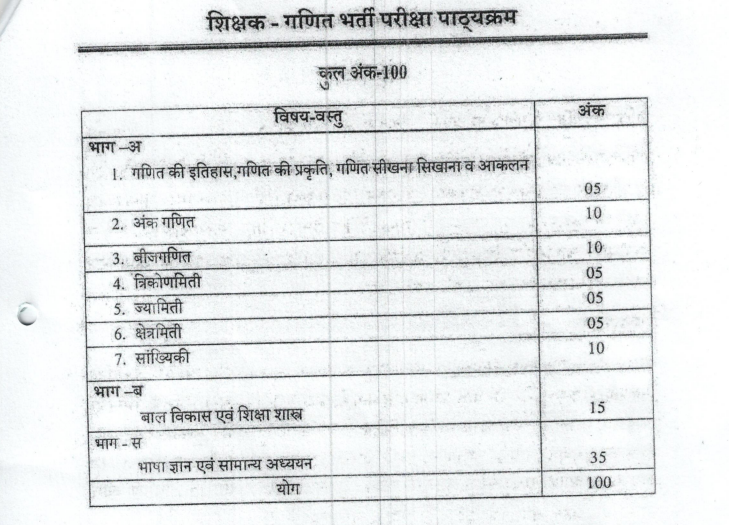
Distribution varies by notification. Common components include Child Development & Pedagogy, languages, the concerned teaching subject, Computer Knowledge, and General Knowledge. The table below reflects a typical structure drawn from recent CG teacher recruitment patterns; subject-concerned weightage is higher for TGT posts.
| Subject / Section | Approximate Marks / Questions |
|---|---|
| Child Development & Pedagogy | 15–30 |
| General Hindi | 15–25 |
| General English | 10–25 |
| Concerned Subject (Maths / Science / Social Science / Language etc.) | 30–60 or higher |
| Computer General Knowledge | 5–10 |
| General Knowledge (including CG GK & Current Affairs) | 10–30 |
| General Mental Ability / Reasoning (if included) | 10–15 |
| Total | 100 or 150 |
CG Vyapam TGT Syllabus 2026
The syllabus emphasizes both content knowledge suitable for secondary-level teaching and pedagogical skills. Below are key areas based on standard CG teacher examinations and SCERT-aligned topics. Candidates should prioritize the official syllabus PDF when released.
Child Development and Pedagogy
This section assesses understanding of how children learn and develop, inclusive practices, and effective teaching strategies. Topics typically cover the concept and principles of child development across stages from childhood to adolescence, including physical, cognitive, social, emotional, and moral aspects. Theories of Piaget, Kohlberg, Vygotsky, and others on cognitive and moral development are important, along with the influence of heredity and environment.
Inclusive education concepts, identification and support for children with special needs, and gender issues in education receive attention. Learning processes, motivation, intelligence theories, language and thought relationships, and constructivist approaches form core areas. Assessment methods, continuous and comprehensive evaluation (CCE), classroom management, teaching-learning materials, and the role of the teacher under the Right to Education Act and National Education Policy 2020 are also covered. Aspirants should study how to create child-centered, activity-based, and inclusive classrooms.
General Hindi
The Hindi section tests grammar, vocabulary, comprehension, and language pedagogy suitable for teaching. Key areas include वर्ण विचार (vowels, consonants, spelling, gender, number, case, sandhi), शब्द विचार and शब्द रचना (word classification by origin—Tatsam, Tadbhav, Deshaj, foreign; prefixes, suffixes, compounds, one-word substitutions).
Parts of speech (पद व पद भेद), sentence structure, types of sentences, punctuation, and unseen prose or poetry comprehension with questions on meaning, vocabulary, and inference are standard. Idioms, proverbs, synonyms, antonyms, and error correction appear regularly. Pedagogy of language development—how children acquire language skills (listening, speaking, reading, writing), methods of teaching Hindi, and remedial teaching—is often integrated.
General English
English focuses on grammar, vocabulary, reading comprehension, and language teaching methods. Core grammar topics include tenses, articles, prepositions, subject-verb agreement, active-passive voice, direct-indirect speech, and sentence transformation or rearrangement. Vocabulary covers synonyms, antonyms, one-word substitutions, idioms, phrases, and spelling.
Unseen passages (prose and sometimes poetry) test comprehension, inference, and verbal ability. Pedagogy of language development includes principles of language learning and acquisition, listening-speaking-reading-writing skills, teaching-learning materials, evaluation of language skills, and approaches for multilingual classrooms. Candidates should practice both accuracy in usage and pedagogical application.
Mathematics / Science / Social Science (Concerned Subject)
For Mathematics-focused posts, topics generally include number systems, arithmetic (percentage, profit-loss, simple and compound interest, ratio-proportion, averages), algebra (equations, polynomials), geometry (lines, angles, triangles, circles, mensuration), data handling, and statistics, along with the nature of mathematics and pedagogy of teaching mathematics at the upper-primary/secondary level.
Science sections (when applicable) cover physics (motion, force, energy, light, electricity), chemistry (matter, atoms, acids-bases, reactions), and biology (life processes, diversity, environment) at the appropriate level, plus scientific method and teaching approaches. Social Science typically includes history (Indian freedom struggle, world events), geography (physical, India and Chhattisgarh), civics/polity, and economics basics, with emphasis on pedagogical strategies for social studies. Subject pedagogy—concept formation, activity-based learning, and assessment—is integral across all streams.
Computer General Knowledge
This section tests basic digital literacy essential for modern classrooms. Topics usually include fundamentals of computers (hardware, software, input-output devices, memory), operating systems, MS Office (Word, Excel, PowerPoint), internet and email basics, computer networks, cybersecurity awareness, and common abbreviations or shortcuts. Knowledge of educational technology tools and their classroom application may also appear.
General Knowledge and Chhattisgarh GK
The GK portion covers Indian history, geography, polity, economy, general science, and current affairs (national and international). Special emphasis is placed on Chhattisgarh-specific knowledge: history, geography, culture, art, literature, administrative structure, government schemes, important personalities, and recent developments in the state. National Education Policy 2020 provisions related to school education and constitutional provisions affecting education are relevant. Regular reading of newspapers and state-specific resources strengthens this section.
CG Vyapam TGT Subject-wise Syllabus 2026
The CG Vyapam TGT syllabus mainly includes questions from the concerned subject along with teaching-related topics wherever applicable. Candidates should focus on both conceptual understanding and regular practice.
| Subject | Subject-wise Topics & Sub-topics |
|---|---|
| English |
|
| Hindi |
|
| Social Science |
|
| Sanskrit |
|
| Mathematics |
|
| Agriculture |
|
UP TGT General Studies Syllabus
These sections are repeated across English, Hindi, Social Science, Sanskrit, Mathematics and Agriculture, so they do not need to be repeated under every subject. The common syllabus consists of Child Development & Pedagogy, General Hindi, General English, Mental Ability, Computer Education and General Knowledge.
| Common Section | Topics & Sub-topics |
|---|---|
| Child Development & Pedagogy | Child Development: Concept of development and its relationship with learning; principles of child development; heredity and environment; critical perspective on intelligence; multiple intelligence; language and thought; individual differences; linguistic diversity; differences based on caste, gender, community and religion; assessment for learning vs assessment of learning; school-based assessment; Continuous and Comprehensive Evaluation.
Inclusive Education: Teaching learners from disadvantaged and weaker backgrounds; children with learning difficulties and disabilities; teaching creative and specially talented learners. Learning & Pedagogy: Basics of teaching-learning; children’s learning strategies; learning as a social activity; social context of learning; child as problem solver and scientific investigator; cognition and emotion; motivation and learning; individual and environmental factors supporting learning. |
| General Hindi | Swar, Vyanjan, spelling; gender, number and tense; noun, pronoun, adjective, verb, adverb and case; Samasa; Sandhi — vowel, consonant and visarga; grammatical errors; prefixes and suffixes; word types — Tatsam, Tadbhav, Deshaj and foreign words; synonyms, antonyms, multiple-meaning words and one-word substitutions. |
| General English | Number, Gender, Articles; Noun, Pronoun, Adjective, Verb, Adverb; Prepositions and Conjunctions; Synonyms, Antonyms and Homonyms; One-word substitution; Spellings; Prefixes and Suffixes; Proverbs and Idioms; Active/Passive Voice; Declarative, Negative, Interrogative, Imperative and Exclamatory sentences; Punctuation. |
| General Mental Ability | Reasoning, relationships, analogy, numerical ability, spatial relationships, odd-one-out, number series, letter series, relationships through letters/numbers/figures, coding language, hidden figures, classification, mathematical operations, figure matching and cube-related patterns. |
| Computer Education | Introduction to computers; hardware, software, CPU, ALU, CU, memory, input/output devices; printers; operating systems — MS-DOS, Windows, macOS, Linux, Ubuntu; MS Word, Excel and PowerPoint; Internet and email — Inbox, Outbox, CC, BCC; website browsing; government websites; antivirus and computer security; multimedia; storage devices; search engines and online platforms. |
| General Knowledge | Indian Constitution & Polity: Constitutional provisions, Fundamental Duties, political system, constitutional rights, RTI, democracy, elections, Lok Sabha and Rajya Sabha.
History: Indian history, national movement, civilization and culture, historical events, freedom struggle from 1857–1947 and post-1947 developments. Geography: General geography, India and world geography. Economy: Socio-economic development, population, GNP, per-capita income, Five-Year Plans, agriculture and rural development, industrial development, Indian economy, banking system and current economic events. Science: Basics of Physics, Chemistry, Biology and Botany. Chhattisgarh GK: History, geography, political system, economy, government schemes, awards, traditions, folk songs/music, important personalities and other important topics related to Chhattisgarh. NEP 2020: Part 1 — School Education. |
CG Vyapam TGT Syllabus PDF 2026
CG Vyapam releases the detailed syllabus along with the official recruitment notification. Candidates should download the latest syllabus PDF from the official website and prepare according to the prescribed topics.
| PDF Name | PDF Link |
| English | Eng-syllabus PDF |
| Hindi | Hindi Syllabus PDF |
| Mathematics | Math-syllabus PDF |
| Social Science | SST-syllabus PDF |
| Sanskrit | Sanskrit Syllabus PDF |
| Agriculture | Agri Syllabus PDF |
Preparation Tips for CG Vyapam TGT 2026
Begin by thoroughly analyzing the official syllabus and previous question papers to identify high-weightage topics. Allocate daily time to Child Development & Pedagogy and the concerned subject, as these often decide ranks. Practice language sections daily for speed and accuracy. Maintain notes on Chhattisgarh GK and revise current affairs weekly.
Solve full-length mock tests under exam conditions to improve time management and reduce negative marking errors. Focus on conceptual clarity rather than rote learning, especially in pedagogy and subject content. Group study or online resources for doubt clarification can help, but consistency and regular revision remain the keys to success. Track official updates closely for any changes in pattern or additional instructions.
Candidates are strongly advised to download and study the latest official syllabus and notification from the CGSSB/Vyapam website, as the information above is compiled from available recruitment patterns and may be refined in the final advertisement. Proper planning aligned with the exact syllabus will maximize the chances of selection in the CG Vyapam TGT recruitment 2026.
About The Author
