
Cits Syllabus 2026-27: The Craft Instructor Training Scheme (CITS) is a one-year programme under the Directorate General of Training (DGT), Ministry of Skill Development and Entrepreneurship. It trains candidates to become skilled instructors for Industrial Training Institutes (ITIs) and other vocational training institutions. The course emphasises both advanced trade skills and pedagogical techniques so that instructors can effectively transfer practical knowledge to trainees.
Admission to CITS for the 2026-27 session is through the All India Common Entrance Test (AICET). Training is offered in approximately 42 trades (engineering and non-engineering) at National Skill Training Institutes (NSTIs) and Institutes for Training of Trainers (IToTs). Successful candidates receive the National Craft Instructor Certificate (NCIC) recognised by NCVET. The session for 2026-27 is scheduled to commence on 17 August 2026.
All India Common Entrance Test (AICET) 2026 – Exam Pattern and Syllabus
AICET is a computer-based test (CBT) of two hours duration. It evaluates candidates’ trade-specific knowledge and general aptitude. The exam consists of objective-type multiple-choice questions. There is no negative marking, encouraging candidates to attempt all questions.
Approximately 75% of the questions are based on the Craftsmen Training Scheme (CTS) syllabus of the relevant trade, while 25% cover aptitude (logical, numerical, and reasoning ability). Qualifying marks are 33 for General category, 29 for OBC/EWS, and 20 for SC/ST/PH candidates. Hall tickets and mock tests are available before the examination.
| Section | Weightage | Type of Questions | Focus Areas |
|---|---|---|---|
| Trade Theory | 75% | Objective (MCQ) based on CTS syllabus | Trade-specific technical knowledge |
| Aptitude | 25% | Objective (Logical, Numeric, Reasoning) | Numerical ability, logical reasoning, analytical skills |
| Total Duration | 2 Hours | Computer-Based Test | — |
| Negative Marking | None | — | — |
Trade Theory Component (75%)
This section tests the candidate’s knowledge of the CTS syllabus corresponding to the CITS trade applied for. Questions cover theoretical concepts, practical applications, tools, processes, safety practices, and basic calculations related to the specific trade. Candidates must thoroughly revise the official CTS curriculum of their equivalent trade.
Strong performance in this section is critical because it forms the majority of the paper. Previous years’ CTS question papers and NIMI books are highly useful for preparation. Mapping of CITS trades to equivalent CTS trades is provided in the official prospectus.
Aptitude Component (25%)
The aptitude section assesses numerical ability, logical reasoning, and analytical skills at approximately Class 10 level. Topics typically include percentages, ratios, averages, time and work, time and distance, profit and loss, simple interest, basic algebra, mensuration, series, coding-decoding, analogies, and direction sense.
This section is relatively scoring and helps improve the overall rank. Regular practice of standard aptitude questions enhances speed and accuracy. No specialised technical knowledge is required here.
CITS One-Year Course Structure 2026-27
The CITS programme is of one-year duration with annual examination. The total training includes approximately 1200 hours of core instruction, 150 hours of mandatory On-the-Job Training (OJT) or Group Project, and optional courses of up to 240 hours. The curriculum has three main components: Trade Technology, Engineering Technology / Soft Skills, and Training Methodology (Principles of Teaching).
Trade Technology covers advanced practical and theoretical aspects of the chosen trade. Training Methodology focuses on pedagogical skills, lesson planning, demonstration techniques, and assessment methods. On successful completion and passing the final examination, candidates are awarded the National Craft Instructor Certificate.
Trade-wise Course Syllabus Overview
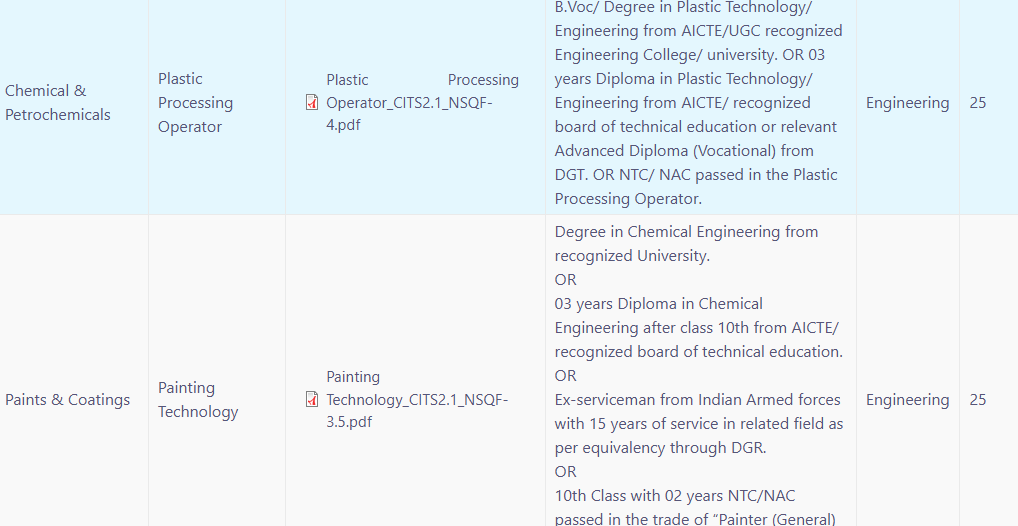
The detailed syllabus for each trade is available on the official DGT website (dgt.gov.in/CITS). Below is a representative summary of important topics for popular engineering and non-engineering trades. All trades follow a similar structure of Trade Technology (Theory + Practical), Workshop Calculation & Science / Soft Skills, and Principles of Teaching.
| Trade | Key Trade Technology Topics | Duration / Level | Entry Qualification Highlights |
|---|---|---|---|
| Fitter | Advanced fitting techniques, precision tools, jigs & fixtures, assembly, maintenance | 1 Year / NSQF 4.5 | Degree/Diploma in Mechanical or NTC/NAC in Fitter |
| Electrician | Advanced electrical circuits, industrial wiring, motors, control panels, safety | 1 Year / NSQF 4.5 | Degree/Diploma in Electrical or NTC/NAC in Electrician |
| Welder | Advanced welding processes (SMAW, GMAW, TIG), inspection, metallurgy basics | 1 Year / NSQF 4 | Degree/Diploma in Mechanical/Metallurgy or NTC/NAC in Welder |
| Electronics Mechanic | Advanced electronics circuits, microcontrollers, PCB, testing & troubleshooting | 1 Year / NSQF 4.5 | Degree/Diploma in Electronics or NTC/NAC in Electronics Mechanic |
| Computer Software Application | Programming, databases, networking basics, software applications, troubleshooting | 1 Year / NSQF 4 | Degree/Diploma in CS/IT or equivalent |
| Draughtsman Mechanical | Advanced CAD, machine drawing, geometric dimensioning & tolerancing | 1 Year / NSQF 4.5 | Degree/Diploma in Mechanical or NTC/NAC in Draughtsman Mechanical |
| Cosmetology | Advanced beauty therapy, hair care, skin treatments, salon management | 1 Year / NSQF 4 | Relevant NTC/NAC or equivalent qualification |
| Dress Making / Fashion Design | Advanced garment construction, pattern making, fashion illustration, textile knowledge | 1 Year / NSQF 3.5–4 | Relevant NTC/NAC or equivalent |
Trade Technology (Common Structure Across Trades)
Trade Technology forms the core of the CITS curriculum. It includes both basic and advanced components of trade practice and theory. Trainees learn modern tools, equipment, industrial processes, quality control, safety standards, and troubleshooting techniques relevant to their trade.
Practical sessions emphasise hands-on skill development under instructor guidance. Theory classes cover scientific principles, material properties, process parameters, and industry best practices. Continuous assessment through sessional work is an integral part of evaluation.
Training Methodology / Principles of Teaching
This component is common to all trades and focuses on pedagogical skills. Topics include principles of teaching and learning, lesson planning, demonstration techniques, use of teaching aids, classroom management, assessment and evaluation methods, and preparation of instructional materials.
Trainees practise micro-teaching, prepare Written Instructional Material (WIM), and learn to design effective training sessions. This section equips future instructors with the ability to transfer skills effectively to ITI trainees.
Engineering Technology / Soft Skills and OJT
Engineering trades include Workshop Calculation & Science and Engineering Drawing. Non-engineering trades may include soft skills modules. Topics cover applied mathematics, basic science concepts relevant to the trade, and technical drawing skills.
Mandatory On-the-Job Training or Group Project provides industry exposure. Trainees apply classroom learning in real workplace settings and develop professional competencies. Optional courses allow further specialisation based on interest and institute offerings.
CITs Syllabus 2026 PDF Download
Download the trade-wise syllabus from this link: Click Now
Eligibility, Fees and Important Guidelines
Candidates must possess NTC/NAC/Diploma/Degree in the relevant field (or be appearing in the final year). Minimum age is 18 years with no upper age limit. Central government reservation policy applies. Provisional admission is permitted for appearing candidates subject to submission of final certificates.
Course fees at NSTIs are nominal (approximately ₹570–₹2420 annually depending on category). Detailed fee structures for IToTs may vary. Candidates should regularly check the official portal nimionlineadmission.in and dgt.gov.in for updates, seat matrix, and counselling schedules.
Preparation Tips and Conclusion
For the entrance exam, prioritise thorough revision of the CTS syllabus of the chosen trade and practice aptitude questions daily. For the course, focus on both skill mastery and teaching methodology. Official syllabi PDFs for individual trades should be downloaded from the DGT website for precise topic coverage.
CITS certification significantly enhances career prospects as an ITI instructor or vocational trainer. Aspirants are advised to follow the official prospectus and website notifications closely for the most accurate and updated information regarding the 2026-27 session.
About The Author
