
Cotton Corporation of India Junior Assistant Syllabus 2026: The Cotton Corporation of India (CCI) has announced a significant recruitment drive for 2026, offering 148 vacancies for various posts, including Junior Assistant. With the online application window opening on 9th July 2026, aspirants need to understand the exam pattern and syllabus to prepare effectively. This detailed guide covers everything from eligibility requirements to the comprehensive syllabus for CCI Junior Assistant 2026.
CCI Recruitment 2026: Overview
The CCI has released its recruitment notification for 2026 with the following key details :
| Particulars | Details |
|---|---|
| Organization | Cotton Corporation of India Ltd (CCI) |
| Total Vacancies | 148 |
| Posts Included | Management Trainee, Junior Commercial Executive, Junior Assistant (General & Accounts), Assistant Manager |
| Application Dates | 9th July to 24th July 2026 |
| Selection Process | Written Test, Document Verification, Medical Examination |
| Official Website | www.cotcorp.org.in |
CCI Junior Assistant Post-Wise Vacancies
The recruitment notification outlines the following post-wise distribution for Junior Assistant positions :
| Post | Vacancies |
|---|---|
| Junior Assistant (Accounts) | 50 |
| Junior Assistant (General) | 30 |
| Total | 80 |
Eligibility Criteria for CCI Junior Assistant
Before diving into the syllabus, candidates must ensure they meet the eligibility criteria:
Junior Assistant (General):
-
Any Graduate with a minimum of 50% marks (45% for SC/ST/PwBD candidates)
Junior Assistant (Accounts):
-
B.Com from a recognized University with an aggregate of 50% marks (45% for SC/ST/PH candidates)
Age Limit: 18 to 30 years for Junior Assistant posts. Age relaxation applicable as per Government of India rules.
CCI Exam Pattern 2026 (All Posts)
The written examination for Junior Assistant and other posts follows a consistent pattern, with the difference lying only in the subject-specific knowledge section.
Key Highlights
-
Exam Mode: Computer-Based Test (Objective MCQ)
-
Total Questions: 120
-
Total Marks: 120
-
Duration: 120 minutes (2 hours)
-
Marking Scheme: +1 mark for a correct answer; -0.25 marks for an incorrect answer
-
Qualifying Marks:
-
UR/EWS/OBC: Minimum 40%
-
SC/ST/PwBD/Ex-Servicemen: Minimum 35%
-
Exam Pattern Table
| Subject | Number of Questions | Marks | Time |
|---|---|---|---|
| General English | 15 | 15 | 120 minutes |
| Reasoning | 15 | 15 | |
| Quantitative Aptitude | 15 | 15 | |
| General Knowledge | 15 | 15 | |
| Subject-Related Knowledge | 60 | 60 | |
| Total | 120 | 120 | 2 hours |
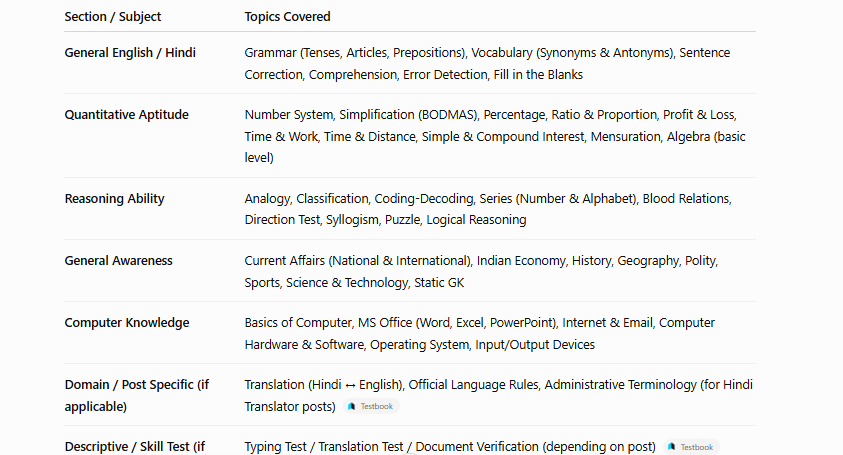
CCI Junior Assistant Syllabus 2026
| Section / Subject | Topics Covered |
|---|---|
| General English / Hindi | Grammar (Tenses, Articles, Prepositions), Vocabulary (Synonyms & Antonyms), Sentence Correction, Comprehension, Error Detection, Fill in the Blanks |
| Quantitative Aptitude | Number System, Simplification (BODMAS), Percentage, Ratio & Proportion, Profit & Loss, Time & Work, Time & Distance, Simple & Compound Interest, Mensuration, Algebra (basic level) |
| Reasoning Ability | Analogy, Classification, Coding-Decoding, Series (Number & Alphabet), Blood Relations, Direction Test, Syllogism, Puzzle, Logical Reasoning |
| General Awareness | Current Affairs (National & International), Indian Economy, History, Geography, Polity, Sports, Science & Technology, Static GK |
| Computer Knowledge | Basics of Computer, MS Office (Word, Excel, PowerPoint), Internet & Email, Computer Hardware & Software, Operating System, Input/Output Devices |
| Domain / Post Specific (if applicable) | Translation (Hindi ↔ English), Official Language Rules, Administrative Terminology (for Hindi Translator posts) |
| Descriptive / Skill Test (if applicable) | Typing Test / Translation Test / Document Verification (depending on post) |
The syllabus is divided into five sections, with the subject-related knowledge section varying based on the specific Junior Assistant post applied for.
1. General English Syllabus
This section tests candidates’ proficiency in the English language. Key topics include :
-
Articles and Prepositions: Understanding the correct usage in sentences
-
Vocabulary and Synonyms: Word meanings and similar words
-
Reading Comprehension: Understanding passages and answering questions
-
Jumbled Sentences: Rearranging words to form coherent sentences
-
Sentence Improvement: Making sentences clearer or more concise
-
Error Detection: Identifying grammatical mistakes
-
Cloze Test: Filling missing words in a passage
-
Sentence Rearrangement: Reordering sentences to create logical paragraphs
2. Reasoning Syllabus
This section evaluates logical and analytical thinking abilities :
-
Syllogism: Logical reasoning with premises and conclusions
-
Coded Inequalities: Solving inequalities using codes
-
Direction and Distance: Understanding spatial relationships
-
Blood Relations: Understanding familial relationships
-
Ordering and Ranking: Sequencing based on given criteria
-
Data Interpretation: Analyzing data from tables and charts
-
Coding and Decoding: Transforming messages using a code
-
Puzzles: Solving logical or mathematical puzzles
-
Pattern Completion: Identifying missing parts in a pattern
-
Alphabet and Number Series: Recognizing sequences
-
Seating Arrangements: Arranging based on given conditions
-
Input-Output: Analyzing patterns in input and output
-
Critical Reasoning: Evaluating arguments
-
Data Sufficiency: Determining if data is sufficient to solve a problem
3. Quantitative Aptitude Syllabus
This section tests mathematical and numerical ability :
-
Ratio and Proportion: Comparing quantities
-
Time and Work: Calculating task completion time
-
Speed and Distance: Relationship between speed, time, and distance
-
Percentages and Averages: Calculation fundamentals
-
Profit, Loss, and Discount: Business mathematics
-
Probability: Likelihood of events
-
Simple and Compound Interest: Interest calculations
-
Data Interpretation: Analyzing numerical data
-
Mensuration: Measurements of geometric shapes
-
Number Series: Pattern identification in sequences
-
Quadratic Equations: Solving equations of form ax² + bx + c = 0
4. General Knowledge Syllabus
This section covers current affairs and general awareness :
-
Current Affairs: Recent events in India and the world
-
Indian Geography: Geographical features of India
-
World Geography: Global geographical knowledge
-
Indian Trade and Economy: Economic policies and trade
-
History of India: Historical events and periods
-
Indian National Movement: Freedom struggle history
-
Indian Constitution: Governing laws and principles
-
Indian Polity: Political system understanding
-
Scientific Research: Ongoing scientific developments
-
Awards and Sports: Recognition in various fields
-
Environmental Issues: Conservation and challenges
5. Subject Knowledge Syllabus
This is the most crucial section, accounting for 60 marks. The syllabus differs based on the specific Junior Assistant post.
For Junior Assistant (General)
Candidates applying for the General post need to focus on agriculture-related topics :
Agriculture and Allied Subjects:
-
Agricultural Marketing, Trade & Practices
-
Farm Power and Machinery
-
Agricultural Entomology (Study of insects affecting agriculture)
-
Crop Pest and their Management
-
Agricultural Microbiology
-
Soil Microbiology
-
Principles of Agricultural Agronomy
-
Field Crops
-
Weed Management
-
Organic Farming and Sustainable Agriculture
-
Dimensions of Agricultural Extension
-
Cotton-specific topics: Cotton procurement, cotton area, production, yield, and domestic and international cotton scenario
General Administration: Knowledge of administrative procedures and practices
For Junior Assistant (Accounts)
Candidates applying for the Accounts post must focus on commerce, finance, and accounting subjects :
Financial Accounting:
-
Accounting Standards and their applications
-
Preparation of financial statements
-
Profit and Loss Account, Balance Sheet, Cash Flow Statement
-
Accounting for Bonus Issue and Amalgamation
-
Financial Statements of Not-for-Profit Organizations
-
Accounts from Incomplete Records
Cost Accounting:
-
Introduction to Cost Accounting
-
Materials, Labor, and Overheads
-
Methods of Costing (Job and Batch, Contract, Operating)
-
Standard Costing and Marginal Costing
-
Budgets and Budgetary Control
Taxation:
-
Income-tax Act, 1961 – Basic concepts
-
Residential status and scope of total income
-
Five Heads of Income
-
Deductions from gross total income
-
Provisions of Goods and Services Tax Act (GST)
Business Law:
-
The Indian Contract Act, 1872
-
The Negotiable Instruments Act, 1881
-
The Companies Act, 2013
-
The Payment of Bonus Act, 1965
-
The Employees’ Provident Fund Act, 1952
-
The Payment of Gratuity Act, 1972
Financial Management:
-
Scope and Objectives
-
Time Value of Money
-
Financial Analysis and Planning
-
Financing Decisions
-
Investment Decisions
-
Management of Working Capital
Auditing:
-
Auditing Concepts and Standards
-
Preparation for an Audit
-
Internal Control
-
Vouching and Verification
-
Company Audit and Audit Report
Preparation Strategy for CCI Junior Assistant 2026
Based on the exam pattern and syllabus, candidates should adopt a structured approach:
-
Understand the Pattern: Familiarize yourself with the 5-section structure and the emphasis on subject knowledge (60 marks).
-
Prioritize Subject Knowledge: Allocate maximum preparation time to the post-specific section, as it carries the highest weightage.
-
Practice Quantitative Aptitude and Reasoning: Regular practice of these sections is essential for speed and accuracy.
-
Stay Updated: For General Knowledge, follow current affairs regularly, particularly related to agriculture, economy, and government schemes.
-
Solve Previous Year Papers: Practice with memory-based papers to understand question trends and difficulty levels .
-
Mock Tests: Attempt mock tests to improve time management and identify weak areas .
-
Focus on Cotton Sector: Given CCI’s specialization, thorough knowledge of cotton production, procurement, and market scenarios is highly recommended.
About The Author
