
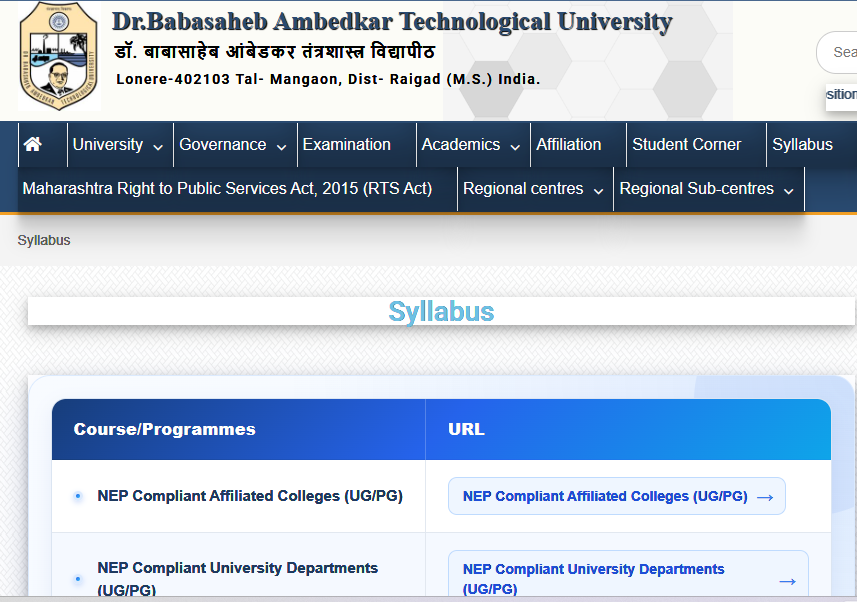
DBATU Syllabus 2026: Dr. Babasaheb Ambedkar Technological University (DBATU / DABATU), Lonere, Maharashtra, is a state technological university offering B.Tech programmes across multiple engineering streams for its university departments and a large network of affiliated colleges. The curriculum follows the National Education Policy (NEP) 2020 framework, featuring multidisciplinary minors (MDM), open electives, flexible credit structures, multiple entry/exit options, and opportunities for honours/research tracks.
First-year syllabus is largely common across branches (especially for affiliated institutes). Higher years are branch-specific. Official PDFs are hosted on the university website (dbatu.ac.in). Always download the latest version from the official portal, as minor revisions occur.
About DBATU and NEP-Aligned B.Tech Structure
- Duration: 4 years (8 semesters), with multiple entry/exit options (e.g., Diploma after 2 years, Degree with minor/honours/research after 4 years).
- Credit Framework (typical for affiliated colleges under NEP): Minimum ~160–176 credits for standard B.Tech with multidisciplinary minor; higher for honours/research/double minor tracks (around 180–194 credits). Students can complete a portion of courses via NPTEL/SWAYAM (with content similarity requirements).
- Key Features:
- Basic Science Courses (BSC), Engineering Science Courses (ESC), Professional Core Courses (PCC), Professional Electives (PEC), Open Electives (OE), Multidisciplinary Minor (MDM) buckets, Ability Enhancement Courses (AEC), Value Education Courses (VEC), and labs/projects/internships.
- Continuous Assessment (CA) + Mid-Semester Exam (MSE) + End-Semester Exam (ESE).
- Absolute grading system (e.g., EX for 91–100, EE for minimum pass around 40–50, etc.).
- Mandatory induction programme at the start of the first year.
- Indian Knowledge System (IKS), Constitution of India, and other value-added/audit courses.
Streams typically include Computer Engineering / CSE / IT / AI & DS / AI & ML and allied, Mechanical Engineering & allied, Civil Engineering & allied (including Environmental, Infrastructure, Structures), Electrical Engineering & allied, Electronics & Telecommunication (EXTC) & allied, Mining, Food Technology, Petrochemical, and others.
First Year B.Tech Syllabus (Common to All Streams)
First year is foundational and largely common. It includes an induction programme (typically 3 weeks) covering physical activities, arts, local visits, lectures, and language support.
Typical structure (Group A/B patterns may apply depending on the batch/institute; NEP-aligned for affiliated colleges from 2024-25):
- Semester I (examples): Engineering Mathematics-I, Engineering Physics (or Chemistry in alternate group), Engineering Graphics, Communication Skills, Energy and Environment Engineering / Basic Civil & Mechanical Engineering (audit), related labs (Physics/Graphics/Communication Skills).
- Semester II: Engineering Mathematics-II, Engineering Chemistry (or Physics), Engineering Mechanics, Computer Programming in C, Workshop Practices, Basic Electrical & Electronics Engineering (audit), related labs.
Credits typically total around 18–20+ per semester including labs and audit courses. Detailed unit-wise topics, teaching schemes (L-T-P), marking schemes (CA/MSE/ESE), and course objectives are in the official PDF.
Second Year B.Tech Syllabus (Branch-Specific)
Branch core subjects begin. Common elements include Engineering Mathematics-III, open electives, MDM courses, and labs.
Examples (NEP 2020, Affiliated Institutes, effective ~2025-26):
- Computer / CSE / AI & Allied: Data Structures, Discrete Mathematics, Artificial Intelligence / Prompt Engineering, Computer Architecture, Design & Analysis of Algorithms, Probability & Statistics, Python Programming lab, Constitution of India / value courses, Open Electives, MDM.
- Electrical: Electrical & Electronics Measurements, Network Theory, Power Systems, Electrical Machines-I, related labs.
- Mechanical: Manufacturing Processes, Thermodynamics, Fluid Mechanics, Strength of Materials, etc.
- Civil & Allied: Surveying, Structural Analysis, Concrete Technology, Fluid Mechanics, Geotechnical basics, etc.
- EXTC / Electronics: Electronic Devices & Circuits, and related.
Semester-wise credit distribution includes PCC, BSC, OE, MDM, VSEC/AEC. Full detailed syllabi with units are in branch-specific PDFs on the affiliated syllabus and B.Tech 2025-26 pages.
Third Year B.Tech Syllabus
Focus shifts to advanced core, electives, and applications. Includes Machine Learning / specialized courses, Database Management, Operating Systems, Software Engineering (for CS/IT/AI streams), Heat Transfer / Design (Mechanical), Power Electronics / Control Systems (Electrical), Structural Design / Environmental Engineering (Civil), etc.
Projects, internships evaluation, and more OE/MDM credits appear. Third-year PDFs are available for many branches (e.g., Civil, IT, Computer) on the official site.
Final Year (Fourth Year) B.Tech Syllabus
Emphasis on advanced electives, major project (Part-I and Part-II), internship, NPTEL/online courses, and industry-oriented topics.
Examples:
- Electrical & Computer: Electrical Drives, AI & Machine Learning, Professional/Open Electives (Industrial Automation, Energy Audit, Data Science, Cloud Computing, Embedded Systems, etc.), Project, Internship evaluation.
- Similar patterns in other branches: specialized PEC/OE groups, project work (significant credits), and exit options for research/honours tracks (CGPA thresholds apply, e.g., ≥7.5 for certain options).
Detailed schemes show L-T-P, CA/MSE/ESE distribution, and total credits around 20–24 per semester.
Additional Components Across Years
- Open Electives & MDM Buckets: Students select from published buckets (ensure no major overlap with core). MDM typically requires ~14 credits from one discipline across semesters 3–8.
- Mandatory / Value Courses: Indian Knowledge System, Constitution of India, Life of Dr. Babasaheb Ambedkar, Communication Skills, Environmental Science, etc.
- Labs, Projects & Internships: Mandatory practicals, mini/major projects, and internship evaluation.
- Evaluation: Theory often 20 CA + 20 MSE + 60 ESE; Labs 60 CA + 40 ESE (or similar). Minimum pass criteria apply.
About The Author
