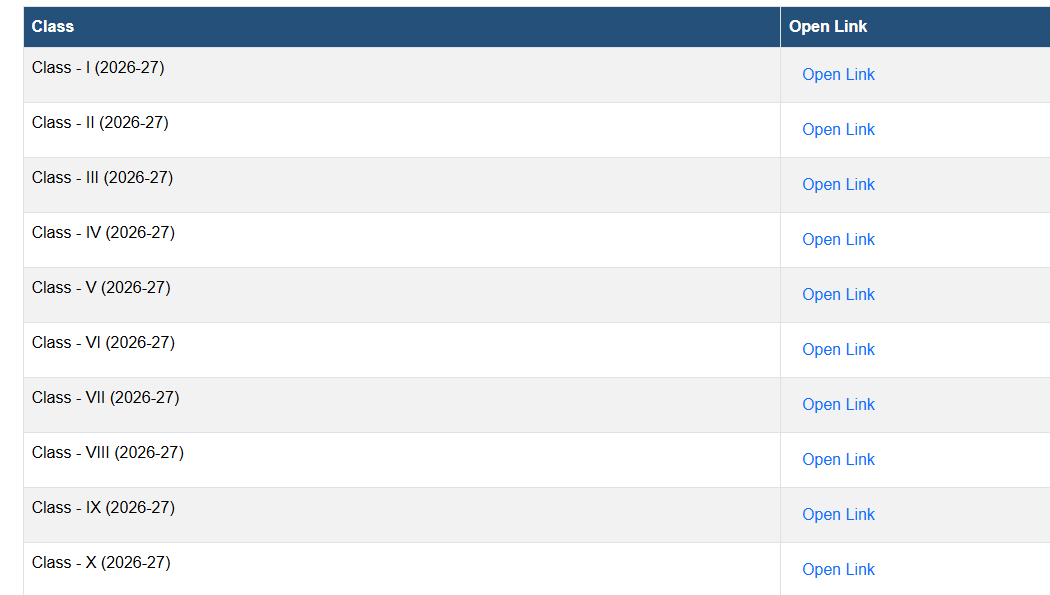
Edudel Syllabus 2026-27: The Directorate of Education (DoE), Government of NCT of Delhi, has officially released the Edudel Syllabus for the academic session 2026-27. This syllabus is designed to guide students, teachers, and parents through the academic year with a structured, month-wise, and term-wise curriculum. It covers all classes from 1 to 12 and includes both academic and vocational subjects .
Key Features of the Edudel Syllabus 2026-27:
-
Term-wise and Month-wise Division: The curriculum is broken down into manageable monthly and term-based segments to ensure systematic learning throughout the year .
-
Accessible Formats: The syllabus is available for all classes—from I to XII—and can be accessed via official platforms.
-
Language Options: Syllabi are often provided in both Hindi and English mediums to cater to diverse learning needs .
-
Focus Areas: The syllabus includes foundational subjects (Languages, Mathematics, Science, and Social Science) and, for higher classes (IX to XII), specialized streams and vocational subjects .
Edudel Syllabus 2026-27: Primary Level (Classes I–V)
| Subject | Topics Covered |
|---|---|
| English | Reading, Writing, Grammar, Vocabulary, Comprehension |
| Hindi | पठन, लेखन, व्याकरण, शब्दावली |
| Mathematics | Numbers, Addition, Subtraction, Multiplication, Division, Shapes, Measurement |
| Environmental Studies (EVS) | Family, Plants, Animals, Food, Water, Travel, Environment |
Edudel Syllabus 2026-27: Upper Primary Level (Classes VI–VIII)
| Subject | Topics Covered |
|---|---|
| English | Prose, Poetry, Grammar, Writing Skills |
| Hindi | गद्य, पद्य, व्याकरण, लेखन कौशल |
| Mathematics | Algebra, Geometry, Mensuration, Data Handling |
| Science | Physics (Motion, Light), Chemistry (Matter), Biology (Plants, Animals) |
| Social Science | History, Geography, Civics |
| Sanskrit (Optional) | Basic Grammar, Translation, Vocabulary |
Edudel Syllabus 2026-27: Secondary Level (Classes IX–X)
| Subject | Topics Covered |
|---|---|
| English | Literature, Grammar, Writing Skills |
| Hindi | साहित्य, व्याकरण, रचनात्मक लेखन |
| Mathematics | Algebra, Trigonometry, Geometry, Statistics |
| Science | Physics, Chemistry, Biology |
| Social Science | History, Geography, Political Science, Economics |
| Computer Science | Basics of Computers, Programming Fundamentals |
Edudel Syllabus 2026-27: Senior Secondary Level (Classes XI–XII)
Science Stream
| Subject | Topics Covered |
|---|---|
| Physics | Mechanics, Electricity, Magnetism, Optics |
| Chemistry | Organic, Inorganic, Physical Chemistry |
| Biology | Botany, Zoology, Human Physiology |
| Mathematics | Calculus, Algebra, Probability |
| Computer Science | Programming, Data Structures |
Commerce Stream
| Subject | Topics Covered |
|---|---|
| Accountancy | Financial Accounting, Ledger, Balance Sheet |
| Business Studies | Management, Marketing, Finance |
| Economics | Micro & Macro Economics |
| Mathematics | Statistics, Probability |
| Informatics Practices | Data Handling, Database |
Arts/Humanities Stream
| Subject | Topics Covered |
|---|---|
| History | Ancient, Medieval, Modern History |
| Geography | Physical & Human Geography |
| Political Science | Constitution, Politics |
| Sociology | Society, Culture, Social Change |
| Psychology | Human Behavior, Development |
Primary Classes (I to V)
For primary classes, the syllabus focuses on building a strong foundation in core subjects:
-
Languages: Hindi and English (with emphasis on grammar and reading comprehension) .
-
Mathematics: Basic arithmetic, shapes, and patterns.
-
Environmental Science (EVS): Understanding the surrounding world, focusing on plants, animals, health, and hygiene.
For example, the syllabus for Class I includes both Hindi and English mediums for teaching Mathematics and Language, ensuring a bilingual approach where necessary .
Middle Classes (VI to VIII)
The syllabus for Classes VI to VIII introduces students to more specialized subjects:
-
Languages: Hindi and English (advanced grammar and composition) .
-
Science: Introduction to Physics, Chemistry, and Biology concepts.
-
Mathematics: Advanced arithmetic, geometry, and data handling.
-
Social Science: History, Geography, and Civics.
A deeper look at the CM Shri School entrance syllabus for Class VI reveals detailed topics such as General Awareness (Indian states, capitals, and culture), Mental Ability (verbal and non-verbal reasoning), and Numerical Aptitude (perimeter, area, fractions, and basic geometry).
Secondary and Senior Secondary Classes (IX to XII)
For higher classes, the syllabus is designed to prepare students for board examinations and competitive entrance exams:
-
Class IX: The syllabus includes English, General Awareness, Mental Ability, Science, and Mathematics, with a focus on problem-solving skills and conceptual clarity aligned to NCERT and CBSE standards.
-
Class XI & XII: The syllabus is divided into subject-specific domains like Physics, Chemistry, Mathematics, Biology, and Social Sciences. For vocational and specialized courses, domain-specific aptitude questions are included. The exam pattern also includes sections on Language and Mental Ability to test analytical skills.
Additional Curricula and Highlights
CM Shri School Admission Test Syllabus
Along with the general curriculum, the CM Shri School Admission Test Syllabus for 2026-27 has also been released for Classes 6, 9, and 11. This includes a structured exam pattern with specific sections for Language, General Awareness, Mental Ability, and Numerical Aptitude.
| Class | Subjects Included | Key Topics | Exam Pattern |
|---|---|---|---|
| Class VI | Hindi, English, General Awareness, Mental Ability, Numerical Aptitude | Reading Comprehension, Basic Arithmetic, Human Body, Transport, Famous Personalities | 75 questions; 300 marks |
| Class IX | English, General Awareness, Mental Ability, Science, Mathematics | Class 8-level concepts; Social Sciences & Current Affairs; Scientific & Quantitative Reasoning | 100 questions; 300 marks |
| Class XI | Language, Mental Ability, Subject-specific (Physics, Chemistry, etc.), Domain Aptitude | NCERT up to Class 10; foundational Class 11 level; aptitude questions for PVA/Humanities/Finance | Paper 1 & 2; up to 100 questions; 400 marks |
Important Observations
-
Rashtraneeti Programme: For the 2026-27 session, the DoE has fully rolled out the Rashtraneeti programme, which includes nine themes. Topics include Leadership and Active Citizenship, Viksit Bharat@2047, water management, environment, and Nourished Nation. This program will cover topics like proper usage of social media, digital literacy, and citizen responsibility.
-
NCERT and CBSE Alignment: The syllabus is typically aligned with standard NCERT textbooks and the CBSE curriculum, ensuring that students are well-prepared for central board examinations.
How to Access the Edudel Syllabus 2026-27 PDF
Students and teachers can download the Edudel Syllabus 2026-27 PDF for all classes from the official website: edudel.nic.in. The syllabus is available for Classes I to XII and includes both the 2025-26 and 2026-27 sessions.
-
For Primary Classes: Visit the official Student Module page to access month-wise syllabus details.
-
For Higher Classes: Detailed syllabi for Class IX and XI are available on the website, including vocational subjects and specialized streams.
Conclusion
The Edudel Syllabus for 2026-27 provides a transparent and well-organized framework for students across Delhi’s government schools. With a structured approach that includes vocational training, competitive exam preparation, and modern curricula like the Rashtraneeti programme, the syllabus aims to foster holistic development and academic excellence for students from Class 1 to 12.
About The Author
