
The IBPS RRB Clerk Syllabus 2026 is an important resource for candidates preparing for the Office Assistant (Multipurpose) examination conducted by the Institute of Banking Personnel Selection (IBPS). The exam is conducted for recruitment to clerical posts in Regional Rural Banks (RRBs) across India.
For many banking aspirants, RRB Clerk is an attractive opportunity because the selection process for Office Assistant consists of Prelims and Mains, with no interview stage. The Preliminary exam acts as a screening stage, while the Mains examination plays a major role in the final selection.
The syllabus is not unusually difficult, but the real challenge is completing questions accurately within a limited time. The Preliminary exam mainly tests Reasoning Ability and Numerical Ability, while the Mains exam adds General Awareness, Computer Knowledge and English/Hindi Language.
Candidates should therefore understand the syllabus before starting preparation instead of randomly solving mock tests or studying every banking topic available.
IBPS RRB Clerk Syllabus 2026: Highlights
| Particulars | Details |
|---|---|
| Exam Name | IBPS RRB Office Assistant (Multipurpose) |
| Common Name | IBPS RRB Clerk |
| Conducting Body | Institute of Banking Personnel Selection (IBPS) |
| Selection Process | Prelims + Mains |
| Prelims Subjects | Reasoning Ability, Numerical Ability |
| Mains Subjects | Reasoning, Numerical Ability, General Awareness, English/Hindi, Computer Knowledge |
| Prelims Questions | 80 |
| Prelims Marks | 80 |
| Prelims Duration | 45 minutes |
| Mains Questions | 200 |
| Mains Marks | 200 |
| Mains Duration | 2 hours |
| Negative Marking | 0.25 mark for each wrong answer |
| Interview | Not applicable for Office Assistant |
The broad 2026 structure continues to focus on Reasoning and Numerical Ability in Prelims, followed by five sections in Mains.
IBPS RRB Clerk Exam Pattern 2026
Before going through the detailed syllabus, candidates should understand how the examination is structured. This helps in deciding how much time should be devoted to each subject.
IBPS RRB Clerk Prelims Exam Pattern 2026
The Preliminary examination contains only two sections: Reasoning Ability and Numerical Ability. Candidates have 45 minutes to complete the paper.
| Section | Questions | Marks | Time |
|---|---|---|---|
| Reasoning Ability | 40 | 40 | 25 minutes |
| Numerical Ability | 40 | 40 | 20 minutes |
| Total | 80 | 80 | 45 minutes |
The current pattern uses sectional timing, meaning candidates need to manage the allotted time for each section carefully rather than freely shifting between the two sections.
What does this mean for candidates?
There is no separate English section in Prelims. This is particularly useful for candidates who are stronger in reasoning and mathematics but are still improving their English.
However, the 45-minute limit makes speed extremely important. A candidate may know how to solve a question but still lose marks if too much time is spent on one puzzle or lengthy calculation.
IBPS RRB Clerk Mains Exam Pattern 2026
The Mains examination is considerably broader. Candidates have to prepare five sections, including General Awareness and Computer Knowledge.
| Section | Questions | Marks | Duration |
|---|---|---|---|
| Reasoning Ability | 40 | 50 | 30 minutes |
| Numerical Ability | 40 | 50 | 30 minutes |
| General Awareness | 40 | 40 | 15 minutes |
| English/Hindi Language | 40 | 40 | 30 minutes |
| Computer Knowledge | 40 | 20 | 15 minutes |
| Total | 200 | 200 | 120 minutes |
A penalty of one-fourth of the marks assigned to a question is applicable for an incorrect answer.
Candidates should remember that English and Hindi are alternative language sections; candidates generally choose one of them as applicable rather than attempting both.
IBPS RRB Clerk Prelims Syllabus 2026
The Prelims syllabus is divided into two subjects:
- Reasoning Ability
- Numerical Ability
Let us look at each subject in detail.
IBPS RRB Clerk Reasoning Ability Syllabus 2026
Reasoning is one of the most scoring sections in the RRB Clerk examination. Most questions are based on logical thinking, arrangements, patterns and relationships.
Full Reasoning Syllabus for Prelims
| Topic | What to Prepare |
|---|---|
| Alphabetical Series | Letter-based sequences and patterns |
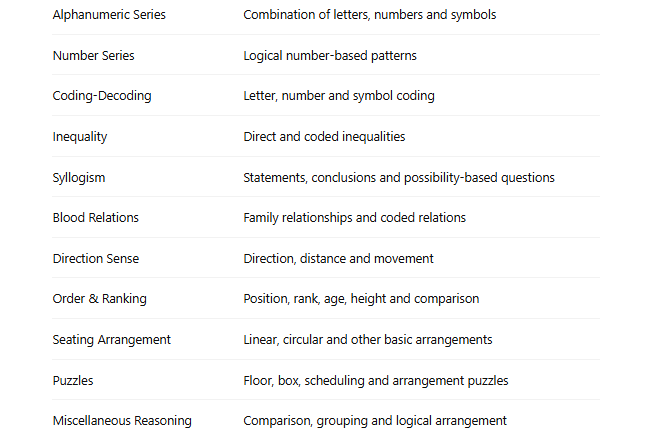
| Alphanumeric Series | Combination of letters, numbers and symbols |
| Number Series | Logical number-based patterns |
| Coding-Decoding | Letter, number and symbol coding |
| Inequality | Direct and coded inequalities |
| Syllogism | Statements, conclusions and possibility-based questions |
| Blood Relations | Family relationships and coded relations |
| Direction Sense | Direction, distance and movement |
| Order & Ranking | Position, rank, age, height and comparison |
| Seating Arrangement | Linear, circular and other basic arrangements |
| Puzzles | Floor, box, scheduling and arrangement puzzles |
| Miscellaneous Reasoning | Comparison, grouping and logical arrangement |
Puzzles, seating arrangements, syllogism, inequality, coding-decoding, blood relations and series are among the key areas generally covered under RRB Clerk Reasoning.
How to prepare Reasoning
Do not try to solve every puzzle immediately. Start with topics such as inequality, syllogism, coding-decoding, direction and blood relations. Once these become comfortable, move towards seating arrangements and puzzles.
The important thing is not merely solving a puzzle but learning to identify which questions can be solved quickly and which ones should be left for later.
IBPS RRB Clerk Numerical Ability Syllabus 2026
Numerical Ability can become a high-scoring section if the basics of calculation and arithmetic are strong. Candidates should focus on both speed and accuracy.
Full Numerical Ability Syllabus
| Topic | Important Areas |
|---|---|
| Simplification | BODMAS, fractions, decimals and basic calculations |
| Approximation | Approximate values and calculation-based questions |
| Number Series | Missing and wrong number series |
| Quadratic Equations | Basic quadratic equations and comparison |
| Number System | Natural numbers, integers and divisibility |
| HCF & LCM | Highest common factor and least common multiple |
| Percentage | Basic and application-based percentage questions |
| Ratio & Proportion | Ratio, proportion and variations |
| Average | Basic and weighted average |
| Profit & Loss | Cost price, selling price, profit, loss and discount |
| Simple Interest | Principal, rate, time and interest |
| Compound Interest | Compound interest and related calculations |
| Partnership | Investment and profit-sharing |
| Mixture & Alligation | Mixing quantities and prices |
| Problems on Ages | Present, past and future age problems |
| Time & Work | Work efficiency and completion time |
| Pipes & Cisterns | Filling and emptying tanks |
| Speed, Time & Distance | Basic speed-distance calculations |
| Boats & Streams | Upstream and downstream problems |
| Trains | Train length, speed and crossing problems |
| Mensuration | 2D and 3D figures |
| Probability | Basic probability |
| Permutation & Combination | Arrangement and selection concepts |
| Data Interpretation | Tables, bar graphs, line graphs, pie charts and caselets |
The broad Numerical Ability syllabus includes simplification, approximation, number series, arithmetic, data interpretation, mensuration, probability and related mathematical concepts.
Preparation tip
Candidates often spend too much time learning difficult arithmetic while ignoring simplification and number series. That can hurt performance because quick-calculation topics can provide relatively efficient scoring opportunities.
IBPS RRB Clerk Mains Syllabus 2026
The Mains syllabus is much wider than Prelims. Candidates should ideally begin preparing Mains subjects alongside their Preliminary preparation instead of waiting until after the Prelims result.
The five sections are:
- Reasoning Ability
- Numerical Ability
- General Awareness
- English/Hindi Language
- Computer Knowledge
IBPS RRB Clerk Reasoning Syllabus for Mains
The Mains Reasoning section goes beyond the basic concepts tested in Prelims.
Complete Reasoning Syllabus
| Topic | Important Areas |
|---|---|
| Puzzles | Floor, box, scheduling, comparison and miscellaneous puzzles |
| Seating Arrangement | Linear, circular, square, rectangular and triangular arrangements |
| Syllogism | Statements, conclusions and possibility |
| Inequality | Direct and coded inequality |
| Coding-Decoding | Alphabet, number, symbol and coded patterns |
| Blood Relations | Direct and coded blood relations |
| Direction Sense | Direction and coded direction |
| Order & Ranking | Ranking and comparison |
| Alphanumeric Series | Letter-number-symbol patterns |
| Input-Output | Machine/input-output arrangement |
| Data Sufficiency | Two- and three-statement questions |
| Statement & Assumption | Identifying assumptions |
| Statement & Conclusion | Drawing logical conclusions |
| Statement & Inference | Logical inference |
| Cause & Effect | Identifying causes and consequences |
| Course of Action | Selecting suitable action |
| Strength of Argument | Evaluating arguments |
| Resultant/Coded Series | Series-based reasoning |
| Comparison/Grouping | Categorisation and comparison |
The Mains syllabus includes advanced reasoning topics such as input-output, data sufficiency, statement-based reasoning, coded inequalities and different types of puzzles.
IBPS RRB Clerk Numerical Ability Syllabus for Mains
The Mains Numerical Ability section is more calculation-intensive. Candidates should be comfortable with arithmetic as well as Data Interpretation.
Complete Numerical Ability Syllabus
| Topic | Important Areas |
|---|---|
| Simplification & Approximation | BODMAS, fractions, decimals, roots, squares and cubes |
| Number Series | Missing, wrong and pattern-based series |
| Quadratic Equations | Equations and quantity comparison |
| Data Interpretation | Table, bar, line, pie, mixed and caselet DI |
| Data Sufficiency | Two- and three-statement problems |
| Percentage | Basic and application-based questions |
| Ratio & Proportion | Direct and indirect applications |
| Average | Simple and weighted average |
| Profit & Loss | Profit, loss, discount and marked price |
| Simple & Compound Interest | Interest calculations |
| Time & Work | Work and efficiency |
| Pipes & Cisterns | Filling and emptying |
| Speed, Time & Distance | Relative speed and applications |
| Boats & Streams | Upstream/downstream |
| Trains | Crossing and relative speed |
| Partnership | Investment and profit sharing |
| Mixture & Alligation | Quantity and price-based problems |
| Ages | Age-based arithmetic |
| Number System | Divisibility, numbers and remainders |
| HCF & LCM | Fundamental applications |
| Mensuration | Area, volume and perimeter |
| Probability | Basic probability |
| Permutation & Combination | Arrangement and selection |
| Algebra | Basic algebraic expressions and equations |
| Quantity Comparison | Comparison-based numerical questions |
Data Interpretation deserves special attention because questions may appear in several formats, including tables, bar graphs, line graphs, pie charts, mixed DI and caselets.
IBPS RRB Clerk General Awareness Syllabus 2026
General Awareness is often the section that separates candidates in the Mains examination. Unlike Quantitative Aptitude or Reasoning, it cannot usually be mastered through a few days of practice.
A consistent habit of reading current affairs is much more useful.
Complete General Awareness Syllabus
| Area | Topics to Cover |
|---|---|
| Current Affairs | National and international events |
| Banking Awareness | Banking terms, institutions and developments |
| Financial Awareness | RBI, monetary policy, financial system |
| Economy | Indian economy and major economic developments |
| Government Schemes | Central and state government schemes |
| Banking & Financial Institutions | RBI, NABARD, SEBI, SIDBI, etc. |
| RRB Awareness | Regional Rural Banks and rural banking |
| Reports & Indexes | Important national and international reports |
| Awards & Honours | Major awards and recognitions |
| Sports | Tournaments, winners and important events |
| Defence | Exercises, appointments and developments |
| Science & Technology | Major scientific developments |
| Important Days | National and international days |
| Books & Authors | Important books and authors |
| Appointments | Important national and international appointments |
| Obituaries | Important personalities who have passed away |
| Static GK | Capitals, currencies, national parks, headquarters, etc. |
| State Current Affairs | Important developments related to states |
| Government Apps & Initiatives | Major digital and welfare initiatives |
The General Awareness syllabus generally combines current affairs with banking, economy, government schemes, reports, sports, defence, science and static awareness.
How much current affairs should you study?
Instead of trying to memorise several years of news, candidates should focus on recent current affairs, particularly banking, financial, national, international and government-related developments.
For RRB exams, rural development, agriculture, financial inclusion and banking-related news also deserve attention.
IBPS RRB Clerk English Language Syllabus 2026
Candidates choosing English in the Mains examination should prepare grammar, vocabulary and reading comprehension together.
Complete English Syllabus
| Topic | Important Areas |
|---|---|
| Reading Comprehension | Passage-based questions |
| Cloze Test | Fill-in-the-blank passage |
| Error Detection | Grammar and sentence errors |
| Sentence Correction | Improving incorrect sentences |
| Phrase Replacement | Replacing incorrect phrases |
| Fill in the Blanks | Single and double fillers |
| Word Usage | Correct usage of words |
| Vocabulary | Synonyms, antonyms and contextual vocabulary |
| Spelling | Incorrect and correct spellings |
| Idioms & Phrases | Common expressions |
| Sentence Rearrangement | Para jumbles |
| Word Rearrangement | Rearranging words |
| Phrase/Word Swap | Correcting word positions |
| Match the Columns | Sentence/phrase matching |
| One-Word Substitution | Appropriate single-word expressions |
Reading comprehension, cloze tests, error detection, sentence rearrangement, vocabulary and word usage are among the major areas covered under the English section.
IBPS RRB Clerk Hindi Language Syllabus 2026
Candidates who are more comfortable with Hindi can choose Hindi as their language paper, subject to the applicable examination rules.
Complete Hindi Syllabus
| Topic | Important Areas |
|---|---|
| अपठित गद्यांश | Passage-based questions |
| रिक्त स्थान | Fill in the blanks |
| गद्यांश में रिक्त स्थान | Cloze-type questions |
| वाक्य त्रुटि | Identifying sentence errors |
| शब्द त्रुटि | Word-related errors |
| वर्तनी त्रुटि | Spelling errors |
| समानार्थक शब्द | Synonyms |
| विलोम शब्द | Antonyms |
| मुहावरे | Idioms |
| लोकोक्तियाँ | Proverbs |
| वाक्यांश के लिए एक शब्द | One-word substitution |
| वाक्य सुधार | Sentence correction |
| शब्द प्रयोग | Correct contextual usage |
Candidates should not prepare Hindi only from grammar rules. Reading comprehension, vocabulary and regular practice are equally important.
IBPS RRB Clerk Computer Knowledge Syllabus 2026
Computer Knowledge is generally considered one of the more manageable sections, but candidates should not completely ignore it because the section contains a significant number of questions.
Complete Computer Knowledge Syllabus
| Topic | Important Areas |
|---|---|
| Computer Fundamentals | Basic concepts of computers |
| Generations of Computers | Different computer generations |
| Hardware | Components and devices |
| Software | System and application software |
| Operating System | Windows and basic OS concepts |
| Input Devices | Keyboard, mouse, scanner, etc. |
| Output Devices | Monitor, printer, speakers, etc. |
| Computer Memory | RAM, ROM, cache and storage |
| Storage Devices | HDD, SSD, optical and external storage |
| Number System | Binary, decimal and other systems |
| Computer Languages | Basic programming-language concepts |
| Computer Networks | LAN, MAN, WAN and networking basics |
| Network Topology | Bus, star, ring, mesh, etc. |
| Internet | Internet fundamentals and services |
| Internet Applications | Email, browsing and online services |
| TCP/IP | Basic networking protocol concepts |
| OSI Model | Layers and functions |
| Cyber Security | Online security and protection |
| Cyber Crime | Common cyber threats |
| Data Security | Data protection concepts |
| MS Word | Basic functions and shortcuts |
| MS Excel | Formulas, functions and worksheets |
| MS PowerPoint | Presentations and features |
| Shortcut Keys | Common computer shortcuts |
| Computer Abbreviations | Important computer-related abbreviations |
| Multimedia | Audio, video, graphics and multimedia concepts |
The syllabus commonly covers computer fundamentals, hardware/software, operating systems, networks, internet, cyber security, MS Office and computer abbreviations.
IBPS RRB Clerk Syllabus: Prelims vs Mains
A quick comparison can make the difference between the two stages easier to understand.
| Subject | Prelims | Mains |
|---|---|---|
| Reasoning Ability | Yes | Yes |
| Numerical Ability | Yes | Yes |
| General Awareness | No | Yes |
| English/Hindi | No | Yes |
| Computer Knowledge | No | Yes |
| Total Questions | 80 | 200 |
| Total Marks | 80 | 200 |
| Duration | 45 minutes | 2 hours |
The biggest difference is therefore not just the number of questions. Mains requires preparation across five different areas, so candidates should start building General Awareness, Computer and Language preparation early.
Important Topics for IBPS RRB Clerk 2026
Although every topic in the syllabus should be covered, some areas deserve extra attention because they regularly form an important part of banking-exam preparation.
Reasoning
- Puzzles
- Seating Arrangement
- Syllogism
- Inequality
- Coding-Decoding
- Blood Relations
- Direction Sense
- Series
- Data Sufficiency
- Input-Output
Numerical Ability
- Simplification
- Approximation
- Number Series
- Data Interpretation
- Percentage
- Ratio
- Average
- Profit & Loss
- Time & Work
- Speed, Time & Distance
- Simple & Compound Interest
General Awareness
- Current Affairs
- Banking Awareness
- RBI-related updates
- Government schemes
- Financial awareness
- Economy
- RRB-related developments
- Reports and indexes
- Sports and awards
English/Hindi
- Reading Comprehension
- Cloze Test
- Error Detection
- Fill in the Blanks
- Sentence Rearrangement
- Vocabulary
- Grammar
Computer
- Computer Fundamentals
- Hardware and Software
- Operating Systems
- Internet
- Networking
- MS Office
- Cyber Security
- Shortcut Keys
How to Prepare for IBPS RRB Clerk 2026
A common mistake is to treat Prelims and Mains as completely separate examinations. A better approach is to build a preparation plan where Prelims speed and Mains-level knowledge develop together.
1. Build your basics first
Start with fundamental concepts in Reasoning and Numerical Ability. If the basics are weak, solving hundreds of mock-test questions will not solve the problem.
2. Practise calculations every day
For Numerical Ability, spend some time every day on multiplication, squares, cubes, fractions, percentages and simplification. Faster calculations can save valuable seconds in the actual examination.
3. Make puzzles a regular part of preparation
Do not leave puzzles for the final weeks. Begin with basic seating arrangements and gradually move towards floor, box and scheduling puzzles.
4. Read current affairs regularly
General Awareness is a Mains subject, but it cannot be prepared effectively overnight. Make short notes and revise them regularly.
5. Do not ignore Computer Knowledge
Computer questions can be relatively scoring if the concepts are clear. Complete the fundamentals, networking, internet, MS Office and cyber-security portions before moving to advanced revision.
6. Practise sectional tests
A full mock test tells you your overall score, but sectional tests show exactly where you are losing marks.
For example, if your Numerical Ability score is good but your time is consistently running out, the solution may be speed and question selection rather than more theory.
7. Analyse every mock test
Simply taking mock tests is not enough. After each test, identify:
- Questions answered incorrectly
- Questions left unattempted
- Questions that consumed too much time
- Topics where accuracy is low
- Easy questions missed because of time pressure
This analysis can be more valuable than taking another random mock test.
IBPS RRB Clerk 2026 Preparation Strategy
A simple daily routine can be more effective than studying for long hours without a plan.
| Study Area | Suggested Focus |
|---|---|
| Reasoning | Concepts + puzzles + sectional practice |
| Numerical Ability | Arithmetic + calculation practice + DI |
| General Awareness | Daily current affairs + weekly revision |
| English/Hindi | Grammar + vocabulary + reading |
| Computer | Concept revision + MCQs |
| Mock Tests | Regular full and sectional tests |
| Revision | Short notes and error notebook |
Candidates should gradually increase the difficulty level. In the beginning, focus on accuracy. Once accuracy becomes stable, start working on speed.
IBPS RRB Office Assistant Syllabus 2026: Preparation Checklist
Before appearing for the examination, candidates should make sure they have covered the following:
- Complete Reasoning syllabus
- Complete Numerical Ability syllabus
- Practised all major puzzle types
- Practised Data Interpretation
- Revised arithmetic formulas
- Covered current affairs
- Revised banking and financial awareness
- Completed Computer fundamentals
- Prepared English/Hindi language section
- Taken sectional mock tests
- Taken full-length mock tests
- Analysed mistakes
- Revised important short notes
Conclusion
The IBPS RRB Clerk Syllabus 2026 is manageable when it is divided into smaller sections. Prelims should be approached with a focus on speed, accuracy and question selection, while Mains requires a broader preparation strategy covering Reasoning, Numerical Ability, General Awareness, Language and Computer Knowledge.
The most important thing is consistency. You do not need to master the entire syllabus in a few days. Instead, complete one topic at a time, practise questions regularly, revise your mistakes and gradually increase your mock-test performance.
About The Author
