
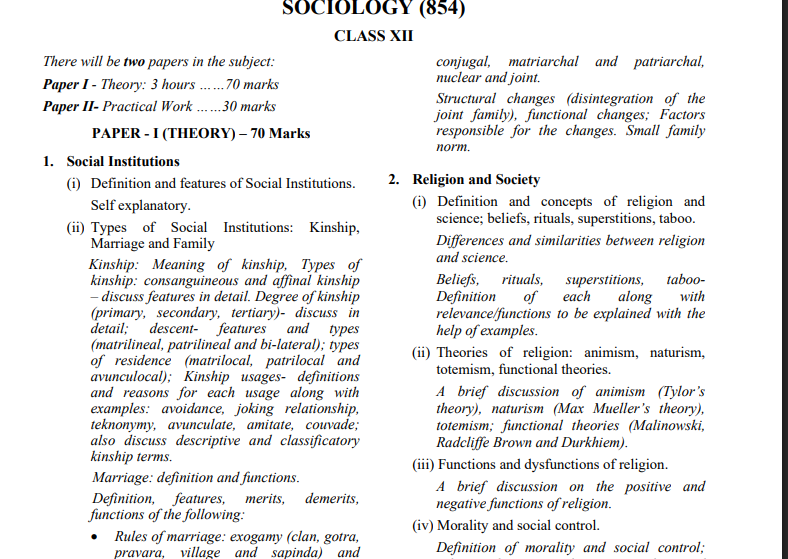
The ISC Class 12 Sociology Syllabus 2026-27 provides a comprehensive study of social institutions, structures, and changes within society. Through theoretical learning and practical research, students will develop a strong understanding of sociological concepts, focusing on Indian contexts. This syllabus aims to equip students with analytical and research skills necessary for understanding social patterns and changes.
ISC Class 12 Sociology Syllabus 2026-27
The ISC Class 12 Sociology Syllabus 2026-27 focuses on various aspects of social structures, institutions, and dynamics of change. Students will learn about topics such as kinship, family, religion, social stratification, political and economic organization, tribal India, social change, and development. The syllabus also emphasizes empirical and ethnographic studies, enabling students to gain practical knowledge by conducting two research projects related to the topics covered in theory.
Paper I – Theory (70 Marks)
1. Social Institutions
(i) Definition and Features of Social Institutions:
Social institutions are established systems of social behavior, built on norms and values that serve essential functions in society.
(ii) Types of Social Institutions: Kinship, Marriage, and Family
- Kinship
- Meaning of kinship
- Types: Consanguineous (blood-related) and affinal (marriage-related) kinship
- Degree of kinship: Primary, secondary, tertiary
- Descent: Types (matrilineal, patrilineal, bi-lateral)
- Residence types: Matrilocal, patrilocal, avunculocal
- Kinship usages: Avoidance, joking relationship, teknonymy, avunculate, amitate, couvade; descriptive and classificatory kinship terms
- Marriage
- Definition and functions of marriage
- Rules: Exogamy (clan, gotra, pravara), endogamy (caste, varna), cousin marriages (cross, parallel), levirate, sororate, hypergamy, hypogamy
- Forms: Polygamy (polyandry, polygyny), monogamy
- Family
- Definition and features (MacIver’s features)
- Functions of the family
- Types: Consanguineous, conjugal, matriarchal, patriarchal, nuclear, joint families
- Structural and functional changes in family life
2. Religion and Society
(i) Definition of Religion and Science
Understanding the concepts of beliefs, rituals, superstitions, and taboos and their relevance.
(ii) Theories of Religion
- Animism (Tylor’s theory)
- Naturism (Max Mueller)
- Totemism
- Functional theories (Malinowski, Radcliffe-Brown, Durkheim)
(iii) Functions and Dysfunctions of Religion
Exploring both positive and negative roles of religion in society.
(iv) Morality and Social Control
Definition of morality, its relation to religion, and its role in maintaining social control.
3. Political Organization
Political Organization and Social Change
Understanding political organization, Panchayati Raj, 73rd Amendment, and the role of Panchayats in empowering women and children.
4. Economic Organization
(i) Definition of Economic Organization
Explaining economic and free goods.
(ii) Economies of Indian Tribes
Descriptions of tribal economies including food gathering, agriculture, handicrafts, pastoralism, and industrial labor.
(iii) Agrarian Economy, Jajmani System, and MGNREGA
Details of land relations, caste-based occupations, and rural employment programs.
(iv) Traditional Markets
Features of weekly markets and barter systems.
5. Tribal India – Past, Present, and Future
(i) Definition and Features of Tribe
Characteristics of tribes in India.
(ii) Dormitories in Tribal India
Features and functions of tribal dormitories and their cultural significance.
(iii) Present Conditions and Problems
Addressing issues such as economic, political, social, and cultural challenges faced by tribes. Discussing government policies for tribal upliftment.
6. Social Stratification
(i) Elements of Social Stratification
Definition and features of social stratification, class, caste systems, and social mobility.
(ii) Caste System
Exploring the theory of divine origin, merits, and demerits of the caste system. A comparison of caste and class.
(iii) Gender
Difference between sex and gender, patriarchal ideologies, and gender issues in India.
7. Social Change and Development
(i) Definition of Social Change and Development
Features and sources of social change.
(ii) Aspects of Development
Definitions of industrialization, urbanization, modernization, globalization, and sustainable development.
(iii) Social Movements
Meaning, causes, and societal impact of social movements.
(iv) Role of Education in Social Change
The function of education in creating social change, with a focus on the Right to Education (RTE).
(v) Role of Mass Media in Social Change
The influence of print, electronic, and audiovisual media, as well as the Right to Information (RTI).
Paper II – Practical Work (30 Marks)
Students are required to complete two studies based on topics from the theory syllabus. Each study will be assessed by both the teacher and an external examiner.
Assessment Criteria:
| Criteria | Teacher Marks | Examiner Marks |
|---|---|---|
| Process | 1 | |
| Understanding, Knowledge, and Analysis | 2 | 3 |
| Presentation | 2 | 4 |
| Viva | 3 |
ISC Class 12 Sociology Syllabus 2026-27 PDF Download
Students can easily access the ISC Class 12 Sociology Syllabus 2026-27 in PDF format for free. The PDF will help students prepare better for both the theory and practical papers. Having the PDF on hand will make it convenient for students to keep track of important topics and requirements for their projects and exams. The syllabus can be downloaded from the official website of the CISCE or from other educational platforms that provide the updated curriculum.
ISC Class 12 Sociology Syllabus-Click Here To Download PDF
ISC Class 12 Sociology Syllabus 2026-27: FAQs
Q1. Who conducts the ISC Class 12 Sociology exam?
The exam is conducted by the Council for the Indian School Certificate Examinations (CISCE).
Q2. What is the subject code for ISC Class 12 Sociology?
The subject code for Sociology in ISC Class 12 is 67.
Q3. What is the total marks distribution?
The total marks are 100, divided as:
- Theory Exam: 80 marks
- Project Work: 20 marks
Q4. What is the exam pattern of ISC Sociology 2026–27?
The theory paper is divided into two sections:
- Section A (30 marks): Compulsory short-answer/objective questions
- Section B (50 marks): Long-answer questions (attempt any 5 out of 8)
Q5. What are the main units in the syllabus?
The syllabus includes the following key units:
- Sociological Theory & Thinkers
- Research Methods
- Family, Marriage & Kinship
- Social Stratification (Caste, Class, Gender)
- Religion, Culture & Socialisation
- Economy, Polity & Education
- Social Change & Movements in India
Q6. What is included in project work?
Project work (20 marks) includes:
- Field study / survey
- Viva voce
- Report writing & documentation
Q7. Are there any important sociologists in the syllabus?
Yes, major thinkers include:
- Auguste Comte
- Emile Durkheim
- Max Weber
- Karl Marx
Q8. Which topics are most important for scoring good marks?
High-weightage topics include:
- Social Stratification (Caste & Class)
- Sociological Theories
- Social Change & Movements
- Family & Kinship
Q9. Are NCERT books enough for preparation?
Yes, CISCE recommends NCERT Sociology books:
- Class 11: Introducing Sociology, Understanding Society
- Class 12: Indian Society, Social Change and Development in India
Q10. Is there internal choice in the paper?
Yes, students get internal choice in Section B, where they can attempt any 5 questions out of 8.
Q11. What skills are tested in the Sociology exam?
The exam tests:
- Conceptual understanding
- Analytical ability
- Application of sociological theories
- Writing skills
Q12. What are some common project topics?
Examples include:
- Changing family structure
- Gender roles in society
- Caste discrimination
- Impact of urbanisation
- Role of media in society
Q13. Is Sociology a scoring subject in ISC?
Yes, Sociology is considered a high-scoring subject if concepts are clear and answers are well-structured.
Q14. How should students prepare for ISC Sociology?
- Read NCERT thoroughly
- Focus on definitions & thinkers
- Practice previous year papers
- Use examples in answers
Q15. What is the duration of the theory exam?
The ISC Class 12 Sociology theory exam is conducted for 3 hours.
About The Author

Brajesh
Brajesh (MCA, M.Tech (IT)) is a passionate education and career content creator with a strong academic background in Computer Applications (MCA) and Technology (M.Tech). With years of hands-on experience in exam preparation strategies, syllabus analysis, and government job updates, he helps students and aspirants navigate their academic and professional journeys with clarity and confidence.