
The Jharkhand Fishery Extension Supervisor (FES) exam is conducted by the Jharkhand Staff Selection Commission (JSSC) or related recruitment boards under state agriculture/fisheries departments. Although the exact notification for 2026 may vary, the syllabus and pattern generally follow Jharkhand technical/graduate-level recruitment exams with a strong focus on fisheries science + general studies.
This article provides a complete, aspirant-friendly syllabus, exam pattern, and preparation strategy based on the latest trends.
Jharkhand Fishery Extension Supervisor Exam Pattern 2026
The exam pattern is expected to be similar to other JSSC technical exams:
Selection Process
- Written Examination (CBT/OMR)
- Document Verification
In some cases:
- Prelims + Mains (if applicants are large)
- Otherwise, Direct Mains Exam
Expected Written Exam Pattern
| Section | Subject | Questions | Marks | Duration |
|---|---|---|---|---|
| Paper 1 | General Studies + Jharkhand GK | 50–60 | 50–60 | 2 hrs |
| Paper 2 | General Science & Mathematics | 30–40 | 30–40 | 2 hrs |
| Paper 3 | Fisheries / Technical Subject | 80–100 | 80–100 | 2–2.5 hrs |
| Total | — | 150–200 | 150–200 | 4–6 hrs |
Key Features
- Objective type (MCQs)
- Negative marking possible (approx. -1 for wrong answers)
- Merit based mainly on technical paper
Jharkhand Fishery Extension Supervisor Syllabus 2026
| Section / Paper | Subjects | Topics Covered |
|---|---|---|
| Paper 1 | General Hindi | Grammar (Sandhi, Samas, Tenses), Vocabulary, Synonyms & Antonyms, Comprehension, Sentence Correction |
| Paper 2 | General Knowledge & Jharkhand GK | Current Affairs (National & International), Jharkhand History, Geography, Economy, Culture, Government Schemes |
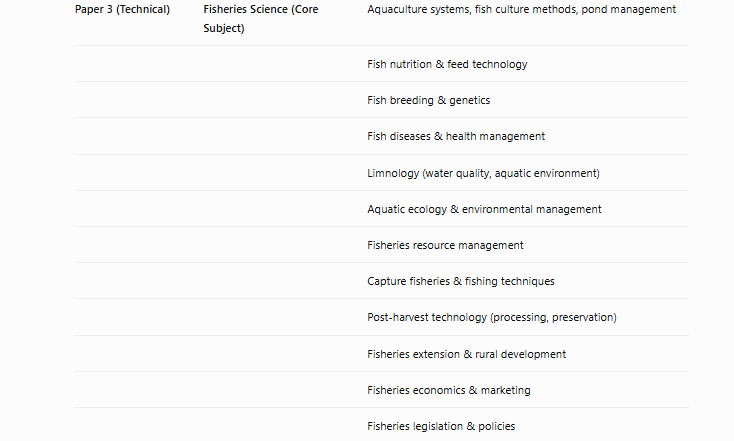
| Paper 3 (Technical) | Fisheries Science (Core Subject) | Aquaculture systems, fish culture methods, pond management |
| Fish nutrition & feed technology | ||
| Fish breeding & genetics | ||
| Fish diseases & health management | ||
| Limnology (water quality, aquatic environment) | ||
| Aquatic ecology & environmental management | ||
| Fisheries resource management | ||
| Capture fisheries & fishing techniques | ||
| Post-harvest technology (processing, preservation) | ||
| Fisheries extension & rural development | ||
| Fisheries economics & marketing | ||
| Fisheries legislation & policies |
Important Topic-wise Breakdown (Technical Section)
| Topic | Key Concepts |
|---|---|
| Aquaculture | Types of aquaculture, composite fish culture, integrated farming |
| Fish Nutrition | Nutrient requirements, feed formulation, feeding methods |
| Fish Health | Bacterial, viral, parasitic diseases & control measures |
| Limnology | Water parameters (pH, DO, temperature), productivity |
| Fish Genetics | Breeding techniques, hybridization |
| Fisheries Extension | Training programs, communication methods, rural upliftment |
| Post-Harvest | Fish preservation, cold storage, marketing chain |
| Fisheries Economics | Cost-benefit analysis, fishery business management |
These topics align with standard fisheries syllabus used in competitive exams and include aquaculture, ecology, breeding, and post-harvest management.
The syllabus is divided into 3 major sections:
1. Fisheries Science (Core Subject)
This is the most important section and carries maximum weightage.
A. Aquaculture
- Types of aquaculture (freshwater, brackish, marine)
- Pond preparation & management
- Composite fish culture
- Integrated fish farming (fish + poultry + agriculture)
- Hatchery management & seed production
B. Fish Biology & Physiology
- Fish anatomy & classification
- Reproductive systems
- Growth & metabolism
- Fish behavior
C. Fish Nutrition & Feed Technology
- Nutritional requirements
- Artificial feed formulation
- Feeding techniques
D. Fish Health Management
- Fish diseases (bacterial, viral, parasitic)
- Diagnosis & treatment
- Water quality management
E. Fisheries Resource Management
- Inland & marine fisheries
- Conservation methods
- Sustainable fishing
F. Fishing Technology
- Fishing crafts & gears
- Nets, traps, trawlers
G. Fish Processing & Preservation
- Drying, salting, freezing
- Value-added products
H. Fisheries Economics & Extension
- Fish marketing
- Government schemes
- Extension education
- Rural development programs
These topics align closely with national-level fisheries syllabus frameworks.
2. General Studies (GS)
Important Topics
- Indian History & Freedom Movement
- Geography (India + Jharkhand)
- Indian Polity & संविधान
- Economy & Budget
- Environment & Ecology
- Science & Technology
- Current Affairs
Jharkhand Special GK
- History & culture of Jharkhand
- Tribes, languages, festivals
- Minerals, industries
- Government schemes
- Important personalities
Jharkhand-specific GK has high weightage in state exams.
3. General Science & Mathematics
General Science
- Physics (basic concepts)
- Chemistry (basic reactions)
- Biology (especially agriculture & environment)
Mathematics
- Arithmetic (Profit & Loss, Percentage)
- Ratio & Proportion
- Time & Work
- Simple & Compound Interest
- Data Interpretation
4. Mental Ability / Reasoning
- Analogies
- Coding-Decoding
- Series
- Blood relations
- Direction sense
- Logical reasoning
Important Highlights
- Fisheries subject carries highest marks
- Questions are mostly concept-based + practical
- State GK plays a crucial role in selection
- Exam can be conducted in CBT or OMR mode
30-Day Study Plan for Jharkhand Fishery Extension Supervisor 2026
This 30-day smart study plan is designed to help you cover the complete syllabus of the Jharkhand Fishery Extension Supervisor (FES) exam with proper revision and practice. It prioritizes Fisheries (high weightage) while balancing GK, Science, and Maths/Reasoning.
Daily Study Structure (Follow Every Day)
- Fisheries (Core Subject) → 4–5 hours
- General Studies + Jharkhand GK → 2 hours
- Maths/Reasoning/Science → 1.5–2 hours
- Practice MCQs + Revision → 1 hour
Total: 8–10 hours/day
Week 1 (Day 1–7): Build Strong Basics
Fisheries Focus: Aquaculture & Biology
- Types of aquaculture (freshwater, marine)
- Pond preparation & management
- Fish anatomy, classification, physiology
GS + Jharkhand GK
- Jharkhand geography (rivers, minerals)
- Indian history (ancient + medieval)
Maths/Reasoning
- Percentage, Ratio
- Basic reasoning (series, analogy)
Day-wise Plan (Week 1)
| Day | Fisheries | GS & Jharkhand GK | Maths/Reasoning |
|---|---|---|---|
| Day 1 | Aquaculture basics | Jharkhand geography | Percentage |
| Day 2 | Pond management | Minerals & industries | Ratio |
| Day 3 | Fish anatomy | Ancient history | Series |
| Day 4 | Fish physiology | Medieval history | Analogy |
| Day 5 | Composite culture | Jharkhand culture | Coding-decoding |
| Day 6 | Integrated farming | Revision GS | Practice |
| Day 7 | Weekly revision | Mock test | Mock test |
Week 2 (Day 8–14): Strengthen Core Fisheries
Fisheries Focus
- Fish nutrition & feed
- Fish diseases & health management
- Water quality
GS
- Indian Polity
- Jharkhand schemes
Maths/Reasoning
- Profit & Loss
- Time & Work
Weekly Plan
| Day | Fisheries | GS | Maths |
|---|---|---|---|
| Day 8 | Nutrition basics | Constitution | Profit & Loss |
| Day 9 | Feed formulation | Fundamental rights | Time & Work |
| Day 10 | Fish diseases | Jharkhand schemes | SI/CI |
| Day 11 | Parasites & treatment | Economy basics | DI |
| Day 12 | Water quality | Budget | Reasoning |
| Day 13 | Revision | Revision | Practice |
| Day 14 | Full mock test | Analysis | Weak areas |
Week 3 (Day 15–21): Advanced Topics + Practice
Fisheries Focus
- Fisheries economics
- Fishing technology
- Fish processing & preservation
GS
- Environment & Ecology
- Current Affairs
Maths/Reasoning
- Mixed practice
Weekly Plan
| Day | Fisheries | GS | Maths |
|---|---|---|---|
| Day 15 | Fishing gears | Environment | Mixed |
| Day 16 | Fish marketing | Ecology | Mixed |
| Day 17 | Processing | Current affairs | DI |
| Day 18 | Preservation | Science tech | Reasoning |
| Day 19 | Economics | Revision | Practice |
| Day 20 | Full revision | Revision | Practice |
| Day 21 | Full mock test | Analysis | Weak areas |
Week 4 (Day 22–30): Revision + Mock Tests
Focus
- Complete revision
- Practice maximum MCQs
- Improve speed & accuracy
Final Phase Plan
| Day | Task |
|---|---|
| Day 22 | Fisheries full revision (Aquaculture) |
| Day 23 | Fisheries revision (Diseases & nutrition) |
| Day 24 | Fisheries revision (Economics & processing) |
| Day 25 | GS full revision |
| Day 26 | Jharkhand GK revision |
| Day 27 | Maths & reasoning revision |
| Day 28 | Full mock test |
| Day 29 | Weak areas + revision |
| Day 30 | Final mock + quick notes |
Preparation Strategy
Subject-wise Tips
Fisheries
- Focus on aquaculture + disease management
- Study ICAR-level basics
GS & Jharkhand GK
- Read Jharkhand GK book
- Follow current affairs (last 6–12 months)
Maths & Reasoning
- Practice daily (easy scoring section)
Best Books (Suggested)
- Fisheries Science – ICAR Notes
- Lucent GK
- Jharkhand General Knowledge Book
- RS Aggarwal (Maths & Reasoning)
Final Words
The Jharkhand Fishery Extension Supervisor 2026 exam is a great opportunity for candidates with a fisheries or agriculture background. The key to success lies in:
- Strong grip on technical fisheries subjects
- Good command of Jharkhand GK
- Regular practice of MCQs
About The Author
