
The Kuwait Grade 2 Arabic Curriculum (2026–27) is designed to build strong foundational language skills among young learners. Guided by the Kuwait Ministry of Education, the curriculum focuses on developing communication, literacy, and cultural awareness through structured and engaging learning experiences. Arabic is not only taught as a subject but also as a tool for thinking, expression, and understanding cultural identity.
Kuwait Grade 2 Arabic Curriculum 2026-27 Objectives
The primary aim of the Grade 2 Arabic curriculum is to help students:
- Develop basic reading and writing proficiency
- Improve listening and speaking skills
- Understand simple grammar and sentence structure
- Build vocabulary related to daily life
- Appreciate Arabic culture, values, and traditions
The curriculum emphasizes interaction with different types of texts—spoken, written, and visual—to strengthen communication skills.
Grade 2 Arabic Curriculum: Key Learning Areas
1. Reading Skills (القراءة)
- Recognition of letters, words, and short sentences
- Reading simple stories and passages
- Understanding meaning through context
- Answering basic comprehension questions
Activities such as reading worksheets and story-based exercises are commonly used to enhance comprehension.
2. Writing Skills (الكتابة)
- Writing Arabic letters correctly
- Forming words and simple sentences
- Practicing handwriting and spelling
- Expressing ideas through short paragraphs
Students gradually move from copying words to creating their own sentences.
3. Grammar & Language Structure (القواعد)
- Basic sentence formation (noun + verb)
- Introduction to pronouns and connectors
- Understanding simple grammatical rules
- Using correct word order
Exercises like pronoun cards and conjunction practice help reinforce grammar concepts.
4. Listening & Speaking (الاستماع والتحدث)
- Listening to short stories and instructions
- Responding to questions orally
- Participating in classroom discussions
- Practicing pronunciation and fluency
Interactive storytelling and role-play are widely used.
5. Vocabulary Development (المفردات)
- Everyday vocabulary (family, school, nature)
- Word-picture association activities
- Expanding vocabulary through reading
- Using new words in sentences
6. Cultural & Moral Learning
- Learning about Kuwaiti traditions and values
- Understanding social behavior and respect
- Exposure to simple literary texts and poems
The curriculum integrates language learning with cultural identity and moral development.
Teaching Methodology
The curriculum adopts a student-centered approach, including:
- Activity-based learning (worksheets, games, storytelling)
- Visual and digital learning tools
- Group discussions and collaborative tasks
- Continuous assessment through class participation
Modern reforms in Kuwait’s education system also emphasize technology integration and interactive teaching methods.
Assessment Pattern
Assessment is continuous and includes:
- Reading comprehension tests
- Dictation and writing exercises
- Oral presentations and participation
- Homework and classroom activities
Teachers evaluate both language accuracy and communication skills.
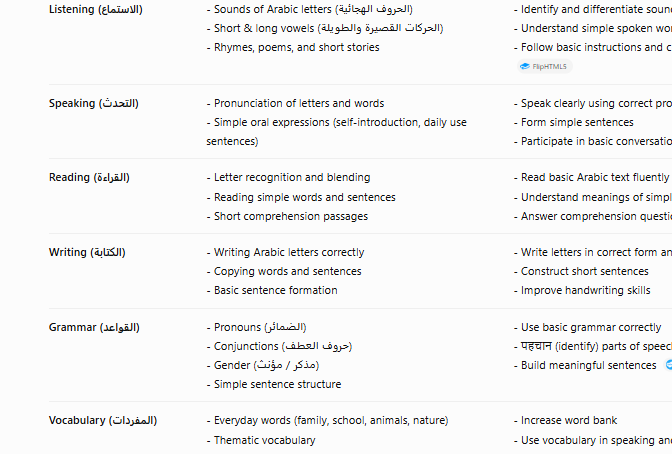
Kuwait Grade 2 Arabic Curriculum 2026–27
Kuwait Grade 2 Arabic Curriculum (2026–27) based on the Kuwait Ministry of Education framework and typical Grade 2 language progression.
| Unit / Strand | Topics / Content | Learning Outcomes / Skills Developed |
|---|---|---|
| Listening (الاستماع) | – Sounds of Arabic letters (الحروف الهجائية) – Short & long vowels (الحركات القصيرة والطويلة) – Rhymes, poems, and short stories |
– Identify and differentiate sounds – Understand simple spoken words & sentences – Follow basic instructions and classroom commands |
| Speaking (التحدث) | – Pronunciation of letters and words – Simple oral expressions (self-introduction, daily use sentences) |
– Speak clearly using correct pronunciation – Form simple sentences – Participate in basic conversations |
| Reading (القراءة) | – Letter recognition and blending – Reading simple words and sentences – Short comprehension passages |
– Read basic Arabic text fluently – Understand meanings of simple texts – Answer comprehension questions |
| Writing (الكتابة) | – Writing Arabic letters correctly – Copying words and sentences – Basic sentence formation |
– Write letters in correct form and sequence – Construct short sentences – Improve handwriting skills |
| Grammar (القواعد) | – Pronouns (الضمائر) – Conjunctions (حروف العطف) – Gender (مذكر / مؤنث) – Simple sentence structure |
– Use basic grammar correctly – पहचान (identify) parts of speech – Build meaningful sentences |
| Vocabulary (المفردات) | – Everyday words (family, school, animals, nature) – Thematic vocabulary |
– Increase word bank – Use vocabulary in speaking and writing |
| Comprehension (الفهم) | – Reading comprehension exercises – Story-based questions |
– Understand main ideas – Retell stories – Answer questions logically |
| Literature & Activities | – Poems and short stories – Storytelling and role-play |
– Develop imagination and expression – Improve listening & speaking skills |
| Phonics & Spelling (الإملاء) | – Letter sounds and blending – Dictation of simple words |
– Improve spelling accuracy – Recognize sound-letter relationships |
| Handwriting (الخط) | – Letter formation and spacing – Writing practice exercises |
– Develop neat and legible handwriting |
Key Features of the Curriculum
- Focus on four core skills: Listening, Speaking, Reading, Writing
- Emphasis on phonics and pronunciation at early stage
- Gradual introduction to basic grammar and sentence formation
- Use of stories, poems, and activities to enhance engagement
- Development of communication and cultural awareness
Kuwait Grade 2 Arabic Curriculum Chapter wise
Chapter / Lesson Names for Kuwait Grade 2 Arabic Curriculum (2026–27) divided into Term 1 and Term 2, based on official textbook structures (“لغتي العربية”) used in Kuwait.
Term 1 (الفصل الدراسي الأول)
Unit 1: أوقات المرح (Fun Times)
| Lesson No. | Lesson Name (Arabic) | Meaning (English) |
|---|---|---|
| 1 | دبدوب الرسام | Teddy the Painter |
| 2 | من أنا؟ | Who Am I? |
| 3 | صحتي في رياضتي | My Health in Sports |
| 4 | سعاد في الحديقة | Souad in the Garden |
| 5 | قوانين اللعب | Rules of Play |
| 6 | ألعابي | My Games |
Unit 2: الأماكن الجميلة (Beautiful Places)
| Lesson No. | Lesson Name (Arabic) | Meaning (English) |
|---|---|---|
| 1 | مدينتي الجميلة | My Beautiful City |
| 2 | في المدرسة | At School |
| 3 | في المكتبة | In the Library |
| 4 | رحلة إلى البحر | Trip to the Sea |
| 5 | الحديقة العامة | Public Park |
Unit 3: يومياتي (My Daily Life)
| Lesson No. | Lesson Name (Arabic) | Meaning (English) |
|---|---|---|
| 1 | يومي في المنزل | My Day at Home |
| 2 | أستيقظ مبكرًا | I Wake Up Early |
| 3 | نظافتي | My Cleanliness |
| 4 | واجباتي | My Duties |
| 5 | أحب عائلتي | I Love My Family |
These 3 units form the core structure of the Term 1 Arabic textbook
Term 2 (الفصل الدراسي الثاني)
Unit 1: أنا والناس (Me and People)
| Lesson No. | Lesson Name (Arabic) | Meaning (English) |
|---|---|---|
| 1 | أنا وأقاربي | Me and My Relatives |
| 2 | أنا أعمل | I Work |
| 3 | بائع العسل وبائع الخل | Honey Seller & Vinegar Seller |
| 4 | هيا نقارن | Let’s Compare |
| 5 | كتابتي صحيحة | My Writing is Correct |
Unit 2: البيئة من حولي (Environment Around Me) (typical theme-based unit)
| Lesson No. | Lesson Name (Arabic) | Meaning (English) |
|---|---|---|
| 1 | الحيوانات حولنا | Animals Around Us |
| 2 | النباتات الجميلة | Beautiful Plants |
| 3 | المحافظة على البيئة | Protecting the Environment |
| 4 | الماء نعمة | Water is a Blessing |
Unit 3: قيم وسلوك (Values & Behavior) (skill-based unit)
| Lesson No. | Lesson Name (Arabic) | Meaning (English) |
|---|---|---|
| 1 | الصدق | Honesty |
| 2 | التعاون | Cooperation |
| 3 | احترام الآخرين | Respecting Others |
| 4 | النظام | Discipline |
Term 2 includes units like “أنا والناس” with lessons such as أنا وأقاربي and بائع العسل وبائع الخل
Term-wise Focus (Overview)
| Term | Focus Areas |
|---|---|
| Term 1 | Alphabet revision, basic reading, simple vocabulary |
| Term 2 | Sentence formation, grammar basics, short writing |
| Term 3 | Reading fluency, comprehension, creative expression |
Importance of Arabic in Grade 2
Arabic learning at this stage is crucial because it:
- Builds a strong literacy foundation
- Enhances communication and thinking skills
- Strengthens cultural identity
- Prepares students for advanced subjects in later grades
Conclusion
The Kuwait Grade 2 Arabic Curriculum 2026–27 is a well-structured program that balances language skills with cultural education. By focusing on reading, writing, grammar, and communication, it ensures that students develop confidence in using Arabic in everyday life. With modern teaching strategies and continuous assessment, the curriculum supports holistic language development and prepares learners for future academic success.
About The Author
