
In 2026, the world’s longest tunnels continue to redefine the limits of human engineering, carving paths through mountains, under seas, and beneath extreme landscapes for both railways and highways.
Deep beneath the Swiss Alps, the Gotthard Base Tunnel remains the undisputed champion among railway tunnels. Stretching 57.1 kilometres (about 35.5 miles) between Erstfeld and Bodio, this twin-tube masterpiece opened in 2016 and still holds the title of the longest railway tunnel in operation. It allows high-speed passenger trains and heavy freight to glide through the Alps at near sea-level gradients, slashing journey times and shifting cargo from roads to rails. Close behind are Japan’s Seikan Tunnel (53.85 km, with a major undersea section) and the Channel Tunnel (50.45 km) linking the UK and France.
Meanwhile, on the highway side, Norway’s Lærdal Tunnel retains its crown as the longest road tunnel in the world at 24.51 kilometres (15.23 miles). Opened in 2000 on the E16 between Aurland and Lærdal, it provides a ferry-free, all-weather link between Oslo and Bergen. Its innovative design—with three large mountain caverns featuring special lighting every few kilometres—helps combat driver fatigue on the roughly 20-minute journey. Newer contenders like China’s Tianshan Shengli Tunnel (approximately 22.1 km, opened in late 2025) and Australia’s WestConnex system have closed the gap, but Lærdal still leads.
Looking ahead, ambitious projects are already rewriting the record books. The Brenner Base Tunnel between Austria and Italy achieved major breakthroughs in 2026; when fully operational (expected around 2032) and combined with the Innsbruck bypass, it will create a continuous underground railway connection of about 64 km—the longest of its kind. On the road front, Norway’s Rogfast Tunnel (around 26.7 km) is set to claim the road-tunnel record in the early 2030s while also becoming the deepest undersea road tunnel.
These subterranean giants are more than feats of concrete and steel. They embody decades of innovation in geology, ventilation, safety systems, and environmental protection. From shifting Alpine freight to rail, enabling year-round connectivity in remote mountain regions, and shrinking travel times across continents, the longest tunnels of 2026 show how far engineering has come—and how much further it continues to push.
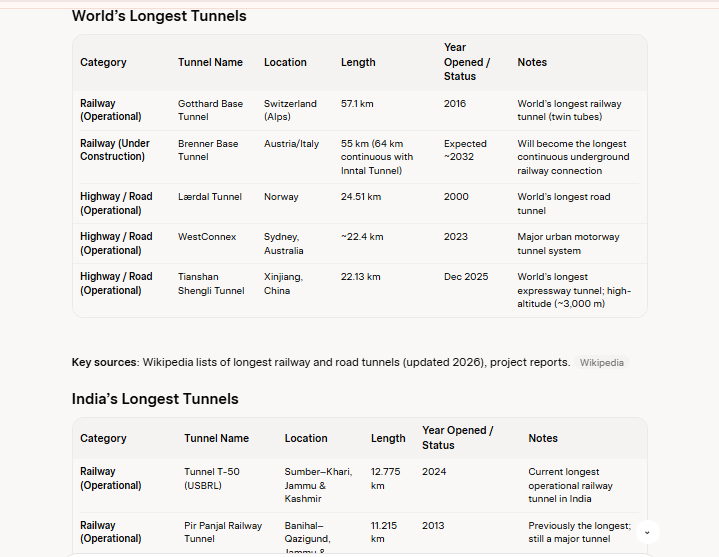
World’s Longest Tunnels
| Category | Tunnel Name | Location | Length | Year Opened / Status | Notes |
|---|---|---|---|---|---|
| Railway (Operational) | Gotthard Base Tunnel | Switzerland (Alps) | 57.1 km | 2016 | World’s longest railway tunnel (twin tubes) |
| Railway (Under Construction) | Brenner Base Tunnel | Austria/Italy | 55 km (64 km continuous with Inntal Tunnel) | Expected ~2032 | Will become the longest continuous underground railway connection |
| Highway / Road (Operational) | Lærdal Tunnel | Norway | 24.51 km | 2000 | World’s longest road tunnel |
| Highway / Road (Operational) | WestConnex | Sydney, Australia | ~22.4 km | 2023 | Major urban motorway tunnel system |
| Highway / Road (Operational) | Tianshan Shengli Tunnel | Xinjiang, China | 22.13 km | Dec 2025 | World’s longest expressway tunnel; high-altitude (~3,000 m) |
Key sources: Wikipedia lists of longest railway and road tunnels (updated 2026), project reports.
India’s Longest Tunnels
| Category | Tunnel Name | Location | Length | Year Opened / Status | Notes |
|---|---|---|---|---|---|
| Railway (Operational) | Tunnel T-50 (USBRL) | Sumber–Khari, Jammu & Kashmir | 12.775 km | 2024 | Current longest operational railway tunnel in India |
| Railway (Operational) | Pir Panjal Railway Tunnel | Banihal–Qazigund, Jammu & Kashmir | 11.215 km | 2013 | Previously the longest; still a major tunnel |
| Railway (Under Construction / Nearing Operational) | Tunnel T-8 (Rishikesh–Karnaprayag) | Devprayag–Janasu, Uttarakhand | 14.57 km | Excavation completed 2025; expected operational Dec 2026 | Will become India’s longest railway tunnel once open |
| Highway / Road (Operational) | Dr. Syama Prasad Mookerjee Tunnel (Chenani–Nashri) | Jammu & Kashmir | 9.28 km | 2017 | Longest fully operational highway tunnel in India |
| Highway / Road (Operational) | Atal Tunnel | Himachal Pradesh | 9.02 km | 2020 | High-altitude strategic tunnel |
| Highway / Road (Under Construction) | Zojila Tunnel | Baltal (J&K)–Minamarg (Ladakh) | 13.15 km | Breakthrough June 2026; expected operational ~2028 | Will become India’s longest road tunnel; world’s longest single-tube bi-directional high-altitude road tunnel |
Longest Tunnel in India
India’s ambitious push for all-weather connectivity in the Himalayas and other challenging terrains has produced some of the most impressive engineering feats in its infrastructure history. By 2026, both the railway and highway networks feature record-breaking tunnels that dramatically cut travel times, enhance strategic mobility, boost tourism and trade, and improve safety by bypassing snowbound, landslide-prone, or circuitous mountain routes.
Longest Tunnel in India: Railway Tunnels- Himalayan Breakthroughs Dominate
As of 2026, the longest railway tunnel in India is Tunnel No. 8 (T-8 / Janasu Tunnel) on the Rishikesh–Karnaprayag Rail Link Project in Uttarakhand.
- Length: Approximately 14.57–14.58 km (upline; parallel downline ~13.09 km).
- Location: Between Devprayag and Janasu in the Garhwal Himalayas.
- Status: Breakthrough achieved in April 2025 (ahead of schedule); full operationalisation targeted for December 2026 as part of the 125 km broad-gauge line.
- Significance: Built by Larsen & Toubro for Rail Vikas Nigam Limited (RVNL). About 10.4 km was bored using a large single-shield Tunnel Boring Machine (TBM “Shakti,” 9.11 m diameter — the largest deployed in the Himalayan region), with the rest completed via the New Austrian Tunnelling Method (NATM). It will slash travel time between Rishikesh and Karnaprayag from around 7 hours by road to about 2 hours by rail, supporting the Char Dham Yatra and regional connectivity across five districts.
This surpasses the previous record holders from the Udhampur–Srinagar–Baramulla Rail Link (USBRL) project in Jammu & Kashmir:
| Rank | Tunnel | Length | Location / Project | Notes |
|---|---|---|---|---|
| 1 | T-8 (Janasu / Devprayag) | ~14.57 km | Rishikesh–Karnaprayag, Uttarakhand | Longest as of 2026; TBM + NATM |
| 2 | Tunnel T-50 (or T-49 in some references) | 12.775 km | Sumber–Khari, USBRL, J&K | Previously longest operational/under advanced construction |
| 3 | Pir Panjal Railway Tunnel (T-80) | 11.215 km | Banihal–Qazigund / Hillar Shahabad, J&K | Opened 2013; long-time record holder; NATM construction |
| 4 | Tunnel T-44 | ~11.13 km | Sawalkote–Sangaldan, USBRL | Part of the dense cluster of long tunnels in the Himalayas |
| 5 | Tunnel T-49 / Sangaldan-related | ~10.18 km or earlier 7–8 km references | Sangaldan area, USBRL | Key link in Kashmir connectivity |
Other notable railway tunnels include the Karbude Tunnel (~6.5 km) on the Konkan Railway and various tunnels on the Northeast Frontier Railway lines. The USBRL project alone hosts multiple tunnels over 5–12 km, transforming year-round rail access to the Kashmir Valley. Future projects (e.g., high-speed rail tunnels or further Himalayan links) may set even longer records later in the decade.
Engineering highlights for railway tunnels: Modern tunnels feature ballastless tracks, 25 kV electrification with rigid catenary, SCADA-controlled ventilation, multi-tier escape passages, and compliance with Railway Board safety codes. Construction in the young, geologically active Himalayas involves dealing with high water ingress, varying rock quality, and seismic risks.
Longest Tunnel in India: Highway (Road) Tunnels- Strategic High-Altitude Links
For highways, 2026 marks a major shift with the Zojila (Zoji-La) Tunnel emerging as India’s longest road tunnel.
- Length: 13.15 km (main tunnel; total project ~30 km including approaches).
- Location: Under Zojila Pass between Baltal/Sonamarg (Jammu & Kashmir) and Minamarg/Drass (Ladakh), at an altitude of about 11,578 feet (3,528 m).
- Status: Final breakthrough achieved in June 2026; full operationalisation expected around 2027–2028 as part of a larger network (including the Z-Morh tunnel).
- Significance: Single-tube bi-directional design using NATM. It provides all-weather connectivity between the Kashmir Valley and Ladakh, reducing travel time on the critical stretch from 1.5–3+ hours (often blocked by snow/avalanches) to 15–45 minutes. Strategically vital for civilian, tourist, and defence movement near the borders. Cost estimates around ₹6,500–6,800 crore. Built by Megha Engineering & Infrastructures Ltd (MEIL) for NHIDCL.
Previous record holders and other major operational highway tunnels include:
| Rank (approx. 2026) | Tunnel | Length | Location | Notes |
|---|---|---|---|---|
| 1 | Zojila Tunnel | 13.15 km | J&K–Ladakh | Longest road tunnel; high-altitude bi-directional |
| 2 | Dr. Syama Prasad Mookerjee Tunnel (Chenani–Nashri / Patnitop) | 9.28 km | NH-44, Jammu & Kashmir | Opened 2017; previously longest; twin-tube (main + escape) with transverse ventilation |
| 3 | Atal Tunnel (Rohtang) | 9.02 km | NH-3, Himachal Pradesh | Opened 2020; world’s longest highway tunnel above 10,000 ft; connects Manali to Lahaul-Spiti |
| — | Sela Tunnel complex | Total project ~12 km (tunnels themselves shorter: ~1 km + 1.55 km) | Arunachal Pradesh (NH-13) | World’s longest bi-lane tunnel above ~13,000 ft; inaugurated 2024; all-weather link to Tawang |
The Atal Tunnel remains iconic as the highest long highway tunnel, reducing Manali–Keylong travel dramatically and ensuring year-round access to Lahaul-Spiti (previously cut off for months). The Dr. Syama Prasad Mookerjee Tunnel features advanced integrated control systems and was the first in India with fully transverse ventilation.
Other significant road tunnels include those on the Mumbai–Pune Expressway (widest in some categories), urban links, and strategic ones like Z-Morh. Emerging projects such as the Shinku La Tunnel (world’s highest motorable tunnel under construction at ~15,800 ft / 4.1 km twin-tube, Himachal–Ladakh link, target ~2028) continue the high-altitude focus.
Key benefits of these highway tunnels:
- All-weather connectivity in snow-prone regions.
- Reduced distances and travel times (often by hours).
- Enhanced safety by avoiding avalanche zones and hairpin bends.
- Strategic advantages for border areas.
- Economic boosts via tourism, trade, and local development.
Broader Context and Future Outlook in India
India’s tunnel boom is driven by projects under the Ministry of Railways, NHAI, NHIDCL, BRO, and state agencies. Techniques like NATM and advanced TBMs have enabled progress in difficult geology. Challenges remain: extreme weather, high costs, environmental sensitivity in the Himalayas, and the need for robust maintenance (ventilation, fire safety, monitoring).
By late 2026, the combination of the ~14.6 km railway tunnel in Uttarakhand and the 13+ km Zojila road tunnel represents a new benchmark. These, alongside the established Pir Panjal rail link, Atal Tunnel, and Chenani-Nashri Tunnel, form the backbone of India’s modern mountain transport network—literally carving pathways through some of the world’s most formidable terrain.
Longest Tunnel in The World
As of mid-2026, the world’s longest transport tunnels continue to redefine what is possible in civil engineering. These subterranean giants pierce mountain ranges, cross underseas, and carve through dense urban areas, enabling faster travel, heavier freight volumes, safer routes, and major reductions in carbon emissions by shifting traffic from roads to rail. While water-supply tunnels remain the absolute longest structures overall (such as the Delaware Aqueduct at 137 km), the records for dedicated railway and highway tunnels tell a story of relentless ambition, especially in the Alps, East Asia, and Scandinavia.
Longest Tunnel in the World for Railways: Gotthard Still Reigns, But the Crown Is Contested
1. Gotthard Base Tunnel (Switzerland) – 57.1 km Opened in 2016, the Gotthard Base Tunnel remains the longest railway tunnel in operation in the world. Running beneath the Swiss Alps between Erstfeld and Bodio, it consists of two single-track tubes and forms the centerpiece of Switzerland’s New Rail Link through the Alps (NRLA).
Key facts:
- Maximum overburden: approximately 2,300–2,500 m (one of the deepest railway tunnels).
- Design speed: up to 250 km/h.
- Journey time through the tunnel: about 20 minutes.
- Impact: Dramatically shortened Zurich–Milan travel times and massively increased freight capacity on the Rotterdam–Basel–Genoa corridor, supporting a modal shift from trucks to trains.
It is also the world’s longest continuous railway tunnel by geodetic (straight-line) distance between portals.
2. Seikan Tunnel (Japan) – 53.85 km Opened in 1988, this undersea giant links the islands of Honshu and Hokkaido under the Tsugaru Strait. Roughly 23.3 km lies beneath the seabed, making it the longest undersea railway tunnel. It carries both conventional and Shinkansen high-speed trains and remains a critical freight and passenger artery.
3. Channel Tunnel (UK–France) – 50.45 km Opened in 1994, the “Chunnel” runs under the English Channel between Folkestone and Coquelles. About 38 km is undersea — the longest undersea section of any railway tunnel. It carries Eurostar passenger trains, freight, and vehicle shuttle services.
4. Yulhyeon Tunnel (South Korea) – 50.3 km Opened in 2016 as part of the Suseo–Pyeongtaek high-speed line, this tunnel supports trains operating at up to 240–300 km/h and ranks as one of the longest pure high-speed rail tunnels.
Other notable operational tunnels include China’s Songshan Lake Tunnel (~38.8 km), Switzerland’s Lötschberg Base Tunnel (34.6 km), and Austria’s newly opened Koralm Tunnel (32.9 km), which entered full service in December 2025 as part of the Koralm Railway linking Graz and Klagenfurt. The Koralm Tunnel is now Austria’s longest railway tunnel and ranks among the top six or seven worldwide.
Under Construction / Soon to Reshape the Rankings
- Brenner Base Tunnel (Austria–Italy): Main bores ~55 km. When combined with the existing Innsbruck (Inntal) bypass, the continuous underground railway connection will reach approximately 64 km, making it the longest continuous railway tunnel system in the world upon opening (expected around 2032). Main tunnel breakthrough occurred in July 2026.
- Mont d’Ambin (Mont Cenis) Base Tunnel (France–Italy): ~57.5 km, part of the Lyon–Turin high-speed line (expected early 2030s).
- Several long tunnels on China’s Sichuan–Tibet railway (Yigong ~42 km and others) are also advancing.
In 2026, the Gotthard Base Tunnel still holds the operational record, but the Alpine base-tunnel projects will rewrite the list within the next decade.
Longest Tunnel in The World: Highway / Road Tunnels: Norway’s Record Holds, China Surges Forward
1. Lærdal Tunnel (Norway) – 24.51 km Opened in 2000, the Lærdal Tunnel on the E16 between Lærdal and Aurland remains the world’s longest road tunnel. It completed a continuous all-weather highway link between Oslo and Bergen without ferries or high mountain passes.
Distinctive features include large “mountain halls” every few kilometres with special blue and yellow lighting designed to combat driver fatigue and monotony. Speed limit is typically 80 km/h.
2. WestConnex (Sydney, Australia) – ~22.4 km Completed in stages and fully operational by 2023, this complex of connected tunnels (M4 East, M8, and the M4–M8 Link) forms one of the longest continuous urban road tunnel systems. It significantly reduces surface congestion in Sydney.
3. Tianshan Shengli (Victory) Tunnel (Xinjiang, China) – 22.13 km Opened to traffic in December 2025, this twin-tube expressway tunnel on the G0711 Ürümqi–Yuli Expressway is the world’s longest highway/expressway tunnel and the longest road tunnel at high altitude (portals and alignment in the 3,000+ m range).
It cuts the crossing of the central Tianshan Mountains from several hours (or a long detour) to about 20 minutes and reduces Ürümqi–Korla travel time dramatically. Maximum overburden exceeds 1,100 m, and it features one of the deepest ventilation shafts (~700 m) ever built for a road tunnel. Construction crossed 16 major fault zones under extreme cold, high ground stress, and strict environmental constraints.
Other major road tunnels:
- Yamate Tunnel (Tokyo, Japan) – 18.2 km (longest urban road tunnel).
- Zhongnanshan Tunnel (China) – 18.04 km.
- Jinpingshan Tunnel (China) – 17.54 km.
- St. Gotthard Road Tunnel (Switzerland) – 16.9 km.
Future Contender
Norway’s Rogfast Tunnel (~26.7 km, including undersea sections) is under construction and is expected to become the world’s longest road tunnel and the deepest undersea road tunnel (nearly 400 m below sea level) when completed in the early 2030s.
Why These Tunnels Matter
- Freight capacity and sustainability: Alpine base tunnels like Gotthard and the forthcoming Brenner shift massive volumes of goods from trucks to rail, cutting emissions and reducing road congestion.
- All-weather connectivity: High-altitude and mountain tunnels (Tianshan Shengli, Lærdal, Atal Tunnel in India, etc.) eliminate seasonal closures caused by snow and avalanches.
- Urban relief: Projects such as WestConnex and Yamate remove traffic from city streets.
- Engineering extremes: Modern tunnels demand advanced tunnel-boring machines, sophisticated ventilation and fire-safety systems, real-time AI monitoring, and solutions for high rock pressure, water ingress, and seismic activity.
Looking Ahead for the World
By the early 2030s, the Brenner Base Tunnel (with Innsbruck connection) is poised to claim the title of longest continuous railway tunnel, while Rogfast is expected to take the road-tunnel crown. China’s continued infrastructure push and Europe’s Trans-European Transport Network (TEN-T) investments ensure that the list of record holders will keep evolving.
About The Author
