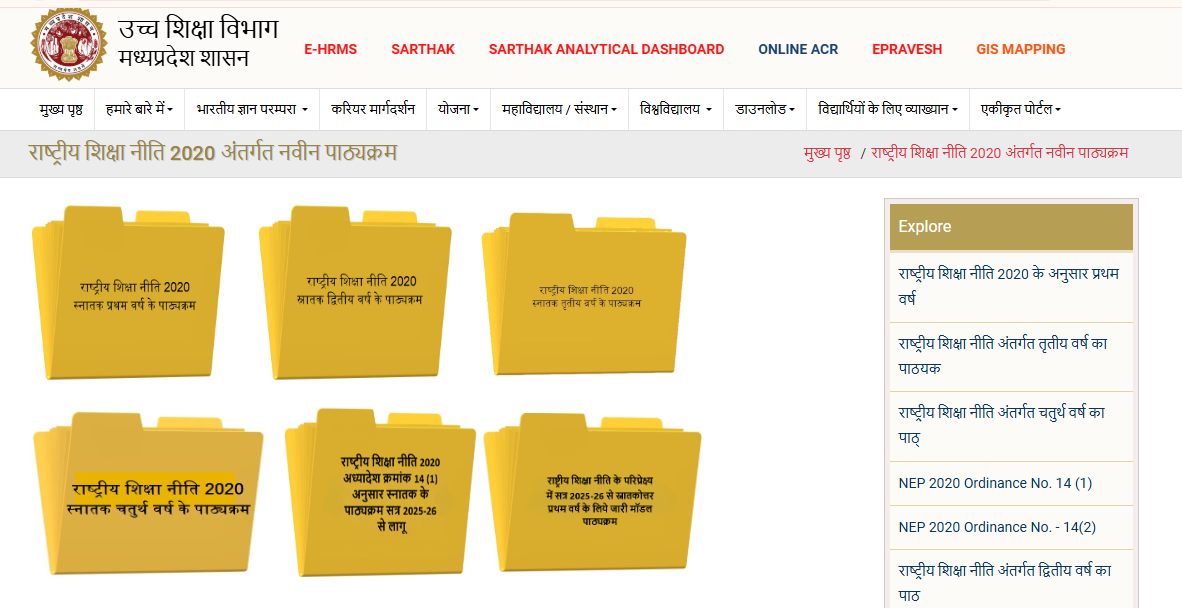
mphighereducation syllabus 2026: The academic landscape of Madhya Pradesh is undergoing a significant transformation in 2026, driven primarily by the implementation of the National Education Policy (NEP) 2020. For students, teachers, and parents alike, understanding the new MP Higher Education Syllabus structure is crucial for academic success. This guide provides a detailed, aspirant-friendly breakdown of the MP Higher Education syllabus for 2026, covering undergraduate, postgraduate, and professional courses across all streams.
Key Features of MP Higher Education Syllabus 2026
- Based on NEP 2020 guidelines
- Includes Core + Elective + Skill-based subjects
- Follows the semester system (CBCS pattern)
- Focus on practical learning, internships & projects
- Provides multiple entry-exit options and a credit transfer system
The NEP 2026 Shift: What You Need to Know
The most significant development for Madhya Pradesh’s higher education is the adoption of the NEP-2020 curriculum, effective from the 2025-26 academic session. This is not just a change in textbooks but a fundamental shift towards a more multidisciplinary, flexible, and skill-oriented education system.
Key changes under NEP include:
-
Flexible Credit Systems: Students can now choose subjects across streams, breaking the rigid silos of Science, Commerce, and Arts.
-
Multiple Entry and Exit Options: This allows students to earn certificates, diplomas, or degrees based on the duration of their study, making education more inclusive.
-
Focus on Practical and Vocational Skills: The curriculum integrates internships, projects, and vocational training to enhance employability.
Undergraduate (UG) Syllabus: mphighereducation syllabus 2026 Stream-Wise Breakdown
The year-wise syllabus structure is being revised to align with NEP. Here is how the 2026 syllabus looks for major undergraduate streams.
1. Science Stream (B.Sc.)
The Science syllabus balances core theoretical knowledge with practical applications.
B.Sc. (Home Science) Syllabus: A Case Study
A detailed look at the B.Sc. Home Science syllabus for the first semester, as prescribed by the Department of Higher Education, Govt. of M.P., showcases the new semester-wise structure.
-
Paper-I Anatomy & Physiology: This foundational paper covers the structure and functions of the human body. Units include the Cell, Circulatory, Digestive, Respiratory, Nervous, and Reproductive Systems. Practicals involve microscopic examinations, blood group identification, and first-aid techniques.
-
Paper-II Introduction to Resource Management: This paper introduces the principles of management, decision-making, and the management process (Planning, Controlling, Evaluation). Practicals include planning events and formulating family goals.
-
Paper-III Introduction to Human Development: It covers the scope and principles of human development, focusing on early childhood care, the ICDS programme, and the influence of heredity and environment.
-
Paper-IV Introduction to Textiles & Clothing: Students learn about natural and artificial fibers, yarn types, fabric finishes, and weaves. Practicals involve the identification of fibers and weaves.
-
Paper-V Introduction to Extension Communication: This paper focuses on family as a social unit, women’s empowerment, and legal issues, integrating social sciences with home science.
-
Paper-VI Computer Basics: A crucial paper for digital literacy, covering MS Windows, MS Word, MS Excel, and MS PowerPoint.
2. Commerce Stream (B.Com.)
For commerce students, the syllabus is designed to build a strong foundation in accounting and business principles.
B.Com. 1st Year (Major-2 – Cost Accounting):
-
The syllabus for Cost Accounting for the 2025-26 session includes core topics such as Cost Concepts, Material Control, Labour Cost Control, Overheads, and Single/Unit or Output Costing.
-
More advanced topics in the later units include Marginal Costing, Break-Even Analysis, and Standard Costing.
Class 11 Commerce (Pre-University Foundation):
The foundation for higher education is laid at the 11th-grade level with detailed syllabi for Accountancy, Economics, and Business Studies.
-
Accountancy: Covers the Fundamentals of Accounting, Partnership, and Company Accounts.
-
Economics: Divided into Microeconomics and Macroeconomics, covering Consumer Behaviour, National Income, Money and Banking.
-
Business Studies: Introduces the principles of management, business environment, and functions like planning, organising, and controlling.
3. Arts / Humanities Stream (B.A.)
The 2026 syllabus for arts subjects emphasises a deep understanding of human society and the environment.
B.A. 3rd Year Geography:
For a comprehensive third-year syllabus, the focus shifts to specialised areas:
-
Unit I: Geography of India: Covers India’s physical features, drainage, climate, resources, economy, and a specific focus on Madhya Pradesh’s geography, resources, and tribal population.
-
Unit II: Environment and Resource Management: This unit is crucial for understanding contemporary environmental issues. It includes Environmental Degradation, Disaster Management, Biodiversity, Sustainable Development, and Environmental Laws.
-
Unit III: Practical Geography: Students learn practical skills in data processing, map projections, remote sensing, GIS, and GPS, making them industry-ready.
4. Science (B.Tech./B.E.)
Postgraduate (PG) Syllabus and Professional Courses
M.Sc. and M.Tech.
Higher education institutions in MP are updating their specialised PG programs.
-
M.Sc. (Applied Physics): A detailed syllabus is available, reflecting the advanced curriculum for physics students.
-
M.Tech (Quantum Computing): Recognising the future of technology, a specialised syllabus for Quantum Computing has been introduced.
MCA (Master of Computer Applications)
The MCA program at institutions like Medicaps University has a structured curriculum for the 2024-2026 batch. The course covers core areas like software development, database management systems, and web technology.
Entrance Exam Syllabus: MP PAT 2026
For students aiming for agriculture and allied courses, the MP PAT (Pre-Agriculture Test) is a key exam. The syllabus for MP PAT 2026 is based on the 11th and 12th standards of the MP Board.
-
Exam Pattern: The exam is offline with 200 questions and a 3-hour duration. There is no negative marking.
-
Key Subjects: Physics, Chemistry, Mathematics, Biology, and Agricultural Science.
-
Agriculture Section: This part focuses on the importance of agriculture, cropping schemes, irrigation, soil science, and cultivation of fruits and vegetables.
Important Resource for Students: The MP Board 11th Syllabus
The syllabus for Class 11 acts as a crucial bridge to higher education. The MP Board has released a combined syllabus for 11th grade for the 2025-26 session, covering all streams.
-
Science Stream: Includes Mathematics, Physics, Chemistry, and Biology.
-
Commerce Stream: Includes Accountancy, Business Studies, and Economics.
-
Arts/Humanities Stream: Includes History, Political Science, Geography, and Sociology.
All syllabi include chapters on core topics such as Sets and Functions (Mathematics), Laws of Motion (Physics), Periodic Table (Chemistry), and Indian Economic Development (Economics).
MP Higher Education Syllabus 2026 Streams
The MP Higher Education syllabus is divided into multiple streams:
1. Arts (BA / MA)
- History
- Political Science
- Sociology
- Hindi / English Literature
- Geography
2. Science (BSc / MSc)
- Physics
- Chemistry
- Mathematics
- Botany / Zoology
- Computer Science
3. Commerce (BCom / MCom)
- Financial Accounting
- Business Studies
- Economics
- Taxation
- Auditing
4. Management (BBA / MBA)
- Marketing Management
- Human Resource Management
- Financial Management
- Business Law
5. Computer & IT (BCA / MCA)
- Programming Languages (C, Java, Python)
- Data Structures
- Database Management
- Artificial Intelligence
- Web Development
Each stream includes core subjects + skill modules + practical training, ensuring job readiness.
MP Higher Education Syllabus 2026 for 1st, 2nd, 3rd Year
First Year (Semester 1 & 2): Foundation Stage
- Basic concepts of core subjects
- Communication skills
- Environmental studies
- Introduction to computers / IT
- Basic mathematics / statistics
Focus: Building conceptual clarity and academic base
Second Year (Semester 3 & 4): Intermediate Stage
- Advanced subject topics
- Introduction to specialization
- Practical work / lab sessions
- Data handling and analytical skills
Focus: Strengthening subject knowledge
Third Year (Semester 5 & 6): Specialization Stage
- Core specialization subjects
- Elective papers
- Case studies / field work
- Skill enhancement (Excel, coding, etc.)
Focus: Career-oriented learning
Final Year / PG Level (Semester 7 & 8)
- Research methodology
- Dissertation / project work
- Internship / industrial training
- Advanced specialization topics
Focus: Research, application, and professional readiness
Subject-wise Syllabus Overview (Example)
Arts Example (BA Political Science)
- Indian Political System
- Public Administration
- International Relations
- Political Theory
Science Example (BSc Physics)
- Mechanics
- Thermodynamics
- Quantum Physics
- Electronics
Commerce Example (BCom)
- Financial Accounting
- Business Law
- Cost Accounting
- Income Tax
Computer Science Example (BCA)
- Programming in C / Java
- Data Structures
- Operating Systems
- DBMS
Skill Enhancement Modules
A unique feature of MP Higher Education 2026 syllabus is the inclusion of skill-based learning:
- Computer skills (MS Excel, Coding)
- Communication & soft skills
- Digital marketing
- Entrepreneurship
- Internship & project work
These modules improve employability and industry readiness.
Examination & Assessment Pattern
- Internal Assessment: Assignments, presentations, tests
- Semester Exams: Theory papers
- Practical Exams: Lab / field work
- Project Work: Final year research
Continuous evaluation system ensures better performance tracking