
The NGEL Assistant Engineer Syllabus 2026 (Renewable Energy) is designed to assess candidates’ technical expertise, analytical ability, and understanding of modern energy systems. The syllabus focuses on core engineering concepts along with specialized topics such as solar, wind, and other renewable energy technologies. It also includes sections on electrical systems, energy management, and environmental sustainability. Aspirants preparing for this exam must develop strong fundamentals along with practical application skills. A clear understanding of the syllabus helps candidates plan an effective preparation strategy, prioritize important topics, and improve their chances of securing a position in the rapidly growing renewable energy sector.
NGEL AE 2026: Quick Overview
NTPC Green Energy Limited (NGEL) has announced a recruitment drive for 114 vacancies, primarily for the post of Assistant Engineer (RE – Renewable Energy) and Deputy General Manager. For the Assistant Engineer post, the key details are:
| Feature | Details |
|---|---|
| Organization | NTPC Green Energy Limited (NGEL) |
| Post | Assistant Engineer (RE – Asset Management/O&M) |
| Total Vacancies | 100 (for AE) out of 114 total |
| Selection Process | Shortlisting, Written Test/Group Discussion, Interview |
| Experience Required | 10 years (post-qualification) |
| Salary | ₹30,000 – ₹1,20,000 (E0 grade) |
NGEL Assistant Engineer Exam Pattern 2026
Written Exam Structure:
| Section | Questions | Type |
|---|---|---|
| Technical (Renewable Energy) | 50 | Objective (MCQ) |
| Aptitude (English + Reasoning + GK) | 50 | Objective (MCQ) |
| Total | 100 Questions | MCQ |
The selection process generally includes shortlisting, followed by a written test or group discussion, and then an interview. For a role like Assistant Engineer, which requires a decade of experience, the written test will likely focus on advanced technical knowledge.
Based on patterns for similar PSU and state-level AE exams, the written test is likely to follow a two-part structure:
Part A: General Aptitude & Reasoning
This section tests cognitive abilities and general awareness. It may include:
-
Quantitative Aptitude: Number systems, averages, percentages, profit & loss, time & work, speed & distance, data interpretation.
-
Reasoning & Logical Ability: Analogies, coding-decoding, blood relations, direction sense, puzzles, and logical deductions.
-
General Knowledge & English: Current affairs, geography, history, basic science, grammar, vocabulary, reading comprehension, and technical writing skills.
Part B: Technical/Discipline Knowledge (Core Electrical/RE)
This part is crucial for the final selection and will test your in-depth knowledge of your engineering discipline. Given the focus on Renewable Energy (RE) Asset Management and O&M , the syllabus will likely be a combination of core electrical engineering subjects and specialized renewable energy topics.
The projected technical syllabus includes:
-
Electrical Circuits and Networks: KCL, KVL, network theorems (Thevenin, Norton, Superposition), transient and steady-state analysis of AC/DC circuits, three-phase circuits, and two-port networks.
-
Electrical Machines: Transformers, DC machines, induction motors, and synchronous machines—their principles, characteristics, starting methods, and performance.
-
Power Systems: Transmission line parameters and performance, fault analysis, protection systems (relays, circuit breakers), load flow analysis, and system stability.
-
Power Electronics & Drives: Semiconductor devices (diodes, thyristors, IGBTs), rectifiers, inverters, choppers, and basic concepts of motor drives.
-
Control Systems: Transfer functions, block diagrams, time/frequency response analysis (Bode plots, Nyquist), stability criteria, and PID controllers.
-
Renewable Energy Systems (Key Focus):
-
Solar Energy: PV cell fundamentals, solar thermal systems, and grid integration.
-
Wind Energy: Wind turbine technology, types, and performance analysis.
-
Distributed Generation: Concepts of distributed generation, smart grids, and environmental implications.
-
-
Measurement & Instrumentation: Measurement of voltage, current, power, energy, bridges, transducers, sensors, and digital instruments .
Part A – Technical / Subject Knowledge (For AE IT)
| Subject Area | Topics Covered |
|---|---|
| Programming & OOPS | C, Python, Object-Oriented Programming concepts |
| Data Structures | Arrays, Stack, Queue, Linked List, Trees, Graphs, Heaps |
| Algorithms | Sorting, Searching, Hashing, Complexity (Time & Space), Graph Algorithms |
| Operating System | Processes, Threads, Scheduling, Deadlock, Memory Management, File System |
| Database Management System (DBMS) | ER Model, Relational Model, SQL, Normalization, Transactions |
| Computer Networks | OSI & TCP/IP Models, Routing, IP Addressing, Transport Layer, Protocols |
| Web Technologies | HTML, CSS, MVC Architecture, HTTP Methods |
Part B – General Aptitude
| Section | Topics Covered |
|---|---|
| General English / Verbal Ability | Grammar, Vocabulary, Reading Comprehension |
| Quantitative Aptitude | Arithmetic, Algebra, Data Interpretation |
| Logical Reasoning | Analytical Reasoning, Puzzles, Coding-Decoding |
| General Knowledge | Current Affairs, Static GK, Basic Science |
NGEL Assistant Engineer (Renewable Energy) Syllabus 2026
The syllabus is mainly divided into 2 parts:
Part A: Technical / Subject Knowledge (Renewable Energy)
This section tests your core engineering + renewable energy concepts.
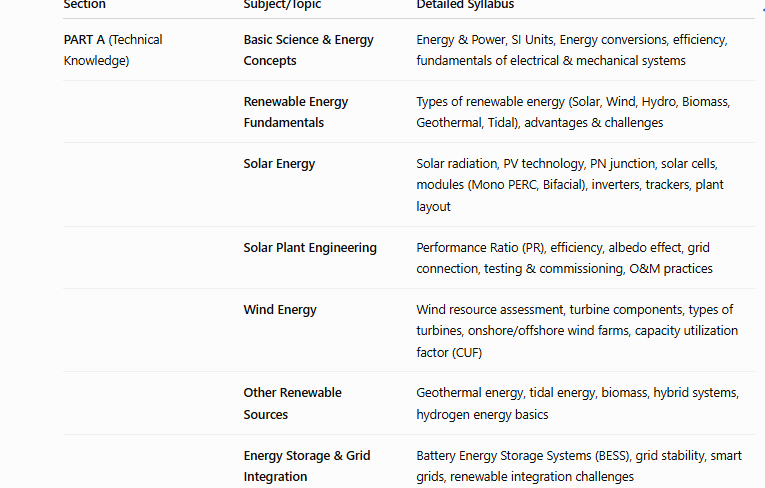
| Section | Subject/Topic | Detailed Syllabus |
|---|---|---|
| PART A (Technical Knowledge) | Basic Science & Energy Concepts | Energy & Power, SI Units, Energy conversions, efficiency, fundamentals of electrical & mechanical systems |
| Renewable Energy Fundamentals | Types of renewable energy (Solar, Wind, Hydro, Biomass, Geothermal, Tidal), advantages & challenges | |
| Solar Energy | Solar radiation, PV technology, PN junction, solar cells, modules (Mono PERC, Bifacial), inverters, trackers, plant layout | |
| Solar Plant Engineering | Performance Ratio (PR), efficiency, albedo effect, grid connection, testing & commissioning, O&M practices | |
| Wind Energy | Wind resource assessment, turbine components, types of turbines, onshore/offshore wind farms, capacity utilization factor (CUF) | |
| Other Renewable Sources | Geothermal energy, tidal energy, biomass, hybrid systems, hydrogen energy basics | |
| Energy Storage & Grid Integration | Battery Energy Storage Systems (BESS), grid stability, smart grids, renewable integration challenges | |
| Environmental & Waste Management | Waste handling in RE sector, sustainability practices, environmental impact | |
| International & Policy Concepts | International Solar Alliance (ISA), renewable policies, government initiatives | |
| Engineering Discipline (Core) | Electrical / Mechanical / Civil basics depending on specialization (machines, power systems, structures, thermodynamics, etc.) | |
| Contracts & Materials (C&M) | Tendering types (open, limited, single), bid evaluation, contracts, reverse auction, payment terms | |
| EMD, Performance Bank Guarantee (PBG), price variation, CVC guidelines, procurement processes |
Key Topics:
1. Basic Renewable Energy Concepts
- Energy, Power & SI Units
- Types of Renewable Energy (Solar, Wind, Hydro, etc.)
- Solar Energy:
- PN Junction, solar cells & modules
- Types of modules (Mono PERC, Bifacial)
- Efficiency, Albedo effect
- Solar plant components & trackers
- Performance Ratio (PR), O&M
- Wind Energy:
- Wind turbine components
- Onshore & offshore wind farms
- Micro-siting
- Capacity Utilization Factor (CUF)
- Other Energy Sources:
- Geothermal, Tidal energy
- Waste management in the renewable sector
- International Solar Alliance concept
2. Contracts & Material Management (C&M)
- Types of Tendering (Open, Limited, Single)
- Bid Process:
- Invitation, evaluation, award
- Qualifying requirements
- Price variation formulas
- Reverse auction (pros & cons)
- CVC guidelines
- Payment terms & billing
- EMD & Performance Bank Guarantee
These topics are directly mentioned in the official NGEL indicative syllabus.
Part B: Aptitude Section
This section checks your general abilities.
Topics:
- General English / Verbal Ability
- Quantitative Aptitude
- Logical Reasoning
- General Knowledge / Awareness
Key Points
- The exam is objective (MCQ-based)
- Equal weightage to Technical + Aptitude sections
- Focus is mainly on core engineering + IT fundamentals
- Suitable for candidates from Computer/IT & related engineering backgrounds
Preparation Tips
- Strengthen core subjects (DSA, DBMS, OS, Networks)
- Practice MCQs daily for aptitude
- Revise basic programming concepts
- Solve previous year technical questions (GATE/PSU level)
About The Author
