
The Odisha Public Service Commission (OPSC) conducts the recruitment examination for the post of Assistant Soil Conservation Officer (ASCO) under the Department of Agriculture & Farmers’ Empowerment. The OPSC ASCO Syllabus 2026 plays a crucial role in guiding candidates through their exam preparation journey. Aspirants aiming for this prestigious government position must have a clear understanding of the syllabus to strategically plan their studies and ensure comprehensive coverage of all essential topics.
The OPSC ASCO exam typically assesses candidates on core subjects related to Agriculture and Soil Conservation, along with General Studies. The syllabus covers a wide range of topics such as soil science, agronomy, horticulture, environmental science, and allied subjects, ensuring that the candidate possesses sound theoretical and practical knowledge that is essential for the role. Additionally, the General Studies section evaluates awareness of current events, general knowledge, and reasoning abilities.
Staying updated with the latest syllabus is vital, as it helps candidates focus only on relevant topics and manage time effectively. In this article, we provide a detailed breakdown of the OPSC ASCO Syllabus 2026, including subject-wise topics, exam pattern, and preparation tips to help aspirants succeed in the upcoming examination.
OPSC ASCO Syllabus 2026
The full detailed syllabus for the OPSC ASCO (Assistant Soil Conservation Officer) Exam 2026 is ideal for a first-time aspirant. This role is typically for candidates with an agricultural or related science background, and the syllabus is designed accordingly.
OPSC ASCO/ASO Syllabus Analysis 2026
The Odisha Public Service Commission (OPSC) Assistant Section Officer/Assistant Section Control Officer syllabus mainly focuses on General Awareness, Reasoning, Mathematics, English, Odia Language, and Computer Skills. The exam tests both conceptual understanding and problem-solving speed. Candidates should prioritize Current Affairs, Odisha GK, Grammar, Arithmetic, and Logical Reasoning for better scoring opportunities.
| Subject/Paper | Important Topics | Difficulty Level | Weightage Analysis | Preparation Strategy |
|---|---|---|---|---|
| General Awareness | Current Affairs, Odisha GK, Indian Polity, Geography, History, Economy, Science, Awards, Books & Authors | Moderate | High scoring with daily revision | Read newspapers, monthly current affairs, Odisha-specific GK |
| Reasoning & Mental Ability | Coding-Decoding, Number Series, Analogy, Blood Relation, Direction Sense, Seating Arrangement | Easy to Moderate | Very scoring section | Practice daily mock questions and shortcuts |
| Quantitative Aptitude / Mathematics | Percentage, Ratio, Profit & Loss, Time & Work, SI-CI, Average, Algebra, Mensuration | Moderate | Time-consuming but high scoring | Focus on formulas and PYQs |
| English Language | Grammar, Synonyms, Antonyms, Error Detection, Comprehension, Vocabulary, Sentence Improvement | Moderate | Important for merit ranking | Improve grammar rules and reading habits |
| Odia Language | Grammar, Vocabulary, Translation, Comprehension | Easy to Moderate | Qualifying but important | Practice Odia writing and grammar basics |
| Computer Skill Test | MS Word, Excel, PowerPoint, Internet, Email, Typing | Easy | Qualifying nature | Practice computer applications regularly |
| General Finance & Procurement (if included) | GST, Budget, e-Tendering, Procurement Rules, Government Finance Basics | Moderate | Emerging important area | Study Odisha government finance basics |
Exam Pattern Analysis
| Paper | Subject | Marks | Questions | Duration |
|---|---|---|---|---|
| Paper I | General Awareness | 100 | 100 | 90 Minutes |
| Paper II | Reasoning & Mathematics | 100 | 100 | 90 Minutes |
| Paper III | English & Odia Language | 200 | 200 | 2 Hours |
| Paper IV | Computer Skill Test | 50 | Practical | 1 Hour |
Most Scoring Areas
- Reasoning
- Current Affairs
- English Grammar
- Arithmetic Short Tricks
- Computer Applications
Toughest Areas
- Advanced Arithmetic
- Odisha-specific GK
- English Vocabulary
Recommended Preparation Ratio
| Section | Recommended Time |
|---|---|
| General Awareness | 30% |
| Reasoning | 20% |
| Mathematics | 25% |
| English & Odia | 20% |
| Computer | 5% |
Best Strategy for 2026
- Solve previous year papers regularly.
- Focus on Odisha Current Affairs.
- Attempt daily mock tests.
- Revise static GK weekly.
OPSC ASCO Exam Pattern 2026
| Paper | Subject | Marks | Duration |
|---|---|---|---|
| 1 | General Studies & General Science | 100 | 1.5 hours |
| 2 | Specialized Subject (Agriculture / Horticulture / Soil Science / Agricultural Engineering) | 100 | 1.5 hours |
🔹 Both papers are objective type (MCQs).
🔹 Negative marking is likely (0.25 per wrong answer – confirm with official notice).
🔹 No Interview — selection is purely written-based.
OPSC ASCO Syllabus for Paper 1: General Studies & General Science (100 Marks)
General Knowledge
-
History of India & Odisha
-
Indian Polity and Constitution
-
Geography of India & Odisha (Rivers, Soils, Climate, Forests, Natural Resources)
-
Culture & Heritage of Odisha
-
Current Affairs (National & International)
-
Major Government Schemes (Central & State level)
-
Environmental Issues & Ecology
General Science
-
Physics (Basics: Motion, Force, Energy, Heat, Light)
-
Chemistry (Acids, Bases, Elements, Compounds, Fertilizers)
-
Biology (Human and Plant Physiology, Microorganisms, Diseases, Immunity)
Mental Ability & Reasoning
-
Coding-Decoding
-
Number Series
-
Blood Relations
-
Direction Test
-
Puzzle
-
Syllogisms
-
Analogies
Quantitative Aptitude
-
Simplification
-
Percentages
-
Ratio and Proportion
-
Profit and Loss
-
Time, Speed and Distance
-
Time and Work
-
Averages
-
Simple & Compound Interest
Computer Awareness (Basic)
-
Basics of Computers
-
MS Office (Word, Excel, PowerPoint)
-
Internet and Email
-
Input-output devices
-
Operating systems
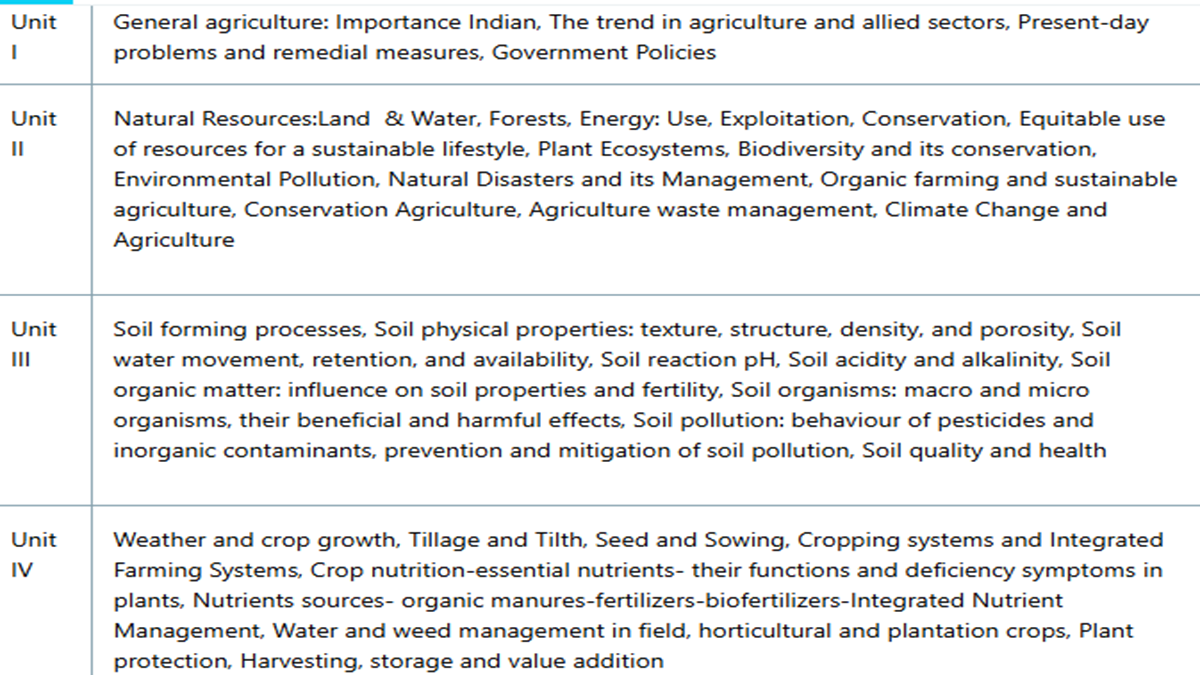
OPSC ASCO Syllabus for Paper 2: Specialized Subject (Any One Based on Qualification – 100 Marks)
You will attempt only the subject you qualified in (Agriculture / Horticulture / Soil Science / Agricultural Engineering).
1. Agriculture
-
Agronomy: Cropping systems, Water management, Weed control
-
Soil Science: Soil classification, Fertility, NPK, Soil erosion
-
Plant Breeding & Genetics: Hybrid varieties, Seed technology
-
Plant Protection: IPM, Pesticides, Insect-pest management
-
Agricultural Economics: Marketing, Farm planning
-
Agricultural Extension: Communication, Rural development
-
Agro-Climatic Zones of Odisha
2. Horticulture
-
Fundamentals of Horticulture
-
Pomology: Fruit science, orchard management
-
Olericulture: Vegetable science
-
Floriculture & Landscaping
-
Plant propagation techniques
-
Pest and Disease Management in Horticultural Crops
-
Post-Harvest Management
3. Soil Science
-
Soil Genesis and Classification
-
Soil Physics: Water retention, Permeability
-
Soil Chemistry: pH, Salinity, Nutrient cycles
-
Soil Fertility & Fertilizers
-
Soil Microbiology
-
Soil and Water Conservation
-
Remote sensing and GIS in soil conservation
4. Agricultural Engineering
-
Soil and Water Engineering: Erosion, Watershed, Irrigation
-
Farm Machinery and Power
-
Renewable Energy in Agriculture
-
Surveying and Leveling
-
Hydraulics and Water Resources
-
Structures for farm & rural use
-
Drainage systems
Preparation Tips for First Timers
-
Start with NCERTs: For GS and General Science, start from Class 6 to 10.
-
Refer Odisha Board Books: Especially for Odisha Geography and Culture.
-
Daily News: Read a good newspaper or use apps for daily current affairs.
-
Subject Mastery: Read ICAR textbooks for your subject specialization.
-
Mock Tests: Practice full-length tests once a week.
-
Previous Year Papers: Very important to understand question patterns.
Best Books to Cover OPSC ASCO Syllabus 2026
To effectively prepare for the OPSC ASCO (Assistant Soil Conservation Officer) Exam 2026, you need to cover subjects related to Soil and Water Conservation, Agriculture, Agronomy, Soil Science, Environmental Science, and General Studies. Below is a list of the best books topic-wise that will help you cover the syllabus thoroughly:
Subject-wise Best Books for OPSC ASCO 2026
1. Soil Science
-
“Soil Science” by D.K. Das – A detailed book covering soil formation, classification, soil fertility, and soil chemistry.
-
“Introductory Soil Science” by D. Patiram – Good for fundamentals and descriptive topics.
2. Agronomy
-
“Principles of Agronomy” by Reddy & Reddy – Core book for principles of crop production, weed control, irrigation, etc.
-
“Fundamentals of Agronomy” by A.S. Reddy – Useful for basic to intermediate level understanding.
3. Soil and Water Conservation
-
“Soil and Water Conservation Engineering” by R. Lal and B.A. Stewart – A reliable book covering methods, practices, and engineering aspects.
-
“Watershed Management” by J.V.S. Murthy – Helpful for watershed development concepts.
4. Environmental Science / Ecology
-
“Environmental Studies” by Erach Bharucha – Covers pollution, biodiversity, ecosystem, and climate change basics.
-
“Environment and Ecology” by Majid Husain – UPSC-level preparation with current developments.
5. General Agriculture
-
“Objective Agriculture” by S.R. Kantwa – Great for MCQs and objective revision.
-
“General Agriculture” by Nem Raj Sunda – Useful for theoretical concepts and quick revision.
6. General Knowledge and Current Affairs
-
Lucent’s General Knowledge – A standard book covering history, polity, geography, and general science.
-
Daily Newspaper (The Hindu / Indian Express) + Monthly Magazine (Pratiyogita Darpan / Vision IAS current affairs) – To stay updated with the latest environmental and agricultural schemes.
Additional Practice & Guides
-
OPSC ASCO Previous Year Papers – Try to collect and practice these to understand the exam pattern.
-
Arihant’s Agriculture Books – Especially their MCQ and competitive guides for practice.
FAQs
1. What is the exam pattern for OPSC ASCO?
-
Written Exam: Objective Type (MCQs)
-
Total Papers: 2
-
Paper I: General Studies
-
Paper II: Agriculture
-
2. What is the duration and marks for each paper?
-
Paper I – General Studies
-
Duration: 1.5 hours (90 minutes)
-
Marks: 100
-
-
Paper II – Agriculture
-
Duration: 1.5 hours (90 minutes)
-
Marks: 100
-
3. Is there negative marking in the OPSC ASCO exam?
-
Yes, 1/4th mark is deducted for each wrong answer.
4. What are the major topics covered in General Studies (Paper I)?
-
Indian Polity & Constitution
-
General Science
-
History & Geography of India and Odisha
-
Current Affairs (National & International)
-
Environmental Issues
-
Logical Reasoning and Analytical Ability
-
General Mental Ability
5. What are the major topics under Agriculture (Paper II)?
-
Soil Science
-
Agronomy
-
Horticulture
-
Plant Protection (Entomology and Plant Pathology)
-
Agricultural Economics & Extension
-
Water Conservation & Watershed Management
-
Agro-Climatic Zones of Odisha
-
Dryland Farming and Rainfed Agriculture
-
Soil Erosion and Conservation Techniques
6. Is the syllabus based on graduation level?
-
Yes, the Agriculture paper is based on Bachelor’s degree level in Agriculture or allied subjects.
7. What is the best way to prepare for the Agriculture paper?
-
Focus on ICAR syllabus, B.Sc. Agriculture textbooks, and previous year question papers.
-
Refer to Odisha-specific agriculture data and soil conservation practices.
8. Will the exam be conducted online or offline?
-
The exam is conducted offline (pen and paper-based).
9. Is there any interview after the written test?
-
Yes, candidates who qualify in the written exam are called for a Viva Voce (Interview) round, carrying 25 marks.
10. Are there any recommended books for OPSC ASCO preparation?
-
General Studies: Lucent’s GK, Odisha-specific current affairs magazines
-
Agriculture:
-
Fundamentals of Agriculture by Arun Katyayan
-
Objective Agriculture by S.R. Kantwa
-
Soil Science by D.K. Das
-
About The Author
