
The Pharmacy Council of India (PCI) has ushered in a transformative era for pharmacy education with its revised PCI syllabus for 2026. This comprehensive overhaul, aligned with the National Education Policy (NEP) 2020, represents the most significant change in over a decade for pharmacy programs across the country. The revised curriculum aims to produce graduates who are not only skilled in traditional pharmaceutical sciences but also proficient in emerging technologies and ready for the evolving demands of the global healthcare industry.
The Driving Force Behind the 2026 PCI Syllabus Revision
The PCI’s decision to revamp the syllabus stems from a critical need to bridge the gap between academic training and industry requirements. The old curriculum, primarily structured under the 2014 regulations, was seen as increasingly outdated in a world where technology is rapidly reshaping healthcare. The new syllabus marks a strategic shift toward creating “industry-ready” graduates with a strong emphasis on practical skills, digital literacy, and specialized knowledge.
PCI Syllabus 2026
The pharmacy curriculum in India is regulated by the Pharmacy Council of India (PCI) under the Pharmacy Act, 1948. All courses follow standardized regulations such as ER-2020 (for D Pharma) and updated frameworks aligned with NEP 2020 (for B Pharma 2026 onward).
PCI New Syllabus
Detailed explanation of the PCI (Pharmacy Council of India) New Syllabus 2026 for pharmacy courses like B.Pharm and D.Pharm, based on the latest updates aligned with NEP 2020.
The Pharmacy Council of India (PCI) has introduced a revised pharmacy syllabus to make education more skill-based, industry-oriented, and flexible.
- लागू (Implementation): Academic session 2026–27
- Based on: National Education Policy (NEP) 2020
- Applies to:
- B.Pharm (Bachelor of Pharmacy)
- D.Pharm (Diploma in Pharmacy)
B.Pharm New Syllabus 2026 (NEP-Based): Course Structure
- Duration: 4 Years (8 Semesters)
- Credit System: CBCS (Credit-Based Choice System)
- Total Credits: ~190+
- Multiple Exit Options:
- After 2 years → Diploma
- After 3 years → Advanced Diploma
- After 4 years → B.Pharm Degree
PCI has officially mandated universities to implement this revised syllabus from 2026–27 session.
Key Features of New B.Pharm Syllabus
- Industry-Oriented Curriculum
- Internships (2 mandatory)
- Research Project (Final Year)
- Electives & Specialization
- Digital & Modern Subjects
- Skill Development & Soft Skills
New-age Subjects Added
- Artificial Intelligence in Pharmacy
- Digital Health & Telemedicine
- Pharmaceutical Data Science
- Blockchain in Healthcare
- Robotic Pharmacy
Semester-wise Major Subjects
1st Year (Foundation)
- Human Anatomy & Physiology
- Pharmaceutical Analysis
- Pharmaceutics
- Pharmaceutical Inorganic Chemistry
- Communication Skills
- Remedial Biology / Mathematics
2nd Year (Core Pharmacy)
- Pathophysiology
- Pharmacology (Basics)
- Pharmaceutical Organic Chemistry
- Physical Pharmaceutics
- Pharmaceutical Microbiology
3rd Year (Advanced Concepts)
- Medicinal Chemistry
- Pharmacology (Advanced)
- Pharmacokinetics
- Pharmaceutical Biotechnology
- Industrial Pharmacy
4th Year (Specialization & Practice)
- Clinical Pharmacy
- Pharmacovigilance
- Regulatory Affairs
- Hospital & Community Pharmacy
- Project Work + Internship
Specialization Tracks (from 5th Semester)
Students can choose:
- Industrial Pharmacy
- Clinical Pharmacy
- Pharmaceutical Research
- Regulatory Affairs
D.Pharm New Syllabus (ER-2020 Based)
Course Structure
- Duration: 2 Years + 500 Hours Training
- Total Subjects: ~12
- Focus: Practical & Community Pharmacy
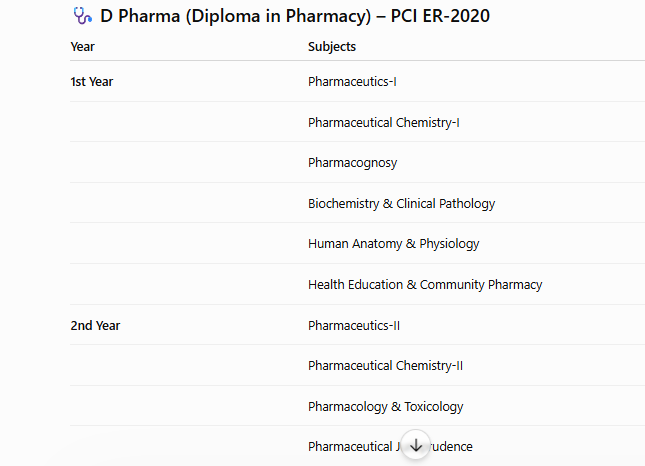
D.Pharm Subjects
1st Year
- Pharmaceutics-I
- Pharmaceutical Chemistry-I
- Pharmacognosy
- Human Anatomy & Physiology
- Biochemistry & Clinical Pathology
- Health Education & Community Pharmacy
2nd Year
- Pharmaceutics-II
- Pharmaceutical Chemistry-II
- Pharmacology & Toxicology
- Hospital & Clinical Pharmacy
- Pharmacy Law & Ethics
- Community Pharmacy & Management
Practical Training
- 500 Hours in:
- Hospital Pharmacy
- Community Pharmacy
- Drug Store
Major Changes in PCI New Syllabus 2026
1. NEP 2020 Integration
- Multidisciplinary learning
- Flexible degree system
2. Skill-Based Learning
- Focus on:
- Clinical skills
- Industry exposure
- Patient care
3. Internship & Training
- Mandatory industrial + hospital exposure
4. Research & Innovation
- Final-year project work compulsory
5. Technology Integration
- AI, Machine Learning, and Digital Pharmacy included
6. Employability Focus
- Prepares for:
- Pharma companies
- Hospitals
- Clinical research
- Entrepreneurship
Old vs New PCI Syllabus (Quick Comparison)
| Feature | Old Syllabus | New Syllabus 2026 |
|---|---|---|
| System | Traditional | Credit-based (CBCS) |
| Flexibility | Low | High (exit options) |
| Focus | Theory | Practical + Skills |
| Technology | Limited | AI, Digital Health |
| Internship | Limited | Mandatory |
| Specialization | Minimal | Available |
PCI D Pharma Syllabus 2026
Duration: 2 Years + 500 hours training
Structure: Year-wise (not semester)
Total Subjects: 12
1st Year Subjects
- Pharmaceutics-I
- Pharmaceutical Chemistry-I
- Pharmacognosy
- Human Anatomy & Physiology
- Biochemistry & Clinical Pathology
- Health Education & Community Pharmacy
2nd Year Subjects
- Pharmaceutics-II
- Pharmaceutical Chemistry-II
- Pharmacology & Toxicology
- Pharmaceutical Jurisprudence
- Drug Store & Business Management
- Hospital & Clinical Pharmacy
Practical Training
- 500 hours (Hospital + Community Pharmacy)
- Includes patient interaction, dispensing, and inventory
D Pharma focuses on basic pharmacy practice, drug dispensing, and patient care.
PCI B Pharma Syllabus 2026
Duration: 4 Years (8 Semesters)
New Update: लागू from 2026–27 (NEP 2020 aligned)
Core Subjects (Across Semesters)
- Human Anatomy & Physiology
- Pharmaceutical Analysis
- Pharmaceutics
- Medicinal Chemistry
- Pharmacology
- Pharmacognosy
- Biochemistry
- Microbiology
Advanced Subjects
- Biotechnology
- Genetic Engineering
- Drug Delivery Systems
- Industrial Pharmacy
- Quality Assurance
- Pharmacovigilance
- Clinical Pharmacy
New Additions (2026)
- Artificial Intelligence in Pharmacy
- Data Science / Python
- Digital Health & Robotics
Practical & Training
- Lab practicals every semester
- Industry + hospital internships
- Final year research project
Key Features (New Curriculum)
- Credit-based system (~190+ credits)
- Multiple exit options (Diploma / Degree)
- Specialization from 3rd year
- Skill + industry-oriented learning
M Pharma Syllabus 2026 (Postgraduate)
Duration: 2 Years (4 Semesters)
Focus: Specialization + Research
Major Specializations
- Pharmaceutics
- Pharmacology
- Pharmaceutical Chemistry
- Pharmacognosy
- Quality Assurance
- Industrial Pharmacy
Core Structure
1st Year
- Advanced Pharmaceutical Sciences
- Modern Analytical Techniques
- Research Methodology & Biostatistics
- Specialized Subjects (based on branch)
2nd Year
- Dissertation / Thesis (Major part)
- Seminar & Journal Club
- Industrial/Research Training
Focus Areas
- Drug research & development
- Clinical trials
- Advanced formulation techniques
- Regulatory affairs
M Pharma is designed for research, teaching, and pharma industry leadership roles.
Quick Comparison (D vs B vs M Pharma)
| Feature | D Pharma | B Pharma | M Pharma |
|---|---|---|---|
| Duration | 2 Years | 4 Years | 2 Years |
| Level | Diploma | Undergraduate | Postgraduate |
| Focus | Basic pharmacy | Advanced + Industry | Specialization + Research |
| Practical | High (500 hrs) | Labs + Internship | Research-based |
| Career | Pharmacist | Industry, Clinical, Govt | Research, Teaching |
D.Pharm Syllabus 2026: A Foundation in Pharmacy Practice
The Diploma in Pharmacy (D.Pharm) program, regulated under the PCI’s Education Regulations 2020, continues to be a two-year course that provides the essential foundation for a career as a registered pharmacist. The 2026 syllabus for D.Pharm maintains its focus on core pharmaceutical sciences and practical training, which is critical for roles in retail and hospital pharmacies.
Year-Wise Breakdown of D.Pharm Subjects
First Year focuses on building a strong scientific base and includes the following subjects :
-
Pharmaceutics: The science of formulating drugs into various dosage forms like tablets, capsules, and injectables.
-
Pharmaceutical Chemistry: The identification, quality testing, and analysis of drugs, including pharmacopoeial methods and basic medicinal chemistry.
-
Pharmacognosy: The study of drugs derived from natural sources, including medicinal plants and herbal remedies.
-
Human Anatomy & Physiology: The foundational understanding of the human body’s structure and function, which is crucial for comprehending drug action.
-
Social Pharmacy: A new subject that addresses the role of the pharmacist in public health, covering national health programs, disease prevention, and health education.
Second Year transitions from foundational science to therapeutic and practical application :
-
Pharmacology: The study of how drugs interact with the body, covering pharmacokinetics, pharmacodynamics, and drug actions across various organ systems.
-
Community Pharmacy & Management: This subject focuses on the operational aspects of a retail pharmacy, including prescription handling, patient counseling, and inventory management.
-
Biochemistry & Clinical Pathology: The study of the biochemical basis of diseases and the interpretation of common laboratory tests.
-
Pharmacotherapeutics: The application of drug therapy for treating common diseases like hypertension, diabetes, and infections, emphasizing rational drug use.
-
Hospital & Clinical Pharmacy: This covers the functions of a hospital pharmacy, including inpatient dispensing, sterile compounding, and drug information services.
-
Pharmacy Law & Ethics: The legal and ethical framework governing pharmacy practice in India, including acts like the Drugs & Cosmetics Act and the Pharmacy Act.
Mandatory Practical Training
A key component of the D.Pharm course is the mandatory 500 hours of practical training. This hands-on experience is typically completed in hospital pharmacies or retail pharmacies and provides students with real-world skills in drug dispensing, patient counseling, and pharmacy operations.
B.Pharm Syllabus 2026: A Paradigm Shift in Undergraduate Education
The Bachelor of Pharmacy (B.Pharm) program has seen the most radical transformation. The 2026 syllabus introduces a Credit-Based Specialization System that replaces the previous “one-size-fits-all” approach, offering students more flexibility and career-focused pathways. The new curriculum is designed for the 2026-2027 academic session and brings with it a host of groundbreaking features.
Key Features of the New B.Pharm Syllabus
-
NEP 2020 Alignment: The curriculum is fully aligned with the National Education Policy, introducing a credit-based structure, multiple entry and exit options, and an Academic Bank of Credits (ABC) . Students can exit after the first year with a certificate, after the second year with a diploma, or after completing the full four years for a B.Pharm degree.
-
Specialization Tracks: For the first time, B. Pharm students can choose a specialization from the 5th semester onward. The two primary tracks are Industrial Pharmacy and Clinical Pharmacy. This allows students to tailor their education to their career goals, whether in drug manufacturing or patient-centered care.
-
Integration of AI and Digital Technologies: This is perhaps the most talked-about feature. The new syllabus systematically integrates Artificial Intelligence (AI), Machine Learning (ML), and Python programming across all four years. The intent is not to create “hardcore programmers” but to equip students with the digital competence to thrive in a technology-driven pharmaceutical industry.
-
Mandatory Internships: The new curriculum mandates two compulsory internships – one in an industrial setting (Semester IV) and another in a clinical setting (Semester VI). This totals 240 hours of practical training, ensuring students gain valuable real-world experience before graduation.
-
Two-Semester Research Project: The final year (Semesters VII and VIII) includes a comprehensive research project (12 credits total). This promotes innovation, analytical thinking, and provides students with a tangible research outcome that enhances their prospects for higher education and R&D roles.
Semester-Wise Breakdown of New Subjects
The first four semesters cover core subjects like Human Anatomy & Physiology, Pharmaceutics, Pharmaceutical Chemistry, Pharmacology, and Pharmacognosy. Below is a list of some of the new subjects introduced under the NEP 2020 framework
| Semester | New Subject | Credit | Type |
|---|---|---|---|
| I | Basics of Python Programming for Pharma Sciences | 3 | AEC |
| I | Healthcare Psychology | 2 | VAC |
| II | Applied Biostatistics and Data Analytics | 3 | SEC |
| III | Introduction to Machine Learning in Pharma Sciences | 3 | AEC |
| III | Ethics & Human Values | 2 | VAC |
| IV | Social Pharmacy & Public Health | 3 | SEC |
| IV | Mandatory Internship I (Community/Hospital) | 4 | Internship |
| V | Innovation & Startup Ecosystem | 3 | SEC |
| VI | AI Applications in Pharmaceutical Sciences | 3 | AEC |
| VI | Intellectual Property Rights (IPR) | 3 | SEC |
| VI | Mandatory Internship II (Clinical) | 4 | Internship |
| VII | AI in Clinical Applications | 3 | AEC |
| VII | Pharmacovigilance | 3 | Core |
| VII | Regulatory Affairs | 3 | Core |
| VII | Research Project I | 6 | Project |
| VIII | AI Ethics & Translational Applications | 3 | AEC |
| VIII | Clinical Pharmacotherapeutics | 4 | Core |
| VIII | Industrial Pharmacy & Facility Design | 3 | Core |
| VIII | Research Project II | 6 | Project |
AEC (Ability Enhancement Courses), SEC (Skill Enhancement Courses), and VAC (Value-Added Courses) are new categories introduced under NEP to classify subjects that build technical skills, practical abilities, and holistic development.
M.Pharm Syllabus 2026: A Focus on Research and Specialization
While the detailed structural changes for M.Pharm programs are not as extensively documented as for B.Pharm, the available information points towards a curriculum that is becoming more research-based and specialization-oriented. The PCI’s stated vision is to make M.Pharm programs more aligned with advanced research and development needs.
M.Pharm Admission and Structure
The M.Pharm course is a two-year (four-semester) postgraduate program that offers a variety of specializations. Some of the common specializations include Quality Assurance, Pharmaceutical Chemistry, Pharmaceutics, Pharmacology, Industrial Pharmacy, and Pharmacognosy.
Admission to the M.Pharm program is highly competitive, based on merit and performance in the Graduate Pharmacy Aptitude Test (GPAT). Candidates must have passed a B.Pharm degree with a minimum of 55% marks (50% for SC/ST/OBC/PwD) from a PCI-approved institution. A key eligibility criterion is that students must have their registration with the State Pharmacy Council, a rule mandated by the PCI.
The table below shows the typical intake for various M.Pharm specializations at PCI-approved institutions :
| School | Duration | Intake |
|---|---|---|
| Quality Assurance | 4 Semesters | 12 |
| Pharmaceutical Chemistry | 4 Semesters | 8 |
| Pharmaceutics | 4 Semesters | 8 |
| Pharmacology | 4 Semesters | 8 |
| Industrial Pharmacy | 4 Semesters | 6 |
| Drug Regulatory Affairs | 4 Semesters | 15 |
| Pharmaceutical Biotechnology | 4 Semesters | 15 |
| Pharmacognosy & Phytochemistry | 4 Semesters | 15 |
PCI Syllabus for D Pharma, B Pharma & M Pharma PDFs
The Pharmacy Council of India (PCI) prescribes syllabus PDFs for D.Pharm, B.Pharm, and M.Pharm courses on its official website.
- D.Pharm (Diploma in Pharmacy): A 2-year course under ER-2020 covering subjects like Pharmaceutics, Pharmaceutical Chemistry, Pharmacology, Pharmacognosy, Human Anatomy & Physiology, and Hospital Pharmacy with strong practical training.
- B.Pharm (Bachelor of Pharmacy): A 4-year (8 semesters) program with ~190+ credits including core subjects such as Pharmaceutics, Pharmaceutical Analysis, Medicinal Chemistry, Pharmacology, Pharmacognosy, and internships.
- M.Pharm (Master of Pharmacy): A 2-year postgraduate course with specialization areas like Pharmaceutics, Quality Assurance, Pharmacology, and Drug Regulatory Affairs, along with research and dissertation work.
Official PDFs:
Conclusion
The PCI Syllabus 2026 marks a watershed moment for pharmacy education in India. The revised curricula for D.Pharm, B.Pharm, and M.Pharm are designed to create a new generation of pharmacists who are not just experts in drug science but are also technologically adept, clinically aware, and ready to contribute to a rapidly digitizing global healthcare landscape.
This comprehensive overhaul, driven by the NEP 2020 and extensive industry consultation, promises to enhance the employability of graduates and elevate the standard of Indian pharmaceutical education to world-class levels. While challenges in implementation, such as faculty training and infrastructure upgrades, are acknowledged, the new syllabus sets a bold and necessary direction for the future of the profession.
About The Author
