
The Rajiv Gandhi Proudyogiki Vishwavidyalaya (RGPV) is the state technological university of Madhya Pradesh, offering undergraduate, postgraduate, and diploma programs in engineering, pharmacy, management, and applied sciences. The RGPV Syllabus 2026 is designed under the Credit-Based Grading System (CBGS) to provide industry-oriented knowledge and practical skills.
RGPV Syllabus 2026 – Overview
| Particulars | Details |
|---|---|
| University Name | Rajiv Gandhi Proudyogiki Vishwavidyalaya (RGPV) |
| Courses Offered | B.Tech, M.Tech, Diploma, Pharmacy, MCA |
| Academic Year | 2026 |
| Syllabus Mode | Online (PDF) |
| Pattern | Semester-wise (CBGS) |
| Semesters | 8 (B.Tech), 6 (Diploma) |
RGPV provides branch-wise and semester-wise syllabus PDFs for all courses.
RGPV Syllabus 2026
Overview of the RGPV Syllabus 2026 (mainly for B.Tech/Diploma – semester-wise structure). The exact subjects vary by branch (CSE, ME, CE, EE, etc.), but the core structure is similar across programs.
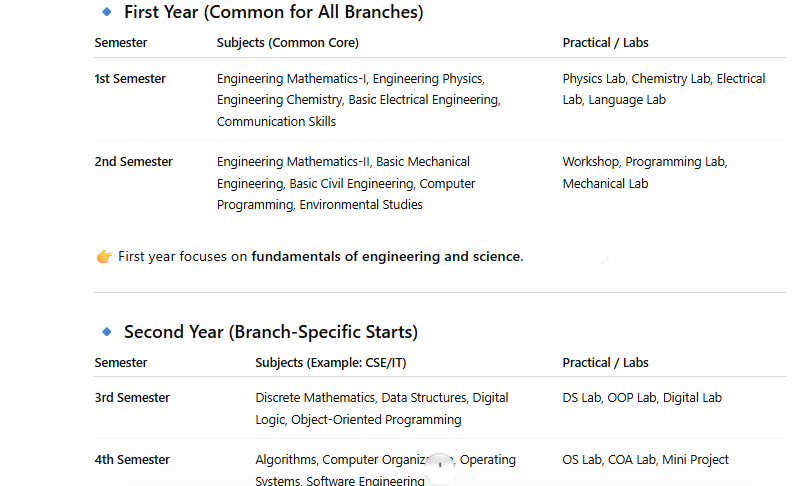
First Year (Common for All Branches)
| Semester | Subjects (Common Core) | Practical / Labs |
|---|---|---|
| 1st Semester | Engineering Mathematics-I, Engineering Physics, Engineering Chemistry, Basic Electrical Engineering, Communication Skills | Physics Lab, Chemistry Lab, Electrical Lab, Language Lab |
| 2nd Semester | Engineering Mathematics-II, Basic Mechanical Engineering, Basic Civil Engineering, Computer Programming, Environmental Studies | Workshop, Programming Lab, Mechanical Lab |
First year focuses on fundamentals of engineering and science.
Second Year (Branch-Specific Starts)
| Semester | Subjects (Example: CSE/IT) | Practical / Labs |
|---|---|---|
| 3rd Semester | Discrete Mathematics, Data Structures, Digital Logic, Object-Oriented Programming | DS Lab, OOP Lab, Digital Lab |
| 4th Semester | Algorithms, Computer Organization, Operating Systems, Software Engineering | OS Lab, COA Lab, Mini Project |
Third Year (Core Engineering Subjects)
| Semester | Subjects | Practical / Labs |
|---|---|---|
| 5th Semester | Database Management Systems, Theory of Computation, Computer Networks | DBMS Lab, Network Lab |
| 6th Semester | Compiler Design, Machine Learning / Electives, Web Technologies | Project Work, Lab Work |
Final Year (Advanced + Project)
| Semester | Subjects | Practical / Labs |
|---|---|---|
| 7th Semester | Artificial Intelligence, Cloud Computing, Electives | Major Project Phase-I |
| 8th Semester | Advanced Electives, Industrial Training | Major Project Phase-II |
Key Highlights of RGPV Syllabus 2026
| Feature | Details |
|---|---|
| University | Rajiv Gandhi Proudyogiki Vishwavidyalaya (RGPV) |
| Course Type | B.Tech / Diploma / Polytechnic |
| Pattern | Semester System (1–8 Sem for B.Tech, 1–6 for Diploma) |
| Mode | Theory + Practical + Internal Assessment |
| Branches | CSE, Mechanical, Civil, Electrical, Electronics, etc. |
| Update | Revised periodically as per AICTE guidelines |
RGPV B.Tech Syllabus 2026 (All Branches)
RGPV B.Tech syllabus is divided into:
- 1st Year (Common for all branches)
- 2nd to 4th Year (Branch-specific subjects)
1st Year (Common Subjects for All Branches)
All engineering students study the same subjects in the first year:
Core Subjects:
- Mathematics-I & II
- Engineering Physics / Chemistry
- Basic Electrical Engineering
- Basic Mechanical Engineering
- Engineering Graphics
- Communication Skills (English)
- Environmental Science
Practical/Labs:
- Physics/Chemistry Lab
- Workshop
- Communication Lab
These subjects build a strong foundation in engineering fundamentals.
RGPV 2nd Semester Syllabus
Overview of the RGPV (B.Tech) 2nd Semester Syllabus 2026 based on the latest available curriculum pattern and exam subjects from RGPV Official Website and exam schedule.
Common Subjects (First Year – Most Branches)
| Subject Code | Subject Name | Key Topics Covered |
|---|---|---|
| BT-201 / M-2 | Engineering Mathematics-II | Differential Equations, Laplace Transform, Vector Calculus, Fourier Series |
| PH-201 / CY-201 | Physics / Chemistry (Group Based) | Optics, Quantum Physics / Electrochemistry, Polymers, Corrosion |
| ES-201 | Basic Electrical & Electronics Engineering | Circuit Laws, AC/DC, Transformers, Semiconductor Basics |
| ME-201 | Basic Mechanical Engineering | Thermodynamics, IC Engines, Manufacturing Processes |
| CE-201 | Basic Civil Engineering / Mechanics | Structures, Forces, Stress-Strain, Surveying Basics |
| CS-201 | Basic Computer Engineering | Programming Concepts, C Language Basics, Computer Fundamentals |
| HU-201 | Communication Skills / English | Grammar, Technical Writing, Communication Skills |
Practical & Lab Subjects
| Lab Code | Lab Name | Description |
|---|---|---|
| BT-202 | Mathematics Lab | MATLAB / Computational Problems |
| PH-202 / CY-202 | Physics / Chemistry Lab | Experiments based on theory |
| ES-202 | Electrical Lab | Circuit experiments, measurements |
| CS-202 | Computer Lab | Programming in C / Basic Coding |
| ME-202 | Mechanical Workshop | Fitting, Welding, Machine tools |
| CE-202 | Civil Lab | Surveying, Material Testing |
Branch-Specific Variation (As per Latest Pattern)
| Branch | Subjects (Example from 2026 Exam) |
|---|---|
| CSE (AI/ML) | Discrete Structures, Statistical Methods, Digital Logic, OOP, AI Basics |
| CSE (Data Science) | Discrete Maths, Statistics, DLD, OOP, Data Analytics |
| CSBS | Linear Algebra, Statistics, Data Structures, Electronics, Economics, Communication |
These variations are visible in the 2026 exam timetable released by RGPV.
2nd Year (Branch Core Begins)
From the second year, specialization starts.
Common Subjects (Many Branches):
- Mathematics-III
- Data Structures / Engineering Mechanics
- Electronics / Electrical Basics
Example (CSE Branch):
- Data Structures
- Digital Logic
- Discrete Mathematics
3rd Year (Advanced Core Subjects)
Students focus on advanced and technical subjects.
Example (CSE):
- Operating Systems
- Database Management System
- Computer Organization
- Theory of Computation
According to student discussions, most core technical subjects are covered till 6th semester.
4th Year (Specialization + Projects)
Final year focuses on:
- Elective subjects
- Industrial training
- Major project
8th Sem RGPV Syllabus
RGPV (Rajiv Gandhi Proudyogiki Vishwavidyalaya) B.Tech 8th Semester Syllabus 2026 in a clear tabular form.
Note: Subjects vary by branch. Below I’ve provided the most common structure (CSE + Electrical example) based on official scheme.
Computer Science Engineering (CSE)
| S.No | Subject Code | Subject Name | Type | Credits | Marks (Approx.) |
|---|---|---|---|---|---|
| 1 | CS-801 | Soft Computing | Core | 6 | 150 |
| 2 | CS-802 | Web Engineering | Core | 6 | 150 |
| 3 | CS-820 | Elective – II | Elective | 4 | 100 |
| 4 | CS-830 | Elective – III | Elective | 4 | 100 |
| 5 | CS-805 | Major Project | Practical | 8 | 200 |
| 6 | CS-806 | Self Study | Internal | 2 | 50 |
Total Credits: ~30
Includes theory, practical, and project work
Common Elective Subjects (CSE)
- Image Processing & Computer Vision
- Data Mining
- Artificial Intelligence
- Cloud Computing
- Cyber Security
(Exact electives depend on college availability)
Electrical Engineering (Example)
| S.No | Subject Code | Subject Name | Type | Credits | Total Marks |
|---|---|---|---|---|---|
| 1 | EE-802 | Power System Protection | Core | 6 | 200 |
| 2 | — | Elective – III | Elective | 4 | 120 |
| 3 | — | Elective – IV | Elective | 4 | 120 |
| 4 | EE-803 | Major Project | Practical | 8 | 300 |
| 5 | — | Seminar | Practical | 2 | 60 |
Total Marks: ~800
Electrical Electives (Examples)
- Advanced Electrical Drives
- Process Control
- Renewable Energy Systems
- Power System Planning
Key Highlights of RGPV 8th Sem
- Final semester focuses on Project + Electives
- Major Project carries highest weightage
- Minimal core subjects (mostly specialization-based)
- Includes seminar / self-study component
- Designed as per AICTE flexible curriculum
RGPV Branch-wise Syllabus 2026
RGPV offers multiple engineering branches with separate subject structures.
Computer Science Engineering (CSE)
- Programming (C, C++, Java)
- Data Structures
- Algorithms
- DBMS
- Operating Systems
- Computer Networks
- Artificial Intelligence
Mechanical Engineering (ME)
- Thermodynamics
- Fluid Mechanics
- Machine Design
- Manufacturing Technology
- Heat Transfer
Civil Engineering (CE)
- Structural Analysis
- Geotechnical Engineering
- Transportation Engineering
- Environmental Engineering
Example: Soil testing experiments like permeability and shear tests are included in labs.
Electrical Engineering (EE)
- Electrical Machines
- Power Systems
- Control Systems
- Network Analysis
Electronics & Communication Engineering (ECE)
- Analog Electronics
- Digital Electronics
- Signals & Systems
- Communication Systems
Information Technology (IT)
- Similar to CSE with focus on:
- Software Engineering
- Networking
- Web Technologies
Automobile / Other Branches
- Automobile Engineering
- Chemical Engineering
- Mining Engineering
- Biotechnology
RGPV Diploma Syllabus 2026
RGPV also offers polytechnic (diploma) courses with a 6-semester structure.
Diploma Structure:
- 1st Year: Basic Engineering Subjects
- 2nd Year: Core Technical Subjects
- 3rd Year: Advanced Topics + Training
The syllabus is available semester-wise for all branches.
RGPV Subject Example (Detailed)
Here is an example of a core subject:
Mathematics-III (Common Subject)
Topics include:
- Fourier Series
- Laplace Transform
- Complex Variables
- Numerical Methods
These topics help students solve engineering problems using mathematical models.
RGPV Physics Syllabus 2026
RGPV (Rajiv Gandhi Proudyogiki Vishwavidyalaya) Engineering Physics syllabus 2026 for B.Tech 1st Year (BT-201) presented in a clear form based on the latest available curriculum.
| Module No. | Unit / Topic | Detailed Syllabus |
|---|---|---|
| Module 1 | Quantum Mechanics | Wave nature of particles, de-Broglie hypothesis, operators, time-dependent & time-independent Schrödinger equation, particle in 1D box, uncertainty principle, wave packets |
| Module 2 | Wave Optics | Huygens’ principle, interference (YDSE), Newton’s rings, Michelson interferometer, diffraction (single slit, circular aperture), Rayleigh criterion, diffraction grating |
| Module 3 | Solid State Physics | Crystal structure, unit cells, X-ray diffraction, Bragg’s law, band theory of solids, conductors, semiconductors & insulators |
| Module 4 | Lasers & Optical Fibers | Laser principles, types of lasers, population inversion, applications; optical fibers, numerical aperture, types & uses |
| Module 5 | Electrostatics & Electromagnetism | Electrostatics in vacuum, electric field & potential, Maxwell’s equations, electromagnetic waves basics |
| Module 6 | Modern Physics & Applications | Nanotechnology basics, superconductors, relativity concepts, nuclear physics fundamentals (in some updated modules) |
Practical / Lab (General Outline)
| Component | Details |
|---|---|
| Experiments | Interference, diffraction, laser experiments, optical fiber experiments |
| Instruments | Spectrometer, traveling microscope, laser setup |
| Viva & Record | Based on performed experiments |
RGPV M2 Syllabus 2026 (B.Tech 1st Year – 2nd Semester)
the RGPV Engineering Mathematics-II (M2) Syllabus 2026 in a clear tabular format based on the latest available RGPV (BT-202) curriculum.
| Unit | Topics / Chapters |
|---|---|
| Unit I | Fourier Series & Fourier Transform • Introduction to Fourier Series • Even & Odd functions • Half-range series • Fourier series for discontinuous functions • Fourier Transform (definition & properties) • Sine & Cosine transforms |
| Unit II | Laplace Transform • Definition & basic transforms • Properties of Laplace Transform • Shifting theorems • Laplace transform of derivatives • Inverse Laplace Transform • Convolution theorem • Applications to solve differential equations |
| Unit III | Ordinary Differential Equations (ODEs) • Second-order differential equations • Variable coefficient equations • Method of variation of parameters • Series solution of differential equations |
| Unit IV | Partial Differential Equations (PDEs) • Formation of PDEs • First-order PDE (Lagrange & Charpit methods) • Higher-order linear PDEs • Homogeneous & non-homogeneous equations • Heat & wave equations (separation of variables) |
| Unit V | Vector Calculus • Vector differentiation • Gradient, divergence, curl • Line, surface & volume integrals • Green’s theorem • Gauss divergence theorem • Stokes’ theorem |
Course Objective (RGPV BT-202)
- Focus on ODEs, PDEs, Fourier & Laplace transforms, and vector calculus
- Helps students solve engineering and physical problems mathematically
- Builds foundation for advanced subjects in engineering
Important Notes for Students
- M2 is numerical + conceptual subject
- Units II (Laplace) & V (Vector Calculus) are usually high scoring
- Practice previous year questions + derivations + numericals
- Standard books: B.S. Grewal, Erwin Kreyszig
RGPV Exam Pattern 2026
The syllabus is aligned with the CBGS evaluation:
Marking Scheme:
- Mid-Sem Exam: 20–30 marks
- End-Sem Exam: 70–80 marks
- Practical/Lab: Separate evaluation
Key Features:
- Continuous assessment
- Theory + practical focus
- Industry-oriented curriculum
How to Download RGPV Syllabus 2026 PDFs
Follow these steps:
- Visit RGPV Official Website
- Go to “Academics” section
- Click on “Scheme & Syllabus”
- Select your branch & semester
- Download PDF
Important Features of RGPV Syllabus 2026
Updated as per industry standards
Includes practical & lab work
Covers emerging technologies (AI, Data Science, etc.)
Semester-wise structured learning
Focus on skill development
Conclusion
The RGPV Syllabus 2026 provides a well-structured roadmap for engineering, diploma, and technical education students. It covers everything from basic engineering concepts in the first year to advanced specialization and project work in the final year.
About The Author
