
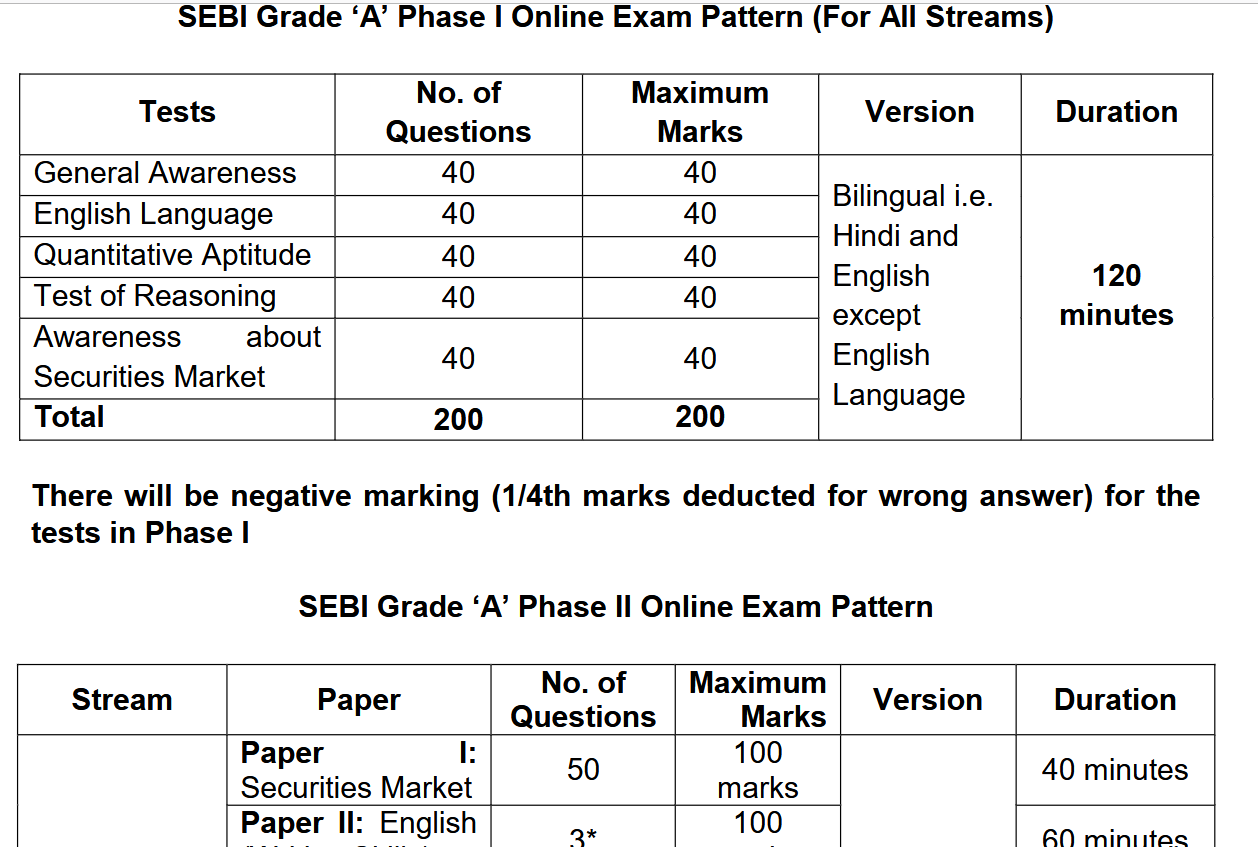
The Securities Exchange Board of India (SEBI) has established the SEBI Grade A Syllabus and Exam Pattern 2026 for Phases 1 and 2, each of which consists of two papers. One can expedite preparation and succeed in the test by being aware of the SEBI Grade A syllabus and exam format. A thorough understanding of the exam design, including information on the marking method, subject-wise mark distribution, and negative marking procedures, is equally crucial
SEBI Grade A Syllabus 2026
The SEBI Grade A syllabus is divided into two main phases: Phase I (Prelims) and Phase II (Mains). Here’s the full detailed syllabus for 2026:
SEBI Grade A Phase I: Prelims Syllabus
Paper 1: Common for All Streams (100 Marks, Objective)
- English Language
- Reading Comprehension
- Cloze Test
- Spotting Errors
- Sentence Improvement/Correction
- Para Jumbles
- Fill in the Blanks
- Synonyms & Antonyms
- Vocabulary Usage
- Quantitative Aptitude
- Number Series
- Simplification/Approximation
- Data Interpretation (Bar Graph, Line Graph, Pie Chart, etc.)
- Quadratic Equations
- Arithmetic (Profit & Loss, Time & Work, Time & Distance, Simple & Compound Interest, etc.)
- Probability
- Reasoning Ability
- Puzzles and Seating Arrangement
- Syllogism
- Blood Relations
- Coding-Decoding
- Direction Sense
- Input-Output
- Inequalities
- General Awareness (Including Financial Sector Awareness)
- Current Affairs (Last 6–8 months)
- Banking and Financial Awareness
- Static General Knowledge
Paper 2: Stream-Specific (100 Marks, Objective)
For General Stream:
- Commerce & Accountancy
- Accounting Principles
- Financial Statements and Ratios
- Auditing Standards
- Cost and Management Accounting
- Management
- Principles of Management
- Organizational Behavior
- Finance
- Financial Markets
- Corporate Finance
- Risk Management
- Time Value of Money
- Economics
- Microeconomics & Macroeconomics
- Indian Economy
- Monetary and Fiscal Policy
- Companies Act
- Basics of Company Law
- General Laws
- Contract Act, 1872
- Negotiable Instruments Act
For IT, Legal, Research, and Other Streams:
The syllabus focuses on the stream-specific subjects relevant to the specialization.
SEBI Grade A Phase II: Mains Syllabus
Paper 1: English Descriptive (Common for All Streams, 100 Marks)
- Essay Writing
- Precis Writing
- Comprehension
- Business/Office Correspondence
Paper 2: Stream-Specific (100 Marks)
- General Stream: Same topics as Phase I, but the difficulty level is higher.
- IT, Legal, Research, and Other Streams: Advanced topics based on the stream.
Interview Phase
Candidates who clear Phase II are called for the interview. The interview carries significant weightage in the final selection.
SEBI Grade A Phase 1 and 2 Important Topics 2026
List of the most important topics for the SEBI Grade A 2026 Phase 1 and Phase 2 exams, especially useful if you’re preparing now for SEBI Grade A (Assistant Manager) 2026. These are based on the official syllabus structure and trends from recent cycles.
Phase 1 — Prelims (Objective MCQs)
Paper 1 — Common for All Streams
Focus on these key sections and topics that appear consistently:
1. General Awareness (incl. Financial & Economic Awareness)
-
Current affairs (last 1 year + budget, policy updates)
-
Financial markets & institutions (RBI, SEBI, banking regulation)
-
Fiscal policy, monetary policy, inflation, GDP, RBI frameworks
-
Derivatives basics: forwards, futures, swaps
-
Govt schemes, awards, international events
2. English Language
-
Reading comprehension
-
Para jumbles & sentence arrangement
-
Error spotting & grammar
-
Vocabulary (synonyms/antonyms, idioms/phrases)
3. Quantitative Aptitude
-
Data interpretation (graphs, tables)
-
Number series & approximations
-
Arithmetic: percentages, ratio, averages, time & work
-
Mensuration, probability, basic algebra
4. Reasoning Ability
-
Seating arrangements, puzzles
-
Syllogism, inequalities
-
Blood relations & directions
-
Coding – decoding, logical reasoning
Paper 2: Stream-Specific (General Stream)
For General stream candidates, Paper 2 topics are critical in both Phase 1 and Phase 2:
Commerce & Accountancy
-
Financial accounting basics
-
Cash flow & ratio analysis
-
Accounting standards overview
Management
-
Principles of management
-
Leadership theories, motivation & communication
-
Organizational behavior basics
Finance
-
Financial markets & instruments
-
Bonds, equity & derivatives
-
Functions of financial institutions
Costing
-
Cost & management accounting fundamentals
-
Marginal costing, lean systems, JIT
Companies Act, 2013
-
Key chapters (Accounts, Audit, Directors, etc.)
-
Corporate governance principles
Economics
-
Micro & macro fundamentals (demand & supply)
-
Fiscal & monetary policy
-
National income concepts
Phase 2- Mains
Paper 1 English (Descriptive)
This section is common for all streams. Most important aspects you must master:
-
Essay writing — on economic/finance, regulatory issues
-
Precis writing — summarization skills
-
Reading comprehension — analytical understanding
Focus areas:
Practice structuring essays, clarity of ideas
Keep updated examples from financial news
Work on grammar, coherence, vocabulary
Paper 2 — Stream-Specific (Objective/MCQ)
For General Stream:
All Paper 2 topics from Phase 1 are reused but at a higher difficulty and depth — emphasis on:
-
Financial markets (both domestic & global context)
-
Corporate finance & cost accounting applied questions
-
Companies Act provisions, recent amendments
-
Economics deeper questions like policy impacts, macro indicators
Stream-Specific Notes (If You’re in Non-General Streams)
Legal Stream
Important topics include:
-
Constitution of India, Contract Law
-
Criminal law fundamentals
-
Law of Evidence & Civil Procedure
-
Administrative law & principles of natural justice
-
Securities laws, SEBI Act, Company Law provisions
IT Stream
Depending on the latest pattern, focus on:
-
Data structures (arrays, trees, graphs)
-
Algorithms (sorting/searching, recursion)
-
SQL & database fundamentals
-
Networking basics & cybersecurity principles
Research Stream
Major areas:
-
Economics & econometrics
-
Statistics basics & applied topics
-
Finance & commerce quantitative methods
High-Impact Topics (Based on Trends)
Across Phase 1 and Phase 2, the following repeat often and are highly valuable:
General Awareness: Government budgets, RBI policy, SEBI updates
English: Reading comprehension & precision writing
Reasoning: Seating & puzzles
Quant: Data interpretation & number series
Finance & Economics: Market instruments, inflation, fiscal/monetary policy
Companies Act: Provisions relevant to corporate compliance
Costing: Lean systems & management accounting
SEBI Grade A Exam Pattern 2026
The SEBI Grade A Exam Pattern 2026 in tabular form:
Phase 1: Online Screening Test
| Paper | Subjects | Maximum Marks | Duration | Remarks |
|---|---|---|---|---|
| Paper 1 | General Awareness (including Financial Sector awareness), English Language, Quantitative Aptitude, Reasoning Ability | 100 | 60 minutes | Common for all streams |
| Paper 2 | Subject-Specific (as per the stream applied) | 100 | 40 minutes | Minimum cutoff: 30% |
- Weightage: Paper 1 – 1/3rd weightage, Paper 2 – 2/3rd weightage.
- Cutoff: Aggregate cutoff for Phase 1 is 40%.
- There will be negative marking (1/4th marks deducted for wrong answer) for the
tests in Phase 1.
Phase 2: Online Examination
| Paper | Subjects | Maximum Marks | Duration | Remarks |
|---|---|---|---|---|
| Paper 1 | English Descriptive (Essay, Precis, and Comprehension) | 100 | 60 minutes | Common for all streams |
| Paper 2 | Subject-Specific (as per the stream applied) | 100 | 40 minutes | Minimum cutoff: 40% |
- Weightage: Paper 1 – 1/3rd weightage, Paper 2 – 2/3rd weightage.
- Cutoff: Aggregate cutoff for Phase 2 is 50%.
- There will be negative marking (1/4th marks deducted for wrong answer) for the
tests in Phase 2.
Phase 3: Interview
| Stage | Details |
|---|---|
| Interview | Candidates shortlisted based on Phase 2 performance will appear for the interview. |
| Weightage | 85% marks from Phase 2 + 15% marks from Interview. |
SEBI Grade A Syllabus 2026 PDF Download
Download SEBI Grade A Syllabus PDF by clicking by below link:
Best Book to Cover SEBI Grade A Syllabus
The SEBI Grade A exam covers a diverse syllabus, including General Awareness, Quantitative Aptitude, Reasoning, English Language, and specialized subjects depending on the stream. Here’s a list of the best books to cover the SEBI Grade A syllabus for the General Stream (2026):
General Awareness (with a focus on Financial Awareness)
- “Manorama Yearbook”: Covers current affairs and general knowledge.
- “Banking Awareness” by Arihant Experts: Provides an in-depth understanding of financial awareness.
- Online Sources: Regularly follow websites like PIB, RBI, SEBI updates, and newspapers such as The Hindu or Economic Times.
Quantitative Aptitude
- “Quantitative Aptitude for Competitive Examinations” by R.S. Aggarwal: Comprehensive and beginner-friendly.
- “Fast Track Objective Arithmetic” by Rajesh Verma: Good for shortcuts and advanced practice.
Reasoning Ability
- “A Modern Approach to Verbal and Non-Verbal Reasoning” by R.S. Aggarwal: Ideal for conceptual clarity and extensive practice.
- “Analytical Reasoning” by M.K. Pandey: Recommended for puzzles, seating arrangements, and critical reasoning.
English Language
- “Objective General English” by S.P. Bakshi (Arihant Publications): Good for grammar and vocabulary.
- “Word Power Made Easy” by Norman Lewis: Best for vocabulary building.
- Practice comprehension and essays: Regular practice is essential.
Specialized Subjects
For the General Stream, these subjects are important:
a. Securities Market & Financial Sector
- “Indian Financial System” by Bharati V. Pathak: A comprehensive resource on the Indian financial system.
- “The Basics of Finance” by M. Y. Khan: Covers financial markets and instruments.
- “Securities Laws & Capital Markets” by Taxmann: Tailored for SEBI-related topics.
b. Economics
- “Indian Economy” by Ramesh Singh: Recommended for macroeconomics and Indian economy-related topics.
- NCERT Economics Textbooks (Class 11 & 12): Great for foundational concepts.
c. Accountancy & Companies Act
- “A Handbook on Corporate and Allied Laws” by Munish Bhandari: Covers the Companies Act comprehensively.
- “Accounting Standards Made Easy” by D.S. Rawat: Focus on accounting principles and standards.
Legal Aspects (if applicable)
- “Bare Acts” (SEBI Act, Companies Act, etc.): Direct study of legal acts and regulations.
- “Legal Aptitude and Legal Reasoning” by A.P. Bhardwaj: For reasoning and law-based sections.
Practice and Mock Tests
- SEBI Grade A Guide by Arihant Publications: Covers all topics in one book with practice questions.
- Oliveboard or PracticeMock Test Series: For online mock exams and section-wise tests.
Tips for Preparation:
- Focus on the official SEBI syllabus for precision.
- Stay updated on financial news and regulatory updates.
- Practice regularly with previous year papers and mock tests.
FAQs
1. What are the main sections covered in the SEBI Grade A Syllabus 2026?
The SEBI Grade A syllabus is divided into Phase 1 and Phase 2 exams.
- Phase 1 (Preliminary Exam):
- General Awareness (with special reference to Financial Sector)
- English Language
- Quantitative Aptitude
- Reasoning Ability
- General Awareness about the Securities Market
- Phase 2 (Mains Exam):
- Paper 1: English (Descriptive Test)
- Paper 2: Relevant Stream (e.g., General, Legal, Information Technology, Research, or Official Language)
2. What is the focus of the General Awareness section in SEBI Grade A?
The General Awareness section emphasizes:
- Current affairs related to banking, financial institutions, and the securities market.
- Updates on SEBI regulations, economy-related news, and important reports (like Union Budget, Economic Survey, etc.).
- Knowledge of government schemes, stock markets, and international financial institutions.
3. What is included in the “Relevant Stream” syllabus for Phase 2?
The “Relevant Stream” syllabus varies by discipline:
- General Stream: Commerce, Finance, Management, Economics, Costing, Companies Act, and Securities Market.
- Legal Stream: Laws like the Constitution of India, Contract Act, Companies Act, Securities Laws, etc.
- Information Technology Stream: Topics related to Data Analytics, Programming Languages, Cybersecurity, and IT Laws.
- Research Stream: Statistics, Econometrics, and Research Methodology.
- Official Language Stream: Translation, Hindi Grammar, and related topics.
4. How should one prepare for the Descriptive English Test in Phase 2?
The English descriptive test evaluates writing skills. Key components include:
- Essay Writing: Topics could be finance-related, economic issues, or general topics.
- Precis Writing: Summarizing a given passage effectively.
- Reading Comprehension: Answering questions based on a provided passage.
Preparation tips:
- Read newspapers and financial magazines.
- Practice writing essays and precis within a time limit.
5. Are there any specific SEBI regulations covered in the syllabus?
Yes, the syllabus includes SEBI-specific regulations like:
- Securities and Exchange Board of India Act, 1992
- Securities Contracts (Regulation) Act, 1956
- Depositories Act, 1996
- Regulations related to IPOs, mutual funds, stock exchanges, and insider trading.
Candidates are advised to refer to the SEBI website for the latest regulations and updates.
About The Author
