
Super TET Syllabus 2026: The Super Teacher Eligibility Test (Super TET), officially the Uttar Pradesh Assistant Teacher Recruitment Examination, is the key recruitment exam for Assistant Teachers in UP government primary (Classes 1–5) and upper primary/junior (Classes 6–8) schools. It is conducted by the Uttar Pradesh Education Service Selection Commission (UPESSC), earlier associated with the UP Basic Education Board (UPBEB).
Unlike UPTET or CTET (which are eligibility tests), Super TET is the actual selection exam. Candidates must already have a valid UPTET or CTET certificate to apply. The same overall exam structure is used for both Primary and Junior levels, with differences mainly in the depth of academic subjects (especially Mathematics, Science, and Social Studies) for upper-primary posts.
Note: As of mid-to-late July 2026, multiple educational portals describe a consistent 150-question pattern with no negative marking. Some recent discussions and videos have mentioned possible changes (e.g., reduced questions or negative marking). Always verify the final details from the official notification on upessc.up.gov.in or updeled.gov.in when released.
Super TET 2026 Exam Pattern Overview
| Particular | Details |
|---|---|
| Exam Mode | Offline (Pen-and-Paper / OMR-based) |
| Question Type | Objective Multiple Choice Questions (MCQs) |
| Total Questions | 150 |
| Total Marks | 150 |
| Duration | 2 hours 30 minutes (150 minutes) |
| Marking Scheme | +1 mark for each correct answer |
| Negative Marking | None (as per prevailing pattern) |
| Medium | Bilingual (Hindi and English) |
| Levels | Primary (Class 1–5) & Junior/Upper Primary (Class 6–8) |
| Syllabus Level | Academic subjects up to Class 12; Pedagogy up to D.El.Ed/BTC level |
The same 10-section structure applies to both levels.
Super TET Subject-Wise Marks Distribution
| Section | Questions | Marks |
|---|---|---|
| Language (Hindi, English & Sanskrit) | 40 | 40 |
| General Knowledge & Current Affairs | 30 | 30 |
| Mathematics | 20 | 20 |
| Science | 10 | 10 |
| Environment & Social Studies | 10 | 10 |
| Teaching Methodology / Pedagogy | 10 | 10 |
| Child Psychology | 10 | 10 |
| Information Technology (ICT) | 5 | 5 |
| Logical & Analytical Reasoning | 5 | 5 |
| Life Skills / Management & Aptitude | 10 | 10 |
| Total | 150 | 150 |
Language + GK together carry 70 marks (nearly 47% of the paper). These, along with Mathematics, form the high-scoring core.
Detailed Subject-Wise Super TET Syllabus 2026
Primary Level (Class 1–5)
| Subject | Topics Covered | Questions | Marks |
|---|---|---|---|
| Language (Hindi, English, Sanskrit) | Grammar, Vocabulary, Comprehension, Teaching Methods | 40 | 40 |
| Mathematics | Number System, Geometry, Measurement, Data Handling, Pedagogy | 20 | 20 |
| Environmental Studies (EVS) | Family, Food, Shelter, Water, Travel, Environment & Pedagogy | 10 | 10 |
| Child Development & Pedagogy | Learning Theories, Child Psychology, Inclusive Education | 10 | 10 |
| General Knowledge & Current Affairs | History, Geography, Polity, Current Affairs (UP + India) | 30 | 30 |
| Reasoning Ability | Analogy, Coding-Decoding, Series, Logical Reasoning | 5 | 5 |
| Information Technology (Computer) | Basic Computer, Internet, MS Office, ICT in Education | 5 | 5 |
| Life Skills / Teaching Aptitude | Classroom Management, Professional Ethics | 10 | 10 |
| Total | — | 150 | 150 |
Primary level syllabus focuses on basic teaching ability + elementary subjects.
Super TET 2026 Syllabus – Junior Level (Class 6–8)
| Section | Subjects | Topics Covered | Questions | Marks |
|---|---|---|---|---|
| Section A (Compulsory) | General Knowledge | History, Geography, Polity, Current Affairs | 50 | 50 |
| Section B (Optional) | Language / Science-Maths / Social Studies | Based on chosen subject specialization | 100 | 100 |
| Total | — | — | 150 | 150 |
Candidates choose one subject group in Section B:
- Language (Hindi/English/Sanskrit)
- Science & Mathematics
- Social Studies
Important Subject-wise Topics (Both Levels)
| Subject | Key Topics |
|---|---|
| Child Development | Piaget Theory, Learning Methods, Inclusive Education |
| Language | Grammar, Comprehension, Pedagogy |
| Maths | Arithmetic, Geometry, Pedagogy |
| EVS / Science | Daily Life Science, Environment, Teaching Methods |
| Social Studies | History, Geography, Civics |
| GK | Static GK + Current Affairs |
| Computer | Basic IT, Digital Education |
1. Language (Hindi, English & Sanskrit) – 40 Marks This is the highest-weightage section. Hindi usually dominates.
- Hindi: Grammar (Sandhi, Samas, Karak, Ling, Vachan, Kaal, Upsarg-Pratyay), Vocabulary (Paryayvachi, Vilom, Anekarthi Shabd), Muhavare & Lokoktiyan, Alankar, Ras, Chhand, Unseen passages (Gadyansh/Padyansh), basic literature and authors.
- English: Tenses, Articles, Prepositions, Active/Passive Voice, Direct/Indirect Speech, Subject-Verb Agreement, Synonyms/Antonyms, Idioms & Phrases, Error spotting, Unseen comprehension.
- Sanskrit: Basic Grammar (Sandhi, Samas, Karak, Shabd-roop, Dhatu-roop) – usually a smaller component.
2. General Knowledge & Current Affairs – 30 Marks
- Static GK: Indian History (Ancient, Medieval, Modern, Freedom Struggle), Geography of India & UP, Indian Polity & Constitution, Economy basics, Art & Culture, Books & Authors, Awards, Important Days.
- Current Affairs: National & International events of the last 6–12 months, Sports, Government schemes (Central & UP), Appointments, Science & Technology.
- Strong focus on Uttar Pradesh-specific topics (history, geography, schemes, districts, culture).
3. Mathematics – 20 Marks Number System, Simplification, LCM & HCF, Fractions, Decimals, Percentage, Profit & Loss, Ratio & Proportion, Average, Simple & Compound Interest, Time & Work, Time-Speed-Distance, Algebra basics, Mensuration (Area, Volume, Perimeter), Geometry, Data Interpretation, Statistics (Mean, Median, Mode). Depth is higher for Junior level.
4. Science – 10 Marks
- Physics: Motion, Force, Work-Energy-Power, Light, Sound, Electricity, Magnetism, Units & Measurement.
- Chemistry: Matter & its states, Atoms & Molecules, Acids-Bases-Salts, Metals & Non-metals, Chemical reactions.
- Biology: Human body systems, Nutrition, Diseases, Cell & Tissues, Plant & Animal Kingdom, Environment & Ecology.
5. Environment & Social Studies – 10 Marks History (Ancient to Modern India, National Movement), Geography (Physical, India & World, Rivers, Climate, Resources), Civics (Constitution, Fundamental Rights & Duties, Governance, Panchayati Raj), EVS (Pollution, Conservation, Biodiversity, Sustainable Development, Disaster Management).
6. Teaching Methodology / Pedagogy – 10 Marks Principles of teaching & learning, Teaching methods & aids (TLM), Lesson planning, Micro-teaching, Evaluation & Assessment (including CCE), Classroom management, Inclusive education, Motivation, NEP-related concepts, Educational psychology applied to classroom.
7. Child Psychology – 10 Marks Growth & Development stages, Theories (Piaget, Vygotsky, Kohlberg, Skinner, Pavlov, Thorndike), Heredity vs Environment, Individual differences, Intelligence & Creativity, Learning theories, Memory & Forgetting, Motivation, Personality, Children with Special Needs, Guidance & Counselling.
8. Information Technology (ICT) – 5 Marks Computer fundamentals (Hardware/Software), MS Office basics, Internet & Email, ICT in teaching, Digital classroom tools, E-learning, Cyber awareness, Educational apps & Open Educational Resources (OER).
9. Logical & Analytical Reasoning – 5 Marks Series (Number/Alphabet), Analogy, Classification, Coding-Decoding, Blood Relations, Direction Sense, Ranking, Syllogism, Venn Diagrams, Calendar & Clock, Puzzles, Non-verbal reasoning.
10. Life Skills / Management & Aptitude – 10 Marks Communication, Problem-solving, Decision-making, Empathy, Stress management, Leadership, Time management, Professional ethics & conduct, Role of teacher (facilitator, guide, counsellor), Constitutional & human values, Classroom discipline, Motivation.
Primary vs Junior (Upper Primary) Level Differences
- Structure: Identical 150-mark, 10-section paper.
- Depth: Primary focuses on foundational concepts (up to roughly Class 8–10 level). Junior/Upper Primary has greater depth and application-based questions in Mathematics, Science, and Social Studies (up to Class 10–12 level), with more subject-specific orientation for specialised posts.
- Pedagogy: Primary emphasises early childhood and primary teaching methods; Junior focuses more on adolescent pedagogy and subject-specific teaching skills.
Super TET Eligibility
- Must have qualified UPTET or CTET (Paper 1 for Primary, Paper 2 for Junior).
- Educational: For Primary – Senior Secondary (50%) + D.El.Ed/BTC or equivalent; for Junior – Graduation + B.Ed (as per notification).
- Age: Generally 21–40 years (relaxations for reserved categories as per UP government rules).
Preparation Tips
- Prioritise Language (especially Hindi grammar + comprehension) and GK/Current Affairs (with strong UP focus) — these two alone can secure nearly half the marks.
- Practice previous Super TET and similar UP teacher exam papers for question trends.
- Cover NCERT books thoroughly for Mathematics, Science, and Social Studies.
- Revise D.El.Ed/BTC pedagogy and child psychology concepts carefully.
- Since there is typically no negative marking, attempt all questions.
- Stay updated via the official UPESSC website for the final notification, vacancy details, and any pattern revisions.
Super TET Syllabus Official Website
UP Super TET Syllabus 2026
| Subject | Number of Questions | Marks |
|---|---|---|
| Language (Hindi, Sanskrit & English) | 40 | 40 |
| Mathematics | 20 | 20 |
| Science | 10 | 10 |
| Environment & Social Studies | 10 | 10 |
| Teaching Aptitude (Shikshan Kaushal) | 10 | 10 |
| Child Psychology (Bal Manovigyan) | 10 | 10 |
| General Knowledge & Current Affairs | 30 | 30 |
| Logical Reasoning | 5 | 5 |
| Information Technology (ICT) | 5 | 5 |
| Life Skills, Management & Attitude | 10 | 10 |
| Total | 150 | 150 |
Super TET Syllabus Most Scoring Topics
The Super TET Syllabus 2026 is intended to evaluate applicants’ academic comprehension, teaching skills, and general aptitude needed for the position of Assistant Teacher in Uttar Pradesh government schools. In addition to teaching aptitude, child psychology, reasoning, information technology, life skills, and current affairs, it covers essential courses including language, math, science, and social studies.
The curriculum provides clarity on section-wise weighting and is framed in accordance with Class 12 norms and D.El.Ed. level pedagogy. This methodical technique aids candidates in organizing targeted, goal-oriented preparation for improved outcomes.
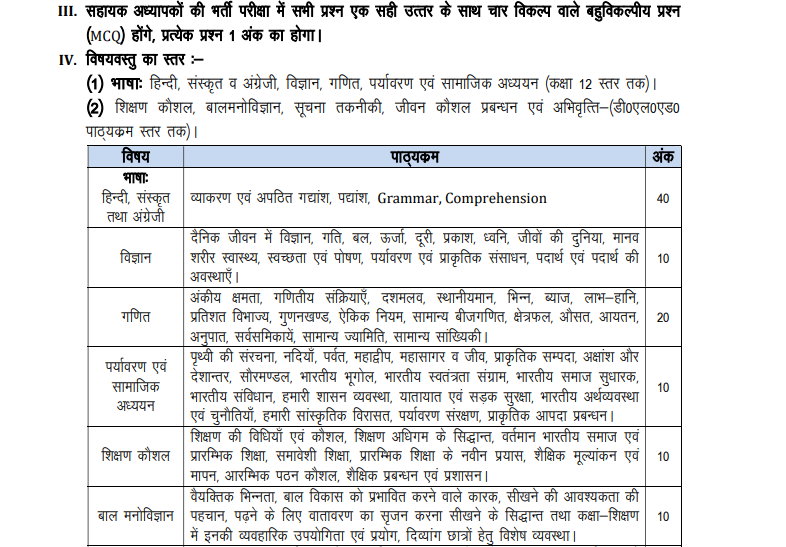
| Subject | Important Topics |
|---|---|
| Language (Hindi, Sanskrit & English) | Grammar (Hindi, Sanskrit, English), Unseen passages (Prose & Poetry), Reading comprehension |
| Science | Science in daily life, Motion, force, energy, light & sound, Living organisms & human body, Health, hygiene & nutrition, Environment & natural resources, Matter & its states |
| Mathematics | Number system & simplification, Fractions & decimals, Percentage, profit & loss, Simple interest, Ratio & proportion, Basic algebra, Geometry & mensuration, Average & data handling |
| Environment & Social Studies | Earth structure, rivers, mountains & oceans, Indian geography, Freedom struggle, Indian Constitution & governance, Transport & road safety, Indian economy & challenges, Cultural heritage, Environmental conservation & disaster management |
| Teaching Aptitude (Shikshan Kaushal) | Teaching methods & skills, Learning theories, Inclusive education, Early childhood education, Educational evaluation & assessment, School management & administration |
| Child Psychology (Bal Manovigyan) | Individual differences, Factors affecting child development, Learning needs & environment, Learning theories & classroom application, Education of differently-abled children |
| General Knowledge & Current Affairs | National & international current events, Important personalities & places, Awards & honors, Sports & games, Indian culture & arts |
| Logical Reasoning | Analogies, Assertion & Reason, Coding-decoding, Number & letter series, Puzzles & seating arrangement, Venn diagrams, Direction sense, Data interpretation |
| Information Technology (ICT) | Computer fundamentals, Internet & smartphone usage, Open Educational Resources (OER), Digital teaching aids, Educational apps & e-learning tools |
| Life Skills, Management & Attitude | Professional conduct & ethics, Motivation & leadership, Role of teacher (facilitator, guide, mentor), Constitutional & human values, Reward & punishment system |
Super TET Syllabus in Hindi
सुपर TET 2026 की परीक्षा की तैयारी कर रहे अभ्यर्थियों के लिए सिलेबस को अच्छे से समझना बहुत महत्वपूर्ण है। यह परीक्षा विभिन्न विषयों पर आधारित होती है, जिनमें भाषा, गणित, विज्ञान, पर्यावरण अध्ययन, शिक्षण कौशल, बाल मनोविज्ञान, सामान्य ज्ञान, तर्कशक्ति और कंप्यूटर/सूचना प्रौद्योगिकी शामिल हैं। हर विषय में उम्मीदवार की विषय की समझ और मूल अवधारणाओं की पकड़ को परखा जाता है। इसलिए सफलता पाने के लिए जरूरी है कि तैयारी को सही रणनीति के साथ विषयवार तरीके से किया जाए। नीचे दी गई तालिका में सभी विषयों के महत्वपूर्ण टॉपिक्स और उनके अंक दिए गए हैं, जिससे अभ्यर्थी अपनी तैयारी को बेहतर ढंग से प्लान कर सकते हैं।
| विषय | महत्वपूर्ण विषय |
|---|---|
| भाषा (हिंदी, संस्कृत और अंग्रेज़ी) | व्याकरण (हिंदी, संस्कृत, अंग्रेज़ी), अप्रत्यक्षित अनुच्छेद (गद्य और पद्य), पढ़ने की समझ |
| विज्ञान | दैनिक जीवन में विज्ञान, गति, बल, ऊर्जा, प्रकाश और ध्वनि, जीवित जीव और मानव शरीर, स्वास्थ्य, स्वच्छता और पोषण, पर्यावरण और प्राकृतिक संसाधन, पदार्थ और उसकी अवस्थाएँ |
| गणित | संख्या पद्धति और सरलकरण, भिन्न और दशमलव, प्रतिशत, लाभ और हानि, सरल ब्याज, अनुपात और समानुपात, बुनियादी बीजगणित, ज्यामिति और मापन, औसत और डेटा हैंडलिंग |
| पर्यावरण और सामाजिक अध्ययन | पृथ्वी की संरचना, नदियाँ, पर्वत और महासागर, भारतीय भूगोल, स्वतंत्रता संग्राम, भारतीय संविधान और शासन, परिवहन और सड़क सुरक्षा, भारतीय अर्थव्यवस्था और चुनौतियाँ, सांस्कृतिक धरोहर, पर्यावरण संरक्षण और आपदा प्रबंधन |
| शिक्षण कौशल | शिक्षण विधियाँ और कौशल, सीखने के सिद्धांत, समावेशी शिक्षा, प्रारंभिक बाल्यकाल शिक्षा, शैक्षिक मूल्यांकन और आकलन, विद्यालय प्रबंधन और प्रशासन |
| बाल मनोविज्ञान | व्यक्तिगत अंतर, बाल विकास को प्रभावित करने वाले कारक, सीखने की आवश्यकताएँ और वातावरण, सीखने के सिद्धांत और कक्षा में आवेदन, विशेष आवश्यकताओं वाले बच्चों की शिक्षा |
| सामान्य ज्ञान और समसामयिक घटनाएँ | राष्ट्रीय और अंतरराष्ट्रीय वर्तमान घटनाएँ, महत्वपूर्ण व्यक्तित्व और स्थान, पुरस्कार और सम्मान, खेलकूद, भारतीय संस्कृति और कला |
| तार्किक तर्क | समानताएँ, कथन और कारण, कोडिंग-डिकोडिंग, संख्या और अक्षर श्रृंखला, पहेलियाँ और बैठने की व्यवस्था, वेन आरेख, दिशा-बोध, डेटा व्याख्या |
| सूचना प्रौद्योगिकी (ICT) | कंप्यूटर की मूल बातें, इंटरनेट और स्मार्टफोन का उपयोग, ओपन एजुकेशनल रिसोर्सेज (OER), डिजिटल शिक्षण सामग्री, शैक्षिक ऐप और ई-लर्निंग टूल |
| जीवन कौशल, प्रबंधन और दृष्टिकोण | पेशेवर आचरण और नैतिकता, प्रेरणा और नेतृत्व, शिक्षक की भूमिका (सुविधाकारक, मार्गदर्शक, संरक्षक), संवैधानिक और मानवीय मूल्य, पुरस्कार और दंड प्रणा |
Super TET Syllabus 2026 PDF
Super TET Syllabus 2026 is designed for the recruitment of Assistant Teachers in Uttar Pradesh. The exam consists of 150 objective questions for 150 marks, conducted in offline mode with no negative marking. The syllabus includes Language (Hindi, English, Sanskrit), Mathematics, Science, Environment & Social Studies, Teaching Aptitude, Child Psychology, General Knowledge, Reasoning, ICT, and Life Skills. Language carries the highest weightage (40 marks), followed by General Knowledge (30 marks). Topics cover grammar, comprehension, basic maths, science concepts, teaching skills, and current affairs. Candidates should download the official PDF to understand subject-wise topics and prepare effectively.
SUPER-TET-Revised-Syllabus-2026 PDF
Selection Process of Super TET 2026
The selection process generally includes:
- Written Exam (Super TET)
- Merit List Based on Score
- Document Verification
Only candidates who have qualified CTET/UPTET are eligible for Super TET.
Preparation Tips for Super TET 2026
- Study NCERT books (Class 6–10) for basics
- Practice previous year papers
- Attempt mock tests regularly
- Focus on Child Psychology & Pedagogy
- Read daily current affairs
Key Points to Remember
- No negative marking → Attempt all questions
- Focus on GK (30 marks) for high scoring
- Teaching sections are game changers
- Balanced preparation across all subjects is necessary
FAQs – Super TET Syllabus 2026
Q1. What is the total number of marks for Super TET 2026?
The exam is conducted for 150 marks.
Q2. Is there negative marking in Super TET?
No, there is no negative marking.
Q3. Who can apply for Super TET?
Candidates who have qualified CTET or UPTET can apply.
Q4. What is the duration of the exam?
The duration is 2 hours 30 minutes.
Q5. Which subject carries the highest weightage?
General Knowledge (30 marks) and Language (40 marks) have the highest weightage.
Conclusion
The Super TET Syllabus 2026 is designed to evaluate both subject knowledge and teaching ability. With 150 questions and no negative marking, candidates have a great opportunity to score high with proper strategy. Focus on concept clarity, pedagogy, and current affairs to crack the exam successfully.
About The Author
