
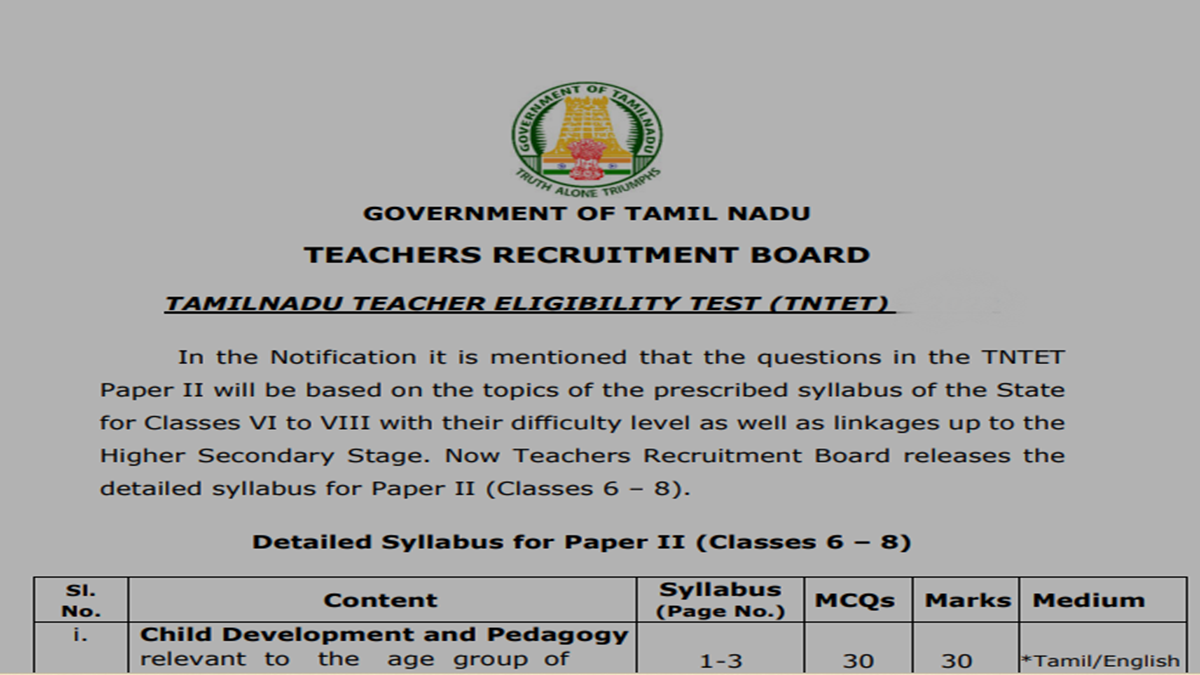
The Tamil Nadu Teacher Eligibility Test (TNTET) is a crucial examination for aspiring educators in Tamil Nadu, aimed at determining their eligibility to teach in government schools. The TNTET syllabus for 2026 outlines the essential topics and areas of knowledge required to succeed in the examination. The test is divided into two papers: Paper I for those wishing to teach classes I to V, and Paper II for those aspiring to teach classes VI to VIII. Both papers assess the candidates’ understanding of child development, language proficiency, mathematics, environmental studies, and the subject-specific content relevant to the level they wish to teach.
In Paper I, candidates will be evaluated on subjects like child development and pedagogy, language I (Tamil/English), language II (English/Tamil), mathematics, and environmental studies.
In Paper II, on the other hand, will focus on topics like child development, language skills, and subject-specific knowledge related to the chosen teaching area, be it science, social studies, or mathematics.
TNTET Syllabus 2026
The Tamil Nadu Teacher Eligibility Test (TNTET) 2026, conducted by the Teachers Recruitment Board (TRB), assesses the eligibility of candidates aspiring to become teachers in Tamil Nadu. The exam comprises two papers:
-
Paper 1: For candidates aiming to teach Classes 1–5 (Primary Level)
-
Paper 2: For candidates aiming to teach Classes 6–8 (Upper Primary Level)
Both papers consist of 150 multiple-choice questions (MCQs), each carrying 1 mark, with no negative marking. The duration for each paper is 3 hours. The syllabus for each paper is detailed below:
TNTET Paper 1 Syllabus (Classes 1–5)
1. Child Development and Pedagogy (6–11 years)
-
Part A – Child Development:
-
Physical and Cognitive Development
-
Social and Emotional Development
-
Moral Development
-
-
Part B – Learning:
-
Learning Theories and Styles
-
Types, Levels, and Approaches to Learning
-
Factors Contributing to Learning
-
Constructivist Approach to Learning
-
2. Language I (Choose one: Tamil, Telugu, Malayalam, Kannada, Urdu)
-
Language Comprehension
-
Vocabulary and Grammar
-
Reading and Speaking Skills
-
Language Functions
3. Language II – English
-
Language Comprehension
-
Vocabulary and Grammar
-
Reading and Speaking Skills
-
Language Functions
4. Mathematics
-
Number System
-
Arithmetic
-
Geometry
-
Algebra
-
Measurements
-
Time and Money
5. Environmental Studies
-
Family and Friends
-
Food, Water, and Shelter
-
Travel and Communication
-
Plants and Animals
-
Science in Everyday Life
-
Environmental Issues
TNTET Paper 2 Syllabus (Classes 6–8)
1. Child Development and Pedagogy (11–14 years)
-
Nature of Educational Psychology
-
Human Growth and Development
-
Cognitive Development
-
Social, Emotional, and Moral Development
-
Intelligence and Creativity
-
Motivation and Group Dynamics
-
Personality and Assessment
-
Mental Health and Hygiene
-
Guidance and Counselling
2. Language I (Choose one: Tamil, Telugu, Malayalam, Kannada, Urdu)
-
Language Comprehension
-
Vocabulary and Grammar
-
Reading and Speaking Skills
-
Language Functions
3. Language II – English
-
Language Comprehension
-
Vocabulary and Grammar
-
Reading and Speaking Skills
-
Language Functions
4. Subject Specialization (Choose one based on teaching preference):
-
Mathematics and Science:
-
Mathematics: Number System, Algebra, Geometry, Measurement, Data Handling
-
Science: Physics, Chemistry, Biology
-
-
Social Science:
-
History
-
Geography
-
Civics
-
Economics
-
TNTET Syllabus Exam Pattern 2026: Overview
| Paper | Classes | Subjects | Total Questions | Marks | Duration |
|---|---|---|---|---|---|
| 1 | 1–5 | Child Development, Language I & II, Mathematics, Environmental Studies | 150 | 150 | 3 hours |
| 2 | 6–8 | Child Development, Language I & II, Subject Specialization | 150 | 150 | 3 hours |
TNTET Syllabus 2026 in Details
The detailed paper-wise and section-wise TNTET syllabus is given below:
TNTET Syllabus 2025 for Paper 1
The TNTET Paper 1 comprises topics from Child Development and Pedagogy, Language-I, Language-II, Mathematics and Environmental Studies. Have a look at the TNTET Paper 1 syllabus below.
| TNTET Subjects | Topics |
|---|---|
| Child Development and Pedagogy (Relevant to Age Group 6 – 11)
TNTET textbooks
|
Part A – Child Development
Part B – Learning
|
| Language I |
|
| Language II |
|
| Mathematics |
|
| Environmental Studies and Science |
|
TNTET Syllabus 2026 for Paper 2
The TNTET Paper 2 comprises topics from Child Development and Pedagogy, Language-I, Language-II, Mathematics and Science or Social Studies. Have a look at the TNTET Paper 2 syllabus below.
| TNTET Subjects | Topics |
|---|---|
| Child Development and Pedagogy (Relevant to Age Group 11 – 14) |
|
| Language I
TNTET textbooks
|
|
| Language II |
|
| Mathematics & Science |
|
| Social Science |
|
TNTET Syllabus 2026: Download PDF
Download the TNTET syllabus PDF for Paper 1 and Paper 2 below.
| TNTET Paper | |
|---|---|
| TNTET Syllabus PDF for Paper 1 | Paper 1 PDF |
| TNTET Syllabus PDF for Paper 2 | Paper 2 PDF |
TNTET Syllabus Analysis for Papers 1 & 2
TNTET (Tamil Nadu Teacher Eligibility Test) Syllabus Analysis 2026 for Paper 1 & Paper 2 presented in a clear tabular format:
Paper 1 (Classes I–V)
| Section | Topics Covered | No. of Questions | Marks | Difficulty Level | Weightage Analysis |
|---|---|---|---|---|---|
| Child Development & Pedagogy | Learning theories, Child psychology, Teaching methods | 30 | 30 | Moderate | Very Important (Concept-based) |
| Language I (Tamil) | Grammar, Vocabulary, Comprehension | 30 | 30 | Easy–Moderate | Scoring Section |
| Language II (English) | Grammar, Reading comprehension, Verbal ability | 30 | 30 | Moderate | High scoring with practice |
| Mathematics | Numbers, Algebra, Geometry, Mensuration, Data Handling | 30 | 30 | Moderate | Practice-oriented |
| Environmental Studies | Science basics, Social science, Environment | 30 | 30 | Easy–Moderate | Factual + Conceptual |
Paper 1 Key Insights:
- Total Questions: 150
- Total Marks: 150
- Focus more on Pedagogy + Languages
- EVS is high scoring with NCERT clarity
Paper 2 (Classes VI–VIII)
| Section | Topics Covered | No. of Questions | Marks | Difficulty Level | Weightage Analysis |
|---|---|---|---|---|---|
| Child Development & Pedagogy | Adolescent psychology, Inclusive education, Learning theories | 30 | 30 | Moderate–Difficult | Highly Important |
| Language I (Tamil) | Grammar, Prose, Comprehension | 30 | 30 | Moderate | Scoring |
| Language II (English) | Grammar, Vocabulary, Comprehension | 30 | 30 | Moderate | Practice-based |
| Mathematics & Science OR Social Science | Subject-specific syllabus (based on chosen stream) | 60 | 60 | Moderate–Difficult | Most Important Section |
Paper 2 Stream-wise Analysis:
Mathematics & Science Stream
| Subject | Topics | Difficulty | Weightage |
|---|---|---|---|
| Mathematics | Algebra, Geometry, Mensuration, Trigonometry | Moderate | High |
| Science | Physics, Chemistry, Biology basics | Moderate–Difficult | High |
Social Science Stream
| Subject | Topics | Difficulty | Weightage |
|---|---|---|---|
| History | Ancient, Medieval, Modern India | Moderate | High |
| Geography | Physical & Indian Geography | Moderate | High |
| Civics | Constitution, Governance | Easy–Moderate | Scoring |
| Economics | Basic concepts, Indian economy | Easy–Moderate | Moderate |
Overall Comparison (Paper 1 vs Paper 2)
| Feature | Paper 1 | Paper 2 |
|---|---|---|
| Level | Primary (Class I–V) | Upper Primary (Class VI–VIII) |
| Difficulty | Easy–Moderate | Moderate–Difficult |
| Focus Area | Basic concepts | Subject specialization |
| Most Important Section | Pedagogy + EVS | Subject (Math/Science or SST) |
| Total Marks | 150 | 150 |
Preparation Strategy (Quick Analysis)
- Paper 1:
- Focus on NCERT Class 1–5
- Practice Language & Pedagogy daily
- Paper 2:
- Strong grip on chosen subject (60 marks)
- Revise NCERT Class 6–10 concepts
- For Both Papers:
- Previous year questions are very important
- Pedagogy is common & high-weightage
TNTET Syllabus 2026: Preparation Tips
-
Understand the Syllabus: Familiarize yourself with the detailed syllabus for each paper and subject.
-
Study Material: Refer to NCERT textbooks, state board books, and other recommended resources.
-
Practice Previous Papers: Solve previous years’ question papers to understand the exam pattern and time management.
-
Mock Tests: Take regular mock tests to assess your preparation level and improve speed and accuracy.
-
Stay Updated: Keep an eye on official notifications from TRB for any changes or updates regarding the exam.
FAQs
1. What is the eligibility criteria for TNTET 2026?
Candidates must have a minimum of 50% marks in their Senior Secondary (or its equivalent) with at least two years of Diploma in Elementary Education (D.El.Ed) or a four-year Bachelor of Elementary Education (B.El.Ed). For Paper II, a Bachelor’s degree in the relevant subject with a B.Ed is required.
2. What is the exam pattern for TNTET 2026?
-
Paper I: 150 multiple-choice questions (MCQs) with a total of 150 marks.
-
Paper II: 150 MCQs with a total of 150 marks.
Each question carries 1 mark, and there is no negative marking.
3. How can I apply for TNTET 2026?
Applications can be submitted online through the official TRB Tamil Nadu website. Candidates need to register, fill in the application form, upload necessary documents, and pay the application fee.
4. What is the application fee for TNTET 2026?
The application fee varies based on the category. Candidates are advised to check the official notification for the exact fee details.
5. When will the TNTET 2026 exam be conducted?
The exam dates are announced by the TRB Tamil Nadu. Candidates should regularly check the official website for updates.
6. How can I prepare for TNTET 2026?
-
Refer to the official syllabus and previous years’ question papers.
-
Focus on understanding child development and pedagogy.
-
Practice time management and attempt mock tests.
-
Stay updated with current affairs, especially in the areas of education and social studies.
About The Author
