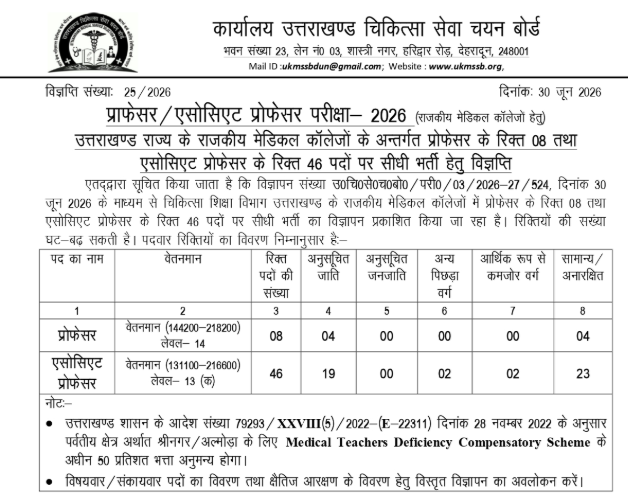
UKMSSB Associate Professor Syllabus: The Uttarakhand Medical Service Selection Board (UKMSSB) conducts recruitment for Associate Professors in Government Medical Colleges.
Important Update (2026):
- Selection is primarily merit-based (API system + Interview) for medical streams.
- In some cases (like nursing/teaching cadres), a written exam pattern may also apply.
UKMSSB Associate Professor Exam Pattern 2026 (Medical Streams)
| Component |
Marks |
Details |
| Research Publications |
20 |
As per NMC/MCI norms (max 20 marks) |
| Teaching Experience |
20 |
4 marks per year after eligibility |
| Higher Qualification |
10 |
DM/M.Ch/DNB Super Speciality |
| Interview (Viva Voce) |
50 |
Subject knowledge + personality |
| Total |
100 Marks |
Final merit-based selection |
This is the primary selection method for clinical & non-clinical medical faculty posts.
Written Exam Pattern (Applicable in Some Streams like Nursing / Academic Posts)
| Paper |
Subjects |
Marks |
Duration |
| Paper 1 |
Research, Education, Teaching, Specialty Basics |
100 |
1.5 Hours |
| Paper 2 |
Core Medical Subjects (Specialization) |
200 |
3 Hours |
| Paper 3 |
GK, Teaching Aptitude, Uttarakhand Knowledge |
100 |
1.5 Hours |
| Interview |
Personality & Subject |
50 |
— |
| Total |
— |
450 Marks |
— |
Negative marking: 0.25 marks deducted per wrong answer
UKMSSB Associate Professor Syllabus 2026 (All Medical Streams)
The syllabus is NOT fixed like UPSC-type exams — it depends on specialization (branch-specific).
(A) Common Subjects (All Streams)
| Subject Area |
Topics Covered |
| Teaching Aptitude |
Teaching methods, evaluation, pedagogy |
| Medical Education |
Curriculum planning, assessment systems |
| Research Methodology |
Biostatistics, research design, ethics |
| General Knowledge |
National & State current affairs |
| Uttarakhand GK |
History, geography, health schemes |
(B) Core Medical Subjects (Stream-wise)
1. Clinical Subjects (MD/MS)
| Stream |
Major Topics |
| Medicine |
Cardiology, Neurology, Endocrinology, Infectious Diseases |
| Surgery |
General Surgery, GI Surgery, Trauma, Oncology |
| Obstetrics & Gynaecology |
Pregnancy, Labour, Infertility, Gynecological disorders |
| Pediatrics |
Neonatology, Growth & Development, Pediatric diseases |
| Orthopedics |
Bone disorders, fractures, spine, joint diseases |
| Psychiatry |
Mental disorders, therapy, pharmacology |
2. Non-Clinical Subjects
| Stream |
Major Topics |
| Anatomy |
Gross anatomy, histology, embryology |
| Physiology |
Systems physiology, neurophysiology |
| Biochemistry |
Metabolism, enzymes, molecular biology |
| Pharmacology |
Drugs, mechanisms, adverse effects |
| Microbiology |
Bacteriology, virology, immunology |
| Pathology |
General & systemic pathology |
3. Para-Clinical Subjects
| Stream |
Major Topics |
| Community Medicine |
Epidemiology, public health, national programs |
| Forensic Medicine |
Legal medicine, toxicology |
| Radiology |
Imaging techniques, diagnosis |
| Anesthesia |
Drugs, procedures, critical care |
4. Super-Speciality Subjects
| Stream |
Topics |
| Cardiology |
Cardiac diseases, interventions |
| Neurology |
CNS disorders |
| Nephrology |
Kidney diseases, dialysis |
| Oncology |
Cancer diagnosis & treatment |
(C) Nursing / Allied Medical Streams (if applicable)
| Subject |
Topics |
| Nursing Research |
Methods, statistics |
| Clinical Nursing |
Medical-surgical, pediatric, OBG |
| Community Health |
Public health nursing |
| Psychology |
Mental health |
These topics are more relevant where written exams are conducted.
3. Selection Process (Step-by-Step)
| Stage |
Description |
| Step 1 |
Application Screening |
| Step 2 |
API Score (Publications + Experience) |
| Step 3 |
Written Exam (if applicable) |
| Step 4 |
Interview |
| Final |
Merit List |
UKMSSB Associate Professor Detailed Syllabus (Stream-wise)
1. General Medicine (MD Medicine) Syllabus
| Unit |
Topics |
| Cardiovascular System |
Hypertension, Heart Failure, Ischemic Heart Disease, Arrhythmias |
| Respiratory System |
Asthma, COPD, Tuberculosis, Interstitial Lung Disease |
| Gastroenterology |
Liver Cirrhosis, Hepatitis, GI Bleeding, Pancreatitis |
| Neurology |
Stroke, Epilepsy, Parkinson’s, Neuropathies |
| Endocrinology |
Diabetes Mellitus, Thyroid Disorders, Adrenal Disorders |
| Nephrology |
Acute & Chronic Kidney Disease, Dialysis, Electrolyte imbalance |
| Hematology |
Anemia, Leukemia, Coagulation Disorders |
| Infectious Diseases |
HIV, Malaria, Dengue, Sepsis |
| Rheumatology |
SLE, Rheumatoid Arthritis |
| Critical Care |
ICU management, Shock, Ventilator support |
Focus: Clinical diagnosis + management + recent guidelines (WHO/NMC protocols)
2. General Surgery (MS Surgery) Syllabus
| Unit |
Topics |
| General Principles |
Wound healing, Shock, Fluid & Electrolyte balance |
| GI Surgery |
Hernia, Appendicitis, Intestinal obstruction, Colorectal diseases |
| Hepatobiliary |
Gallstones, Liver tumors, Portal hypertension |
| Endocrine Surgery |
Thyroid, Parathyroid, Adrenal tumors |
| Oncology |
Tumor biology, Cancer staging, Surgical oncology |
| Trauma & Emergency |
Polytrauma, Burns, Emergency procedures |
| Urology Basics |
Prostate enlargement, Renal stones |
| Vascular Surgery |
Aneurysm, Peripheral vascular disease |
| Minimal Access Surgery |
Laparoscopy, Endoscopy |
| Pre & Post-operative Care |
ICU care, complications management |
Reference level: Bailey & Love + standard MS curriculum
3. Anatomy (Non-Clinical) Syllabus
| Unit |
Topics |
| General Anatomy |
Cell structure, tissues (epithelial, connective, muscle, nerve) |
| Gross Anatomy |
Upper limb, lower limb, thorax, abdomen, head & neck |
| Histology |
Microscopic structure of organs (lungs, liver, kidney, etc.) |
| Embryology |
Fertilization, organ development, congenital anomalies |
| Neuroanatomy |
Brain, spinal cord, cranial nerves |
| Genetics |
Mendelian laws, chromosomal disorders |
| Radiological Anatomy |
X-ray, CT, MRI interpretation |
| Applied Anatomy |
Clinical correlations, surgical anatomy |
Includes regional anatomy + embryology + applied aspects
4. Physiology
| Unit |
Topics |
| General Physiology |
Cell function, homeostasis |
| Cardiovascular |
Cardiac cycle, BP regulation |
| Respiratory |
Gas exchange, lung function |
| CNS |
Reflexes, higher functions |
| Endocrine |
Hormonal regulation |
| Renal |
Urine formation, acid-base balance |
| Gastrointestinal |
Digestion, absorption |
5. Biochemistry
| Unit |
Topics |
| Metabolism |
Carbohydrates, proteins, lipids |
| Enzymes |
Function, kinetics |
| Molecular Biology |
DNA, RNA, genetics |
| Clinical Biochemistry |
Liver function, renal function tests |
| Nutrition |
Vitamins, minerals |
6. Pharmacology
| Unit |
Topics |
| General Pharmacology |
Pharmacokinetics, pharmacodynamics |
| Drug Groups |
Antibiotics, CNS drugs, CVS drugs |
| Chemotherapy |
Anti-cancer, anti-TB drugs |
| Toxicology |
Poisoning management |
| Clinical Pharmacology |
Adverse drug reactions |
7. Pathology
| Unit |
Topics |
| General Pathology |
Inflammation, necrosis, neoplasia |
| Hematology |
Blood disorders |
| Systemic Pathology |
Organ-wise diseases |
| Clinical Pathology |
Lab diagnosis |
8. Community Medicine (PSM)
| Unit |
Topics |
| Epidemiology |
Study design, disease distribution |
| Biostatistics |
Data analysis |
| National Health Programs |
TB, HIV, immunization |
| Environmental Health |
Water, sanitation |
| Health Management |
Policies, planning |
9. Pediatrics
| Unit |
Topics |
| Neonatology |
Newborn care |
| Growth & Development |
Milestones |
| Pediatric Diseases |
Infections, malnutrition |
| Immunization |
Vaccination schedule |
10. Obstetrics & Gynaecology
| Unit |
Topics |
| Obstetrics |
Pregnancy, labor, complications |
| Gynaecology |
Fibroids, infertility |
| Reproductive Health |
Family planning |
Important Notes for UKMSSB Preparation
- Level = MD/MS (PG level) + Teaching orientation
- Questions (if exam held) are clinical + applied + case-based
- Interview focuses on:
- Teaching ability
- Clinical decision-making
- Research publications
Key Takeaways
- Medical Associate Professor recruitment (2026) is mainly interview + academic score-based
- Written exam is not always conducted for MBBS/MD/MS streams
- Syllabus is branch-specific (MD/MS/DM/MCh level)
- Strong focus on teaching experience + research publications
- Interview carries highest weightage (50%)
UKMSSB Associate Professor – High Weightage Topics (Stream-wise)
General Medicine (Very High Weightage)
| Area |
High-Weightage Topics |
| Cardiology |
Myocardial Infarction, Heart Failure, Arrhythmias, Hypertension |
| Respiratory |
COPD, Asthma, ARDS, Tuberculosis |
| Endocrine |
Diabetes Mellitus (insulin therapy), Thyroid disorders |
| Neurology |
Stroke (CVA), Epilepsy, Parkinsonism |
| Nephrology |
Acute Kidney Injury, CKD, Dialysis, Electrolyte imbalance |
| Infectious Diseases |
Sepsis, HIV, Dengue, Malaria |
| Gastroenterology |
Cirrhosis, Hepatitis, GI Bleed |
| Critical Care |
Shock (types & management), ICU protocols |
These areas dominate because clinical decision-making questions are common.
General Surgery (Very High Weightage)
| Area |
High-Weightage Topics |
| General Surgery |
Shock, Wound healing, Fluid & electrolyte balance |
| GI Surgery |
Hernia, Appendicitis, Intestinal obstruction |
| Hepatobiliary |
Gallstones, Liver disease |
| Oncology |
Cancer staging, tumor biology |
| Trauma |
Polytrauma, Burns management |
| Endocrine Surgery |
Thyroid disorders |
| Urology |
Renal stones, Prostate enlargement |
| Perioperative Care |
Pre-op & Post-op complications |
Focus on case-based surgical management (very important).
Anatomy (Moderate–High Weightage)
| Area |
High-Weightage Topics |
| Gross Anatomy |
Head & Neck, Abdomen, Neuroanatomy |
| Neuroanatomy |
Cranial nerves, Brain pathways |
| Embryology |
Development anomalies |
| Histology |
Liver, Kidney, Lung slides |
| Applied Anatomy |
Surgical anatomy, clinical correlations |
| Radiological Anatomy |
CT/MRI interpretation basics |
Viva-based subject → applied & diagram-oriented questions
Physiology (Moderate Weightage)
| Area |
High-Weightage Topics |
| Cardiovascular |
Cardiac cycle, BP regulation |
| Respiratory |
Lung volumes, gas exchange |
| CNS |
Reflexes, higher functions |
| Endocrine |
Hormonal regulation |
| Renal |
Acid-base balance |
Biochemistry (Moderate Weightage)
| Area |
High-Weightage Topics |
| Metabolism |
Carbohydrate & lipid metabolism |
| Enzymes |
Kinetics, regulation |
| Molecular Biology |
DNA replication, mutations |
| Clinical Biochemistry |
LFT, RFT |
| Nutrition |
Vitamins deficiencies |
6. Pharmacology (High Weightage)
| Area |
High-Weightage Topics |
| General |
Pharmacokinetics & dynamics |
| CVS Drugs |
Antihypertensives, Antiarrhythmics |
| CNS Drugs |
Antipsychotics, Antidepressants |
| Antibiotics |
Mechanism & resistance |
| Chemotherapy |
Anti-TB, Anti-cancer drugs |
| Toxicology |
Poison management |
Frequently asked due to clinical application + prescriptions
Pathology (Very High Weightage)
| Area |
High-Weightage Topics |
| General Pathology |
Inflammation, Necrosis |
| Hematology |
Anemia, Leukemia |
| Neoplasia |
Tumor markers, staging |
| Systemic Pathology |
Organ-specific diseases |
| Lab Diagnosis |
Biopsy, cytology |
Community Medicine (PSM) (High Weightage)
| Area |
High-Weightage Topics |
| Epidemiology |
Study design, incidence/prevalence |
| Biostatistics |
Mean, SD, sampling |
| National Programs |
TB, HIV, Immunization |
| Public Health |
Screening, prevention levels |
| Health Policies |
Government schemes |
Highly scoring + frequently asked in teaching interviews
Pediatrics (High Weightage)
| Area |
High-Weightage Topics |
| Neonatology |
Resuscitation, newborn care |
| Growth |
Development milestones |
| Diseases |
Malnutrition, infections |
| Immunization |
Vaccination schedule |
Obstetrics & Gynaecology (High Weightage)
| Area |
High-Weightage Topics |
| Obstetrics |
Normal labor, PPH, Eclampsia |
| Antenatal Care |
High-risk pregnancy |
| Gynaecology |
Fibroids, Infertility |
| Family Planning |
Contraceptive methods |
MOST IMPORTANT “REPEATED” TOPICS (Across All Subjects)
These are must-do topics (highest ROI):
- Shock & emergency management
- Diabetes & hypertension
- Infection control & sepsis
- Pre/post-operative care
- National health programs
- Drug mechanisms & clinical use
- ICU & critical care basics
These areas are repeatedly emphasized in clinical exams and interviews.
Smart Preparation Strategy (Topper Approach)
- 60% time → Core clinical subjects (Medicine + Surgery + Pathology)
- 20% → Supporting subjects (Pharma + PSM)
- 20% → Basic sciences (Anatomy + Physiology)
- Focus on case-based learning + viva questions
- Revise standard textbooks + recent guidelines
Preparation Strategy (Quick Tips)
- Focus on your specialization (PG level concepts)
- Prepare research methodology & teaching aptitude
- Revise recent medical guidelines & protocols
- Keep publications & CV strong (very important)
About The Author
Brajesh (MCA, M.Tech (IT)) is a passionate education and career content creator with a strong academic background in Computer Applications (MCA) and Technology (M.Tech). With years of hands-on experience in exam preparation strategies, syllabus analysis, and government job updates, he helps students and aspirants navigate their academic and professional journeys with clarity and confidence.