
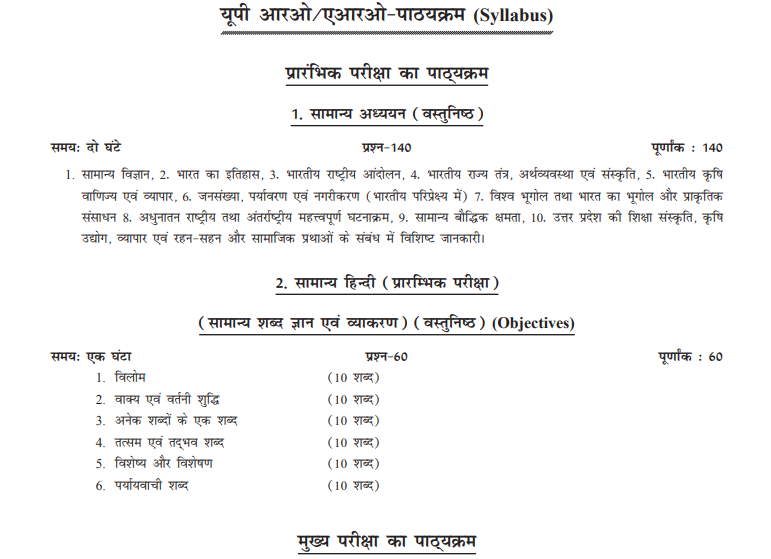
The UPPSC RO ARO Syllabus 2026 has been released by the Uttar Pradesh Public Service Commission (UPPSC) for the upcoming Review Officer (RO) and Assistant Review Officer (ARO) examination. This highly competitive exam aims to recruit qualified candidates for administrative roles in various government departments of Uttar Pradesh. Understanding the detailed syllabus is crucial for aspirants who wish to secure a position through this prestigious exam. The syllabus is divided into two main stages: Preliminary Examination and Main Examination. The Preliminary stage tests candidates’ general awareness, reasoning ability, and command over the Hindi language, while the Main stage focuses on advanced Hindi, essay writing, and general studies. The exam emphasises a candidate’s analytical skills, comprehension, and knowledge of Indian polity, history, economy, and current affairs. The UPPSC RO ARO 2026 syllabus ensures a comprehensive evaluation of a candidate’s intellectual and linguistic abilities. Candidates preparing for this exam should study the topics systematically and practice regularly to improve speed and accuracy. A clear understanding of the syllabus helps in effective time management and targeted preparation, making it a key step toward success in the UPPSC RO ARO 2026 examination.
UPPSC RO ARO Syllabus: Key Insight
-
The pattern for Prelims is clearly two papers: General Studies (140 marks) + General Hindi (60 marks) for 200 marks.
-
For Mains: total about 400 marks (~120 + 100 + 60 + 120) depending on sources.
-
Emphasis on UP‐specific topics appears stronger (as per multiple sources).
-
The descriptive/writing component (drafting + essay) is significant, not just multiple choice.
UPPSC RO ARO Syllabus 2026
The subject-wise syllabus for the Uttar Pradesh Public Service Commission (UPPSC) RO/ARO (Review Officer / Assistant Review Officer) 2026 examination: covering both Prelims and Mains stages. Use it as a framework for your preparation, and always cross-check with the official notification when it is released.
UPPSC RO ARO Exam Pattern 2026
Prelims
-
Two papers:
-
General Studies – 140 marks (140 questions)
-
General Hindi – 60 marks (60 questions)
-
-
Duration: 2 hours for GS, and 1 hour for Hindi (some sources say 3 hours total)
-
Negative marking: ⅓ mark for each wrong answer.
Mains
-
Three papers:
-
Paper 1: General Studies – 120 marks, 2 hours
-
Paper 2: General Hindi & Drafting – 100 marks (Conventional) + 60 marks (Vocabulary) = 160 marks; conventional part ~150 mins, vocabulary ~30 mins.
-
Paper 3: Hindi Essay – 120 marks, about 3 hours.
-
-
Typing test (qualifying) for certain posts (e.g., ARO) may be required.
UPPSC RO ARO Syllabus 2026 for Prelims Exams
UPPSC RO/ARO Prelims Syllabus 2026 form prelims exam in tabular form.
| Paper | Subject | Topics Covered |
|---|---|---|
| Paper 1 | General Studies | • General Science • History of India • Indian National Movement • Indian Polity, Economy & Culture • Indian Agriculture, Commerce & Trade • Population, Ecology & Urbanisation (Indian Context) • World Geography & Geography of India (Natural Resources) • Current Events (National & International) • General Intelligence • Special Knowledge of Uttar Pradesh (Education, Culture, Agriculture, Industry, Trade, Living & Social Traditions) |
| Paper 2 | General Hindi | • Antonyms (विलोम शब्द) • Synonyms (पर्यायवाची) • One Word Substitution • Sentence Correction • Correct Usage of Words • Adjectives & Grammar Usage |
Prelims
1. General Studies
Key topics:
-
History of India; Indian national movement.
-
Indian polity, economy and culture.
-
Geography (India & world) and natural resources.
-
Population, ecology and urbanisation (in the Indian context).
-
Indian agriculture, commerce and trade.
-
General science (basic concepts and applications).
-
Current events of national and international importance.
-
Specialised knowledge regarding the state of Uttar Pradesh: its education, culture, agriculture, industry, trade, and living traditions.
2. General Hindi
Key topics:
-
Antonyms & synonyms.
-
Sentence correction/framing.
-
One-word substitution.
-
Words with the same usage / same nature.
-
Adjectives, general vocabulary.
UPPSC RO ARO Syllabus 2026 for Mains Exam
Mains
Paper 1 – General Studies
More in-depth coverage of topics from Prelims, plus analytical/essay-style questions. Topics include:
-
History of India & the Indian national movement.
-
Indian polity and constitution; governance; economy and planning.
-
Indian and world geography; natural resources; features of India & Uttar Pradesh.
-
Population, ecology, urbanisation (Indian context).
-
Agriculture, commerce, and trade in India.
-
General science & technology (as applied).
-
Current national & international events.
-
Specialised knowledge regarding the state of Uttar Pradesh (education, culture, agriculture industry, trade, living & social traditions).
Paper 2 – General Hindi & Drafting
Part 1 (Conventional – 100 marks):
-
Heading of a given passage; précis writing; explanation of underlined parts.
-
Precisely in tabular form of a given government letter.
-
Correspondence: Official/Demi-official letters; office memo/circular; communique; annotation & reports/reminder.
-
Definition vocabulary (administrative & commercial): English→Hindi (five words); Hindi→English (five words); idioms & phrases (five).
-
Computer knowledge (basic) for drafting – some sources mention.
Part 2 – General Vocabulary – 60 marks:
-
Antonyms (6 words)
-
One word for several words (6)
-
Sentence correction/framing (6 sentences)
-
Derived forms (noun/adjective) (6 words)
-
Same usage / same nature words (6)
Paper 3 – Hindi Essay
-
Three essays (candidates choose one topic from each of three sections)
-
Literature & cultures; social field; political field.
-
Science, ecology & technology; the economy field; agriculture & commerce.
-
National & international events; natural calamities (earthquake, cyclone, flood, drought) & national development plans.
-
-
Word-limit: ~600 words each (approx) and each essay ~40 marks (3 essays = 120 marks)
Books to Cover UP RO ARO Syllabus
-
Drishti Uttar Pradesh RO/ARO 4th Edn: A very good comprehensive book in Hindi covering GS + UP-specific topics. Useful if you prefer Hindi medium and want consolidated coverage.
-
Drishti The Vision Uttar Pradesh RO/ARO: Similar scope, alternate edition — gives you choices if one version appears less available or you want a fresh layout.
-
Ghatna Chakra RO/ARO Hindi Guide (Pre+Main): Focused on Hindi medium, emphasises previous years’ solved papers + practice sets. Strong for revision and sharpening exam-pattern familiarity.
-
Ghatna Chakra UPPSC RO/ARO 2026 Complete GS Revision: A revision-oriented book for General Studies, again Hindi medium — useful closer to exam when you want to revise quickly.
-
Sharda UPPSC RO/ARO 2026-27 Prelim & Main Samanya Hindi: Specifically for the Hindi section (grammar, vocabulary, correspondence) — vital because the Hindi section is high-scoring if prepared well.
-
Drishti IAS Uttar Pradesh RO/ARO 3rd Edn: Another comprehensive alternative; good to have backup/alternate perspective, especially if you prefer variation in presentation.
-
(The last two are placeholders for general reference books; you might consider standard texts like Indian Polity by M. Laxmikanth, ‘Lucent General Science’, etc., mentioned in sources.)
Tips for Using the Books & Strategy
Here are some practical tips so you don’t just buy books but use them efficiently:
-
Choose one comprehensive GS book (like Drishti or Ghatna Chakra) and one dedicated Hindi/Correspondence book. Overloading with many GS books may confuse you.
-
Use previous year papers a lot. For example, the Ghatna Chakra guide emphasises solved papers. This helps you understand what kind of questions keep coming.
-
For the General Hindi section: Focus on grammar, vocabulary (synonyms/antonyms), one-word substitution, idioms/phrases, and sentence correction — these occur frequently in RO/ARO.
-
UP-specific topics: Since the syllabus explicitly mentions “living & social traditions of Uttar Pradesh”, “agriculture, commerce & trade of UP”, etc., you should pick books that cover these (often state-specific booklets).
-
Revision: After you finish primary reading, use a revision book like the “Complete GS Revision” to polish in last phase.
-
Mock tests & timed practice: The pattern involves negative marking (⅓ for wrong answers) in prelims. So timed MCQ practice is critical.
-
Drafting & correspondence (Mains Paper 2): Don’t ignore this just because it seems Hindi/desk work. Books that cover official letter, memo, circular, precis will give you model formats and practice. You’ll want a dedicated section/book for this.
-
Stay updated with current affairs: The GS syllabus includes “current events of national & international importance”. Use monthly magazines/newspapers along with the books.
-
Make short notes: For UP-state data/facts/traditions, make handwritten notes/flashcards so easy to revise.
-
Stick to one medium: If you prefer Hindi medium, most of these books are in Hindi. If you prefer English, verify edition language. But sticking to one language avoids confusion.
Subject-Wise Book Suggestions
Here’s a mini table of “subject → book suggestion”:
| Subject | Recommended Book(s) |
|---|---|
| General Studies (GS) | Drishti UPRO/ARO 4th Edn; Ghatna Chakra GS Revision |
| UP-specific (agri/industry/trade/culture) | The same GS books if they include UP-specific chapters. Check index. |
| General Hindi (Grammar & Vocab) | Sharda Samanya Hindi; Ghatna Chakra Hindi Guide |
| Drafting/Official Correspondence | Look for specific chapters in the Hindi/Correspondence book (Sharda or similar) |
| Previous Year Papers / Practice Tests | Ghatna Chakra Pre+Main guide; practice sets in Drishti editions |
| Current Affairs / Optional Additional GS Support | Use newspapers + a magazine; standard reference books like Indian Polity (Laxmikanth) for polity section |
Things to Watch Out For
-
Ensure you buy the latest edition (2026/2027) since the exam pattern and syllabus can be updated.
-
For Hindi Drafting/Correspondence, check the book includes official letters, memos, reports, etc., not just grammar. The syllabus emphasises that.
-
Don’t ignore “state‐specific” content (Uttar Pradesh), many main questions will lean on that.
-
Avoid buying too many books — stick to minimal and revise thoroughly rather than having half-read many.
-
Use mock tests under timed conditions to simulate exam pressure and negative marking.
-
Remember: For prelims, you’ll need to cross the cutoff in both GS and Hindi sections; good performance in Hindi can give a safety buffer.
FAQs
1. What are the exam stages for RO/ARO 2026?
Answer: The selection process for RO/ARO is comprised of three main stages:
-
Preliminary (Prelims): objective‐type screening test.
-
Main Examination (Mains): descriptive/subjective papers.
-
Typing Test / Skill Test: for posts like ARO, a typing/computer test may be required.
2. What is the syllabus for the Prelims stage?
Answer: The Prelims stage has two papers:
-
Paper 1: General Studies – includes topics such as History of India, Indian National Movement, Indian Polity, Economy & Culture, Geography & Natural Resources of India & World Geography, Population, Ecology & Urbanisation (Indian context), Indian Agriculture, Commerce & Trade, General Science, Current Events of National & International importance, and specialised knowledge about Uttar Pradesh (education, culture, agriculture, industry, trade, living & social traditions).
-
Paper 2: General Hindi – covers antonyms, one-word substitution, sentence correction/framing, adjectives, synonyms, same usage/same nature words.
3. What is the syllabus for the Mains stage?
Answer: The Mains exam has three papers:
-
Paper 1: General Studies – similar topics as in Prelims but in more depth, including Uttar Pradesh-specific content.
-
Paper 2: General Hindi & Drafting – tasks such as writing headings for passages, precis, explanation of underlined parts, correspondence (official/demi-official letters, memos/circulars), communicique/annotation/reports/reminders, vocabulary (English→Hindi, Hindi→English, idioms/phrases), and computer knowledge part.
-
Paper 3: Hindi Essay – candidates must write essays (given topics) in Hindi on literature & culture, social/political fields, science/ecology/technology, economics/agriculture/commerce, national/international events, natural calamities, departmental plans, etc.
4. What is the exam pattern (marking scheme, duration) for Prelims & Mains?
Answer:
-
Prelims: Two papers (General Studies + General Hindi). Example pattern: Paper 1 (General Studies) — 140 marks; Paper 2 (General Hindi) — 60 marks; total 200 marks. Duration: e.g., Paper 1 – 120 minutes, Paper 2 – 60 minutes.
-
Mains: Three papers. Example: Paper 1 – General Studies: 120 marks, 120 minutes. Paper 2 – General Hindi & Drafting: Part 1: 100 marks (150 minutes), Part 2: 60 marks (30 minutes). Paper 3 – Hindi Essay: 120 marks, 180 minutes. Total approx. 400 marks.
5. Is there negative marking in Prelims?
Answer: Yes — for Prelims objective questions, there is a deduction (commonly 0.33 marks) for every wrong answer.
6. What are the major topics in the syllabus that candidates should focus on?
Answer: Some high‐weight or core topics include:
-
History of India & Indian National Movement
-
Indian Polity, Economy & Culture
-
Geography & Natural Resources of India and World Geograph
-
Population, Ecology & Urbanisation (Indian context)
-
Indian Agriculture, Commerce & Trade
-
General Science (basic level)
-
Specialised knowledge about Uttar Pradesh – its education, culture, industry, traditions, trade, etc.
-
For Hindi & Drafting papers – correspondence, vocabulary (English-Hindi/Hindi-English), official letter writing, etc.
7. Are the Prelims marks counted in final merit?
Answer: No. The Prelims serves primarily as a screening/qualifying stage. Only the Mains (and further stages) contribute to final selection.
8. Is the Typing Test mandatory?
Answer: Yes—after Mains, shortlisted candidates are expected to undergo a Typing/Skill Test (qualifying in nature) especially for ARO post.
9. Do I need to prepare differently for Uttar Pradesh‐specific topics?
Answer: Yes—with a dedicated portion of the syllabus covering topics specific to Uttar Pradesh (its education system, agriculture, industry, trade, living conditions, social traditions). Focusing on state‐specific facts & figures will give an edge.
10. Where can I download the official syllabus / PDF?
Answer: You can download the syllabus from the official UPPSC website. Many educational portals also provide PDF versions of the syllabus.
11. How should I approach preparation strategy with this syllabus?
Answer: Suggested strategy:
-
Start with the core topics (History, Polity, Geography, Economy etc.).
-
Simultaneously, build strong vocabulary & drafting skills for Hindi & Official correspondence.
-
For UP‐specific topics, collect current data, government schemes, industrial/trade developments in UP.
-
Practice previous year papers & mock tests (particularly for objective Prelims).
-
For the Mains Hindi Essay & Drafting, practise writing well‐structured answers and official letter formats.
-
Manage time: ensure you’re comfortable with both objective speed and descriptive writing.
-
Keep updating current affairs (national & international) and UP state developments.
12. Any changes noted in the syllabus/pattern vs earlier years?
Answer: You should check each year’s official notification carefully. For 2026, some sources mention updated durations, marks, and emphasised UP-specific content. For example, some portals mention the Prelims duration as 3 hours total for both papers.
About The Author
