
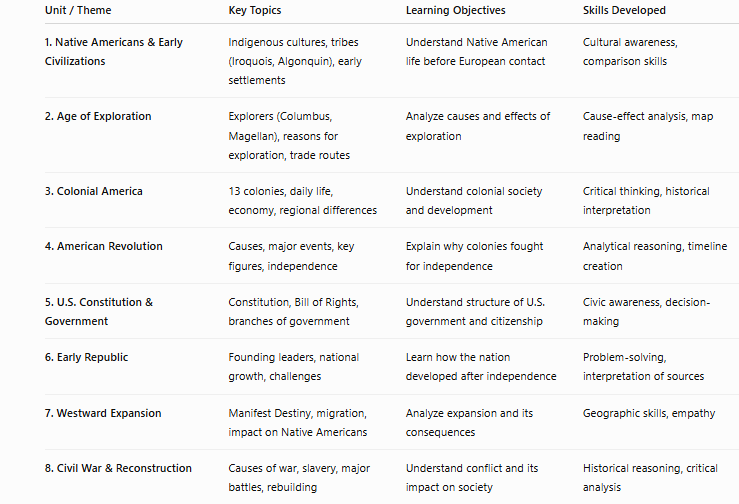
The US Grade 5 Social Studies Curriculum 2026 primarily focuses on United States history, geography, civics, and economics, helping students understand how the nation was formed and how it functions today. At this level, learners explore early American history (pre-colonial to early republic), develop map and analytical skills, and gain awareness of citizenship and governance.
Students are encouraged to use primary sources, maps, discussions, and projects to analyze events, build critical thinking, and connect past events with present society.
US Grade 5 Social Studies Curriculum 2026
| Unit / Theme | Key Topics | Learning Objectives | Skills Developed | Assessment Methods |
|---|---|---|---|---|
| 1. Native Americans & Early Civilizations | Indigenous cultures, tribes (Iroquois, Algonquin), early settlements | Understand Native American life before European contact | Cultural awareness, comparison skills | Projects, presentations, worksheets |
| 2. Age of Exploration | Explorers (Columbus, Magellan), reasons for exploration, trade routes | Analyze causes and effects of exploration | Cause-effect analysis, map reading | Quizzes, map activities |
| 3. Colonial America | 13 colonies, daily life, economy, regional differences | Understand colonial society and development | Critical thinking, historical interpretation | Essays, group discussions |
| 4. American Revolution | Causes, major events, key figures, independence | Explain why colonies fought for independence | Analytical reasoning, timeline creation | Tests, role-play activities |
| 5. U.S. Constitution & Government | Constitution, Bill of Rights, branches of government | Understand structure of U.S. government and citizenship | Civic awareness, decision-making | Debates, mock government activities |
| 6. Early Republic | Founding leaders, national growth, challenges | Learn how the nation developed after independence | Problem-solving, interpretation of sources | Assignments, class discussions |
| 7. Westward Expansion | Manifest Destiny, migration, impact on Native Americans | Analyze expansion and its consequences | Geographic skills, empathy | Map work, case studies |
| 8. Civil War & Reconstruction | Causes of war, slavery, major battles, rebuilding | Understand conflict and its impact on society | Historical reasoning, critical analysis | Exams, project work |
| 9. Geography & Map Skills | Maps, continents, states, regions, resources | Interpret geographic data and locations | Map reading, spatial thinking | Practical tests, activities |
| 10. Economics Basics | Supply & demand, trade, personal finance | Understand economic decisions and systems | Financial literacy, reasoning | Worksheets, real-life examples |
| 11. Civics & Citizenship | Rights, responsibilities, democracy | Develop responsible citizenship | Communication, civic participation | Debates, presentations |
| 12. Social Studies Skills | Timelines, primary/secondary sources, research | Analyze historical information and sources | Inquiry skills, research skills | Research projects, reports |
Key Highlights of Grade 5 Social Studies
- Focus is mainly on U.S. History (founding to Civil War)
- Includes geography, civics, and economics integration
- Emphasizes critical thinking, inquiry-based learning, and real-world connections
- Uses primary sources, debates, and collaborative activities for deeper understanding.
1. History Syllabus (Grade 5)
Key Themes
The Grade 5 history curriculum emphasizes U.S. history from early settlements to the formation of the nation.
Major Units / Topics
- Native American Cultures
- Regional tribes (Plains, Southwest, Eastern Woodlands)
- Lifestyle, environment, and traditions
- Impact of geography on living patterns
- European Exploration & Colonization
- Reasons for exploration (trade, religion, expansion)
- Early colonies (Jamestown, Plymouth)
- Interaction with Native Americans
- Colonial Life
- Economy, culture, and daily life in colonies
- Slavery and early labor systems
- American Revolution
- Causes (taxation, British policies)
- Key events (Boston Tea Party, battles)
- Important leaders
- Formation of the United States
- Declaration of Independence
- Articles of Confederation
- U.S. Constitution
- Early Republic & Expansion
- Growth of the nation
- Westward expansion and migration
- Early economic development
Students learn to analyze cause and effect, compare perspectives, and interpret historical sources.
2. Geography Syllabus (Grade 5)
Key Themes
Geography helps students understand how physical and human factors shaped U.S. development.
Core Topics
- Map Skills & Tools
- Reading maps, globes, atlases
- Latitude, longitude, compass directions
- Interpreting historical maps
- Physical Geography of the U.S.
- Mountains, rivers, plains, climate zones
- Natural resources and their distribution
- Human Geography
- Population distribution
- Settlement patterns
- Cultural regions
- Geography & History Connection
- How geography influenced colonization
- Trade routes and expansion
- Environment & Human Interaction
- Use of natural resources
- Impact of human activities on the environment
Students use maps and geographic tools to interpret historical events and spatial patterns.
3. Civics (Government) Syllabus
Key Themes
Civics introduces students to government structure, citizenship, and democratic values.
Core Topics
- Foundations of Government
- Purpose of government
- Democracy and rule of law
- U.S. Constitution
- Basic principles (freedom, equality, justice)
- Structure of the Constitution
- Three Branches of Government
- Legislative, Executive, Judicial
- Roles and responsibilities
- Rights & Responsibilities of Citizens
- Voting, laws, civic duties
- Rights like freedom of speech and religion
- Local, State & Federal Government
- Levels of government
- How laws are made
- Civic Values
- Equality, liberty, justice
- Respect for diversity and participation
Students learn citizenship skills, civic responsibility, and democratic participation.
4. Curriculum Overview Table
| Subject Area | Key Focus | Major Topics |
|---|---|---|
| History | U.S. development | Native Americans, Colonization, Revolution, Constitution |
| Geography | Land & people | Maps, physical features, human settlement |
| Civics | Government & citizenship | Constitution, rights, branches of government |
| Economics (Integrated) | Basic economy | Trade, resources, economic choices |
5. Skills Developed
- Critical thinking & inquiry
- Map reading and spatial understanding
- Historical analysis using evidence
- Civic awareness and participation
- Communication (discussion, writing, presentations)
Conclusion
The Grade 5 Social Studies Curriculum 2026 (USA) builds a strong foundation in history, geography, and civics, focusing mainly on the origins and development of the United States. Students not only learn facts but also develop analytical, research, and citizenship skills. This curriculum prepares learners to understand their role in society and become informed, responsible citizens in a democratic nation.
About The Author
