The NIOS Syllabus 2026 is designed by the National Institute of Open Schooling (NIOS) to provide flexible and learner-friendly education for both Class 10 (Secondary) and Class 12 (Senior Secondary) students. The syllabus follows modern educational guidelines aligned with NEP 2020, focusing on conceptual understanding, skill development, and self-paced learning.
In this article, you will get a complete breakdown of the NIOS syllabus for Classes 10 and 12, including subject lists, exam pattern, and preparation tips.
Overview of NIOS Syllabus 2026
| Particular | Details |
|---|---|
| Board Name | National Institute of Open Schooling (NIOS) |
| Classes | Class 10 (Secondary) & Class 12 (Senior Secondary) |
| Subjects | 18+ (Class 10), 30+ (Class 12) |
| Marks Distribution | 80 (Theory) + 20 (TMA/Practical) |
| Passing Marks | 33% per subject |
| Exam Sessions | April & October |
| Mode | Flexible + On-Demand Exams |
Students must select at least 5 subjects, including one language subject.
NIOS Class 10 Syllabus 2026
The NIOS 10th syllabus is designed to build a strong foundation in academics along with skill-based learning.
NIOS Class 10 Subject List
1. Language Subjects
- Hindi (201)
- English (202)
- Urdu, Sanskrit, Punjabi (optional)
2. Core Subjects
- Mathematics (211)
- Science & Technology (212)
- Social Science (213)
3. Commerce & Humanities Subjects
- Economics (214)
- Business Studies (215)
- Accountancy (224)
- Home Science (216)
- Psychology (222)
- Indian Culture & Heritage (223)
4. Vocational Subjects
- Data Entry Operations (229)
- Painting (225)
- Music (242/243)
- Folk Art (244)
- Entrepreneurship (249)
Students can choose subjects based on their interest and future career plans.
1. Language Subjects
Language subjects are compulsory (at least one). Students can choose from:
- Hindi (201) – Grammar, comprehension, writing skills
- English (202) – Reading, writing, functional grammar
- Urdu – Literature, poetry, grammar
- Sanskrit – Basic grammar, shlokas, translation
- Punjabi – Language basics and literature
Focus: Communication skills, grammar, and comprehension ability.
2. Core Subjects
These are the main academic subjects:
- Mathematics (211)
- Number system, algebra, geometry, mensuration, statistics
- Science & Technology (212)
- Physics (motion, energy), Chemistry (atoms, reactions), Biology (life processes)
- Social Science (213)
- History, Geography, Political Science, Economics
Focus: Conceptual understanding and analytical skills.
3. Commerce & Humanities Subjects
- Economics (214) – Basic economic concepts, demand & supply
- Business Studies (215) – Trade, business environment, entrepreneurship basics
- Accountancy (224) – Bookkeeping, journal, ledger, accounts
- Home Science (216) – Nutrition, health, family resource management
- Psychology (222) – Human behavior, learning, development
- Indian Culture & Heritage (223) – Traditions, art, history of India
Focus: Practical knowledge and real-life applications.
4. Vocational Subjects
Skill-based subjects to enhance employability:
- Data Entry Operations (229) – Typing, MS Office basics
- Painting (225) – Drawing, coloring, artistic skills
- Music (242/243) – Vocal & instrumental basics
- Folk Art (244) – Traditional Indian art forms
- Entrepreneurship (249) – Business ideas, startup basics
NIOS Class 10 Important Topics
Mathematics
- Number System
- Algebra
- Geometry
- Trigonometry
- Statistics
Science & Technology
- Physics: Motion, Light, Electricity
- Chemistry: Atoms, Acids & Bases
- Biology: Life Processes, Reproduction
Social Science
- History
- Geography
- Political Science
- Economics
Deleted Syllabus (Class 10 – 2026)
- Some derivations in Science
- Selected geometry exercises
- Industrial Revolution (reduced content)
NIOS Class 12 Syllabus 2026
The NIOS 12th syllabus offers a wide range of subjects across Science, Commerce, and Arts streams, but students are free to mix subjects.
NIOS Class 12 Subject List
1. Language Subjects
- Hindi (301)
- English (302)
- Urdu, Sanskrit (optional)
2. Science Subjects
- Mathematics (311)
- Physics (312)
- Chemistry (313)
- Biology (314)
3. Commerce Subjects
- Business Studies (319)
- Accountancy (320)
- Economics (318)
4. Arts/Humanities Subjects
- History (315)
- Geography (316)
- Political Science (317)
- Sociology (331)
- Psychology (328)
5. Vocational Subjects
- Mass Communication (335)
- Data Entry Operations (336)
- Environmental Science (333)
- Tourism (337)
- Introduction to Law (338)
NIOS allows flexible subject combinations, unlike traditional boards.
1. Language Subjects
Hindi (301)
- अपठित गद्यांश एवं पद्यांश
- व्याकरण (समास, वाक्य शुद्धि, अलंकार)
- रचना लेखन (पत्र, निबंध, संवाद)
- साहित्य (कहानी, कविता, नाटक)
English (302)
- Reading Comprehension
- Writing Skills (Essay, Letter, Report)
- Grammar (Tenses, Voice, Prepositions)
- Literature (Prose & Poetry)
Urdu / Sanskrit (Optional)
- Grammar & Composition
- Classical & Modern Literature
- Translation Skills
2. Science Subjects
Mathematics (311)
- Algebra (Matrices, Determinants)
- Calculus (Limits, Derivatives, Integrals)
- Probability & Statistics
- Vectors & 3D Geometry
Physics (312)
- Mechanics (Motion, Laws of Motion)
- Electricity & Magnetism
- Optics
- Modern Physics (Atoms, Nuclei)
Chemistry (313)
- Physical Chemistry (Thermodynamics, Equilibrium)
- Organic Chemistry (Hydrocarbons, Alcohols)
- Inorganic Chemistry (Periodic Table, Coordination Compounds)
Biology (314)
- Cell Structure & Function
- Genetics & Evolution
- Human Physiology
- Ecology & Environment
3. Commerce Subjects
Business Studies (319)
- Principles of Management
- Business Environment
- Marketing Management
- Financial Management
Accountancy (320)
- Accounting Principles
- Partnership Accounts
- Company Accounts
- Financial Statements
Economics (318)
- Microeconomics (Demand, Supply)
- Macroeconomics (National Income)
- Money & Banking
- Indian Economy
4. Arts / Humanities Subjects
History (315)
- Ancient Civilizations
- Medieval India
- Modern Indian History
- Freedom Movement
Geography (316)
- Physical Geography
- Human Geography
- Indian Geography
- Maps & Practical Work
Political Science (317)
- Political Theory
- Indian Constitution
- Governance & Politics
- International Relations
Sociology (331)
- Society & Social Structure
- Culture & Social Change
- Indian Society
- Social Issues
Psychology (328)
- Basics of Psychology
- Learning & Memory
- Personality
- Mental Health
5. Vocational Subjects
Mass Communication (335)
- Communication Basics
- Journalism & Media
- Advertising
- Public Relations
Data Entry Operations (336)
- Computer Basics
- MS Office (Word, Excel)
- Data Entry Skills
- Internet & Email
Environmental Science (333)
- Ecosystem
- Biodiversity
- Pollution
- Sustainable Development
Tourism (337)
- Tourism Concepts
- Travel Management
- Indian Tourism
- Hospitality
Introduction to Law (338)
- Legal System of India
- Fundamental Rights & Duties
- Civil & Criminal Law Basics
- Consumer Rights
NIOS Class 12 Important Topics
Mathematics
- Calculus (Differentiation & Integration)
- Matrices & Determinants
- Vectors & 3D Geometry
- Linear Programming
Physics
- Mechanics
- Electricity & Magnetism
- Optics
- Modern Physics (Atoms & Nuclei)
Chemistry
- Organic Chemistry
- Physical Chemistry
- Inorganic Chemistry
Biology
- Genetics
- Human Physiology
- Ecology
Deleted Syllabus (Class 12 – 2026)
- Reduced derivations in Physics
- Shortened Business Studies topics
- Condensed World History chapters
NIOS Exam Pattern 2026
| Component | Marks |
|---|---|
| Theory Exam | 80 Marks |
| TMA / Practical | 20 Marks |
| Total | 100 Marks |
- Minimum 33% marks required to pass
- TMA (Tutor Marked Assignment) is compulsory
- Practical subjects include viva + project work
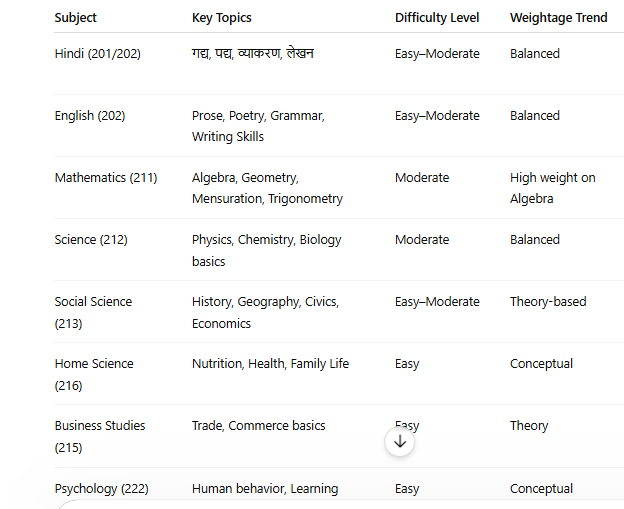
NIOS Class 10 & 12 Syllabus Analysis 2026
Detailed syllabus analysis of NIOS Class 10 & Class 12 (2026) in an easy-to-understand table format.
NIOS Class 10 (Secondary Course) Syllabus Analysis
| Subject | Key Topics | Difficulty Level | Weightage Trend | Scoring Potential | Preparation Tips |
|---|---|---|---|---|---|
| Hindi (201/202) | गद्य, पद्य, व्याकरण, लेखन | Easy–Moderate | Balanced | High | Writing practice + grammar focus |
| English (202) | Prose, Poetry, Grammar, Writing Skills | Easy–Moderate | Balanced | High | Practice comprehension & letter writing |
| Mathematics (211) | Algebra, Geometry, Mensuration, Trigonometry | Moderate | High weight on Algebra | Moderate | Focus on formulas + practice questions |
| Science (212) | Physics, Chemistry, Biology basics | Moderate | Balanced | Moderate | Concept clarity + diagrams |
| Social Science (213) | History, Geography, Civics, Economics | Easy–Moderate | Theory-based | High | Revise NCERT-style notes |
| Home Science (216) | Nutrition, Health, Family Life | Easy | Conceptual | High | Short notes & case-based prep |
| Business Studies (215) | Trade, Commerce basics | Easy | Theory | High | Understand concepts + examples |
| Psychology (222) | Human behavior, Learning | Easy | Conceptual | High | Use real-life examples |
NIOS Class 12 (Senior Secondary Course) Syllabus Analysis
| Subject | Key Topics | Difficulty Level | Weightage Trend | Scoring Potential | Preparation Tips |
|---|---|---|---|---|---|
| Hindi (301/302) | साहित्य, लेखन कौशल, व्याकरण | Easy–Moderate | Balanced | High | Practice writing formats |
| English (302) | Reading Skills, Writing, Literature | Moderate | Balanced | High | Focus on comprehension |
| Mathematics (311) | Calculus, Algebra, Vectors, Probability | Moderate–Hard | Calculus heavy | Moderate | Daily practice required |
| Physics (312) | Mechanics, Electricity, Optics | Hard | Numerical-based | Moderate | Concept + numericals |
| Chemistry (313) | Organic, Inorganic, Physical | Moderate | Organic focus | Moderate–High | Reaction practice |
| Biology (314) | Genetics, Ecology, Human Physiology | Moderate | Theory-based | High | Diagrams + NCERT concepts |
| History (315) | Ancient, Medieval, Modern India | Easy–Moderate | Theory | High | Timeline-based study |
| Geography (316) | Physical, Human, India Geography | Moderate | Diagram-based | High | Maps practice |
| Political Science (317) | Constitution, Politics, Governance | Easy | Theory | High | Current affairs link |
| Economics (318) | Micro, Macro, Indian Economy | Moderate | Conceptual | High | Graphs + definitions |
| Business Studies (319) | Management, Marketing | Easy | Theory | High | Case study approach |
| Accountancy (320) | Financial Statements, Ledger | Moderate | Numerical | Moderate | Practice daily problems |
| Psychology (328) | Behavior, Intelligence, Personality | Easy–Moderate | Conceptual | High | Examples-based prep |
Overall Analysis (Class 10 vs Class 12)
| Factor | Class 10 | Class 12 |
|---|---|---|
| Difficulty Level | Easy–Moderate | Moderate–Hard |
| Theory vs Practical | Theory heavy | Balanced |
| Scoring Subjects | Social Science, Language | Humanities & Commerce |
| Tough Subjects | Maths, Science | Maths, Physics |
| Best Strategy | Concept clarity + revision | Practice + conceptual depth |
Key Features of NIOS Syllabus 2026
- Flexible subject selection
- Self-paced learning system
- On-Demand Exam System (ODES)
- Vocational & skill-based courses
- Valid for competitive exams
Students can complete the course within 5 years with multiple attempts.
How to Download NIOS Syllabus 2026 PDF
Follow these steps:
- Visit the official NIOS website
- Go to “Student Information”
- Select “Syllabus”
- Choose Class 10 or 12
- Download subject-wise PDF
Preparation Tips for NIOS Students
- Focus on NIOS study material (self-learning books)
- Complete TMA assignments on time
- Practice previous year question papers
- Use On-Demand Exams for improvement
- Make a flexible study plan
FAQs – NIOS Syllabus 2026
Q1. How many subjects are required in NIOS?
You must choose minimum 5 subjects, including one language.
Q2. Is NIOS syllabus easier than CBSE?
NIOS is considered more flexible and application-based, but requires self-study.
Q3. Can I change subjects in NIOS?
Yes, subject change is allowed within a specific period.
Q4. What is TMA in NIOS?
TMA stands for Tutor Marked Assignment, carrying 20 marks.
Q5. Is NIOS valid for government jobs?
Yes, NIOS certificates are valid for all government exams and jobs.
Conclusion
The NIOS Syllabus 2026 for Class 10 and 12 is a flexible and student-friendly curriculum designed for diverse learners. With a wide range of subjects, practical learning, and multiple exam opportunities, NIOS is an excellent choice for students seeking alternative education pathways.
About The Author
