
Standardized USA Grade 1 (First Grade) Social Studies Curriculum 2026 presented in a clear format based on common U.S. state standards (like Virginia, Indiana, and national elementary frameworks).
USA Grade 1 Social Studies Syllabus (SST Curriculum)
Introduction
The Grade 1 Social Studies curriculum in the United States is designed to build a strong foundation of citizenship, community awareness, geography, history, and basic economics. At this stage, students begin to understand their role in society, starting from self → family → school → community → nation.
The curriculum focuses on developing basic social skills, cultural awareness, and early analytical thinking, helping students become responsible and informed citizens.
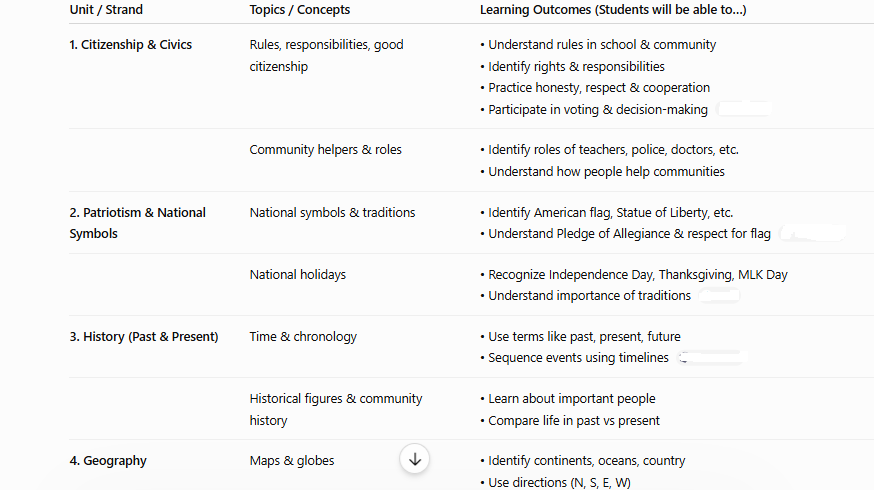
| Unit / Strand | Topics / Concepts | Learning Outcomes (Students will be able to…) |
|---|---|---|
| 1. Citizenship & Civics | Rules, responsibilities, good citizenship | • Understand rules in school & community • Identify rights & responsibilities • Practice honesty, respect & cooperation • Participate in voting & decision-making |
| Community helpers & roles | • Identify roles of teachers, police, doctors, etc. • Understand how people help communities |
|
| 2. Patriotism & National Symbols | National symbols & traditions | • Identify American flag, Statue of Liberty, etc. • Understand Pledge of Allegiance & respect for flag |
| National holidays | • Recognize Independence Day, Thanksgiving, MLK Day • Understand importance of traditions |
|
| 3. History (Past & Present) | Time & chronology | • Use terms like past, present, future • Sequence events using timelines |
| Historical figures & community history | • Learn about important people • Compare life in past vs present |
|
| 4. Geography | Maps & globes | • Identify continents, oceans, country • Use directions (N, S, E, W) • Read simple maps |
| Environment & surroundings | • Identify land, water, weather • Understand how environment affects life |
|
| 5. Culture & Society | Diversity & community | • Recognize similarities & differences among people • Respect different cultures & traditions |
| School & neighborhood | • Identify places in community • Understand roles of people around them |
|
| 6. Economics | Goods & services | • Differentiate goods vs services • Understand producers & consumers |
| Needs & wants | • Identify basic needs (food, shelter, clothing) • Understand choices & saving money |
|
| 7. Seasonal & Daily Life Changes | Time, weather, seasons | • Observe seasonal changes • Understand how seasons affect daily life |
| 8. Ethical & Social Skills | Values & behavior | • Practice kindness, fairness, teamwork • Develop social responsibility |
Key Objectives of Grade 1 Social Studies
By the end of Grade 1, students are expected to:
- Understand their identity, family, and community roles
- Develop basic map and geographic skills
- Learn about national symbols, traditions, and holidays
- Understand rules, responsibilities, and good citizenship
- Identify goods, services, and basic economic concepts
- Recognize changes over time (past vs present)
These objectives align with major social science strands like History, Geography, Civics, Economics, and Culture.
Major Units in the USA Grade 1 SST Curriculum
1. Self, Family, and Community
This unit introduces students to their immediate environment.
Topics Covered:
- Family structures and roles
- School environment and responsibilities
- Community helpers (teachers, police, doctors)
- Rules and cooperation in groups
Learning Outcomes:
- Understand roles in family and school
- Identify importance of rules and cooperation
- Develop respect for others
Students explore how they are part of different groups and how these groups function together.
2. Citizenship and Civics
This unit focuses on developing responsible citizens.
Topics Covered:
- Rules and laws in school and community
- Rights and responsibilities
- Good citizenship traits (honesty, respect)
- Voting and decision-making
Learning Outcomes:
- Practice good behavior and teamwork
- Understand importance of rules
- Learn basics of democracy (voting, fairness)
Students also learn about national symbols and patriotism, such as the flag and pledge.
3. Geography Basics
This unit introduces spatial awareness and mapping.
Topics Covered:
- Maps and globes
- Directions (North, South, East, West)
- Landforms and water bodies
- Location of community, state, and country
Learning Outcomes:
- Read simple maps
- Identify continents and oceans
- Understand how geography affects daily life
Students also learn how the environment influences lifestyle (climate, resources, etc.).
4. History and Time
This unit builds basic historical understanding.
Topics Covered:
- Past, present, and future
- Family history and traditions
- Important historical figures
- National holidays and events
Learning Outcomes:
- Understand change over time
- Sequence events (before, after)
- Recognize contributions of important people
Students begin to explore how life was different in the past compared to today.
5. Economics (Basic Concepts)
This unit introduces simple economic ideas.
Topics Covered:
- Goods and services
- Jobs and occupations
- Needs vs wants
- Saving and spending money
Learning Outcomes:
- Understand how people earn money
- Identify producers and consumers
- Make simple choices about needs and wants
Students learn that resources are limited and choices must be made.
6. Culture and Diversity
This unit promotes inclusivity and respect.
Topics Covered:
- Cultural traditions and festivals
- Diversity in communities
- Respect for differences
Learning Outcomes:
- Appreciate cultural diversity
- Develop respect for others
- Understand similarities and differences
Students learn that communities include people from different backgrounds and traditions.
Assessment Methods
Assessment in Grade 1 Social Studies is activity-based and continuous:
- Class participation
- Worksheets and drawing activities
- Oral presentations
- Projects (family tree, maps)
- Simple quizzes
Focus is on concept understanding rather than memorization.
Skills Developed in Grade 1 SST
- Social and emotional skills
- Communication and collaboration
- Observation and inquiry
- Basic critical thinking
- Cultural awareness
1st Grade Social Studies Curriculum Guide
In the 1st-grade social studies curriculum, learning transitions from basic self-awareness to exploring how an individual fits into the wider world. Instead of forcing young learners to memorize isolated dates or complex geopolitical maps, the curriculum focuses on five core pillars: Civics, Geography, History, Culture, and Economics.
1. The Five Pillars of the Curriculum
Pillar 1: Civics & Citizenship
This pillar teaches children what it means to be a part of a community, focusing heavily on rules, leadership, and the concept of a shared group identity.
-
Rules and Laws: Students learn to differentiate between classroom rules and community laws. They explore why rules exist (safety, fairness) and the consequences of breaking them.
-
National Symbols: Identification of foundational American symbols and landmarks, including the American flag, the bald eagle, the Statue of Liberty, and Mount Rushmore.
-
Leadership: Students learn to identify the current U.S. President, understand the role of a leader, and look briefly at past presidents (like George Washington or Abraham Lincoln).
Pillar 2: Geography & Map Skills
First graders practice abstract spatial thinking by converting the physical spaces they navigate daily into visual maps.
-
Cardinal Directions: Introducing North, East, South, and West.
-
Spatial Mapping: Constructing simple maps of highly familiar areas, such as their classroom, bedroom, or school playground, using basic symbols.
-
Globes vs. Maps: Distinguishing between land and water on a globe, and recognizing the hierarchy of their own location: City $\rightarrow$ State $\rightarrow$ Country $\rightarrow$ Continent.
Pillar 3: History & Chronology (Then vs. Now)
At this age, history is framed as the study of time, continuity, and change.
-
Timelines: Creating simple timelines using words like past, present, future, yesterday, today, and tomorrow.
-
Then and Now: Comparing how families lived long ago versus how they live today, focusing on changes in transportation, school environments, and communication.
-
Primary Sources: Introducing the idea that we learn about the past from artifacts, photographs, old letters, and oral storytelling.
Pillar 4: Culture & Community Traditions
This unit fosters cultural awareness and community appreciation.
-
Family Traditions: Sharing unique family dynamics, holidays, and cultural practices to understand diversity.
-
Community Helpers: Studying the roles of service professions—such as firefighters, doctors, postal workers, and teachers—and understanding how a community relies on teamwork to function.
Pillar 5: Basic Economic Concepts
First graders learn the very basic mechanics of money, choice, and scarcity.
-
Needs vs. Wants: Differentiating between things necessary for survival (food, shelter) and things desired for comfort or play (toys, treats).
-
Scarcity: Understanding that because resources are limited, people must make choices about how they spend and save.
-
Producers and Consumers: Figuring out how people make a living in a community by providing goods or services.
Typical Learning Objectives
By the conclusion of the academic year, a first-grade student is typically expected to master the following milestones:
| Skill Category | Learning Objective |
| Civics | Recite personal address and demonstrate characteristics of responsible citizenship (sharing, following safety rules). |
| Geography | Locate the United States, the seven continents, and the five major oceans on a world map. |
| History | Sequence 3–5 personal or historical events chronologically on a physical timeline. |
| Economics | Identify a basic financial choice and explain the opportunity cost (what is sacrificed) when spending tokens or money. |
The Inquiry-Based Approach: Rather than listening to passive lectures, 1st graders are encouraged to actively explore “compelling questions,” such as: What makes someone a good leader? or How does food that doesn’t grow in our state end up in our lunchroom?
Recommended Hands-on Classroom Activities
Because experiential learning works best for six- and seven-year-olds, classrooms generally rely on interactive projects:
-
The Classroom Store: Students earn “tokens” or play money for classroom jobs and responsible behavior, then choose whether to spend their earnings on small items (stickers, pencils) or save them for larger rewards. This makes the concepts of scarcity and trade concrete.
-
Mapping the Classroom: A spatial-reasoning project where kids draw a blueprint of their classroom, establishing a key with symbols for desks, rugs, and the whiteboard.
-
“Me Bags” and Family Timelines: Students bring in artifacts or photos from home to build a personal timeline, reinforcing the concept of history through their own lived experiences.
Conclusion
The USA Grade 1 Social Studies Curriculum 2026 provides a foundational understanding of the world around children. It emphasizes community awareness, citizenship, geography, history, and economics in a simple and engaging manner.
By focusing on real-life connections and interactive learning, the curriculum helps young learners develop into responsible, informed, and culturally aware citizens.
About The Author
