
The Telangana State Level Police Recruitment Board (TSLPRB) is expected to release its notification for the Police Constable 2026 recruitment drive soon. With the state government’s focus on filling thousands of vacancies, the competition is expected to be intense. A clear understanding of the TSLPRB Police Constable Syllabus and Exam Pattern is the first and most critical step toward success. This article provides a comprehensive overview of the selection process, exam pattern, and detailed syllabus for the upcoming TSLPRB Police Constable 2026 exam.
TSLPRB Police Constable 2026: An Overview
The TSLPRB organizes the police constable recruitment in a structured, multi-stage process to ensure the selection of the most capable candidates. The key stages of selection for the post of Stipendiary Cadet Trainee (SCT) Police Constable are as follows:
-
Preliminary Written Test (PWT)
-
Physical Measurement Test (PMT) & Physical Efficiency Test (PET)
-
Final Written Examination (FWE)
Candidates must clear each stage to progress to the next. It is important to note that the exam pattern and syllabus for both the Preliminary and Final written tests are largely the same, with the key difference being the addition of a “Personality Test” component in the final examination.
TSLPRB Police Constable Exam Pattern 2026
Understanding the exam pattern is crucial for effective time management and strategic preparation. The written examinations for the TSLPRB Police Constable are objective-type and conducted offline.
Preliminary Written Test (PWT) Pattern
| Subjects | Number of Questions | Maximum Marks | Duration |
|---|---|---|---|
| English, Arithmetic Ability, and Reasoning/Mental Ability | 100 | 100 | 3 Hours |
| General Studies | 100 | 100 | 3 Hours |
| Total | 200 | 200 | 3 Hours |
Final Written Examination (FWE) Pattern
| Subjects | Number of Questions | Maximum Marks | Duration |
|---|---|---|---|
| English + Arithmetic / Reasoning and Mental Ability | 100 | 100 | 3 Hours |
| General Studies | 100 | 100 | 3 Hours |
| Total | 200 | 200 | 3 Hours |
Key Points on the Exam Pattern
-
Total Marks: Each written test is for a total of 200 marks.
-
Marking Scheme: Each question carries one mark.
-
Negative Marking: There is no negative marking for incorrect answers, which encourages candidates to attempt all questions.
-
Question Paper: The questions are of Objective Type (Multiple Choice Questions). Except for the English language section, questions are available in both Telugu and Urdu.
-
Difficulty Level: The standard of the examination is generally set at an Intermediate level.
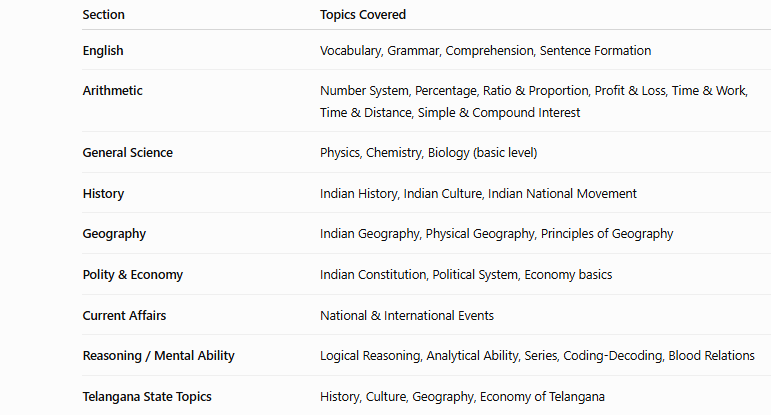
TSLPRB Police Constable Syllabus 2026
| Section | Topics Covered |
|---|---|
| English | Vocabulary, Grammar, Comprehension, Sentence Formation |
| Arithmetic | Number System, Percentage, Ratio & Proportion, Profit & Loss, Time & Work, Time & Distance, Simple & Compound Interest |
| General Science | Physics, Chemistry, Biology (basic level) |
| History | Indian History, Indian Culture, Indian National Movement |
| Geography | Indian Geography, Physical Geography, Principles of Geography |
| Polity & Economy | Indian Constitution, Political System, Economy basics |
| Current Affairs | National & International Events |
| Reasoning / Mental Ability | Logical Reasoning, Analytical Ability, Series, Coding-Decoding, Blood Relations |
| Telangana State Topics | History, Culture, Geography, Economy of Telangana |
Preliminary exam consists of 200 questions (200 marks).
TSLPRB Police Constable Syllabus 2026 (Final Written Exam)
| Paper | Subjects | Important Topics |
|---|---|---|
| Paper 1 | Arithmetic & Reasoning | Advanced Arithmetic, Data Interpretation, Logical Reasoning |
| Paper 2 | General Studies | History, Geography, Polity, Economy, Science, Current Affairs, Telangana GK |
| English (where applicable) | Language Skills | Comprehension, Grammar, Vocabulary |
Final exam level is slightly higher than prelims but follows similar subjects.
The syllabus acts as a roadmap for your preparation. You can download the official syllabus pdf once it is released by TSLPRB. The following is a detailed, subject-wise breakdown of the topics usually covered.
1. English
The English section aims to test the candidate’s understanding and proficiency in the language. The key topics include:
-
Short Essay
-
Comprehension (Unseen Passages)
-
Letter Writing (Formal/Informal)
-
Paragraph Writing
-
Report Writing
-
Translation from English to Telugu
2. Arithmetic Ability
This section evaluates your numerical and problem-solving skills. The topics covered are:
-
Number System
-
Simple & Compound Interest
-
Ratio and Proportion
-
Averages and Ages
-
Problems on Trains, Pipes & Cisterns
-
Percentages
-
Profit & Loss
-
Time & Work
-
LCM & HCF
-
Time, Speed & Distance
-
Partnership
-
Mensuration (Area, Volume)
-
Geometry
-
Progressions
-
Sets
-
Algebra
-
Heights & Distances
3. Reasoning / Mental Ability
This section tests logical thinking and analytical ability. The common topics include:
-
Data Interpretation
-
Clocks & Calendars
-
Dice
-
Seating Arrangement
-
Similarities and Differences
-
Spatial Visualization & Orientation
-
Problem-Solving & Analysis
-
Letter & Number Series
-
Coding & Decoding
-
Puzzles & Puzzle Test
-
Judgemental Decision Making
-
Visual Memory
4. General Studies
This is the most extensive section of the exam, covering a wide range of subjects.
a) General Science
-
General Science in Everyday Life (Physics, Chemistry, Biology)
-
Environmental Aspects and Disaster Management
b) History of India, Indian Culture & Indian National Movement
-
History of Ancient India
-
History of Modern India
-
Social, economic, cultural, and political aspects of the country
-
Indian Culture and Heritage
c) Polity and Economy
-
Political system of the country
-
Rural Development
-
Poverty, Planning, and Economic Reforms in India
d) Current Events of National and International Importance
-
National and International Relations
-
Countries and Capitals
-
Important Days
-
Sports, Awards, and Defense
-
Meetings & Summits
-
Books and Authors
-
Static GK
e) Indian Geography
-
Physical, Human, and Economic aspects of Indian Geography
f) Contents pertaining to the State of Telangana
This is a crucial area that requires focused preparation. Candidates must be thorough with the history, geography, and political landscape of the state.
-
Geography of Telangana
-
History of Telangana
-
Social and Cultural History of Telangana
-
Telangana Movement and State Formation
-
Telangana Idea (1948-1970)
-
Assimilation Phase (1971-1990)
-
Formation of Telangana State (1991-2014)
-
-
Government of Telangana policies and schemes
TSLPRB Constable Final Written Test Syllabus
The syllabus for the Final Written Examination (FWE) is the same as the Preliminary Written Test, with the addition of a key component.
-
Personality Test: In the final written exam, the test of reasoning/mental ability may include questions on a candidate’s personality traits, which are essential for police duties. Topics include:
-
Ethics
-
Sensitivity to Gender and Weaker Sections
-
Social Awareness
-
Emotional Intelligence
-
Physical Tests: PMT and PET
Candidates who clear the Preliminary Written Test are called for the Physical Measurement Test (PMT) and Physical Efficiency Test (PET). While the written exam is crucial, clearing the physical tests is mandatory for final selection.
Physical Efficiency Test (PET)
-
Running Event: Male candidates must complete a 1600-meter run, while female candidates must complete an 800-meter run within the stipulated time to secure marks.
-
Long Jump/Shot Put: Candidates also need to qualify in events like the Long Jump (Men: 4 meters, Women: 2.50 meters) or Shot Put.
Physical Measurement Test (PMT)
Candidates must meet the minimum physical standards.
-
Height: As per the rules for post codes 34, 35, and 36:
-
Men: 162 Centimeters (General) / 160 Centimeters (for certain tribal areas)
-
Women: 152.5 Centimeters (General) / 150 Centimeters (for certain tribal areas)
-
Preparation Tips for TSLPRB Police Constable 2026
-
Syllabus First: Begin your preparation by thoroughly reviewing the syllabus and exam pattern. This will help you identify the most important topics and plan your study schedule.
-
Focus on Telangana: A significant portion of the General Studies paper focuses on Telangana. Dedicate extra time to studying the state’s history, geography, and current affairs.
-
Practice Previous Year Papers (PYQ): Solving previous years’ question papers is one of the best ways to understand the actual exam pattern and difficulty level.
-
Regular Revision: Revise all topics regularly, especially static sections like Arithmetic and Reasoning, to ensure you don’t forget what you’ve learned.
-
Physical Fitness: Since the selection process includes a demanding physical test, maintain a rigorous fitness routine alongside your academic preparation.
Conclusion
The TSLPRB Police Constable 2026 exam is a significant opportunity for candidates aspiring to join the Telangana Police Force. Success in this highly competitive exam requires a strategic approach, deep knowledge of the detailed syllabus, and rigorous practice. By understanding the exam pattern, mastering the subject-wise topics, especially the Telangana-specific areas, and staying physically fit, you can significantly enhance your chances of securing a position in the department.
About The Author
