
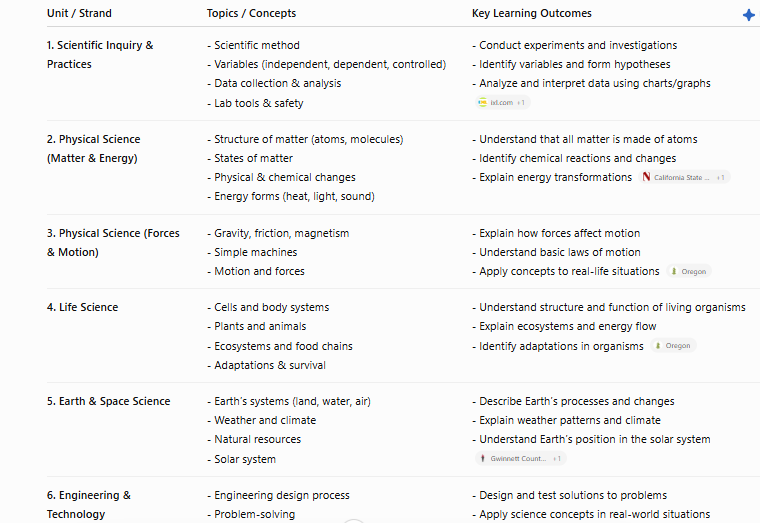
The US Grade 5 Science Curriculum (2026) is primarily based on the Next Generation Science Standards (NGSS) and similar state-level frameworks. It focuses on conceptual understanding, inquiry-based learning, and real-world applications rather than rote memorization. Students are encouraged to explore, experiment, and think critically like young scientists.
US Grade 5 Science Curriculum 2026
| Unit / Strand | Topics / Concepts | Key Learning Outcomes |
|---|---|---|
| 1. Scientific Inquiry & Practices | – Scientific method – Variables (independent, dependent, controlled) – Data collection & analysis – Lab tools & safety |
– Conduct experiments and investigations – Identify variables and form hypotheses – Analyze and interpret data using charts/graphs |
| 2. Physical Science (Matter & Energy) | – Structure of matter (atoms, molecules) – States of matter – Physical & chemical changes – Energy forms (heat, light, sound) |
– Understand that all matter is made of atoms – Identify chemical reactions and changes – Explain energy transformations |
| 3. Physical Science (Forces & Motion) | – Gravity, friction, magnetism – Simple machines – Motion and forces |
– Explain how forces affect motion – Understand basic laws of motion – Apply concepts to real-life situations |
| 4. Life Science | – Cells and body systems – Plants and animals – Ecosystems and food chains – Adaptations & survival |
– Understand structure and function of living organisms – Explain ecosystems and energy flow – Identify adaptations in organisms |
| 5. Earth & Space Science | – Earth’s systems (land, water, air) – Weather and climate – Natural resources – Solar system |
– Describe Earth’s processes and changes – Explain weather patterns and climate – Understand Earth’s position in the solar system |
| 6. Engineering & Technology | – Engineering design process – Problem-solving – Use of technology in science |
– Design and test solutions to problems – Apply science concepts in real-world situations – Understand the link between science and technology |
| 7. Environmental Science | – Conservation of resources – Human impact on the environment – Sustainability |
– Identify environmental issues – Explain conservation methods – Promote sustainable practices |
Key Features of Grade 5 Science Curriculum
- Focus on hands-on learning and experiments
- Integration of science + engineering practices
- Emphasis on real-world problem solving
- Covers three core domains:
Life Science
Physical Science
Earth & Space Science
Overview of Grade 5 Science Curriculum
The curriculum is structured into four core domains:
- Life Science
- Physical Science
- Earth & Space Science
- Engineering, Technology & Scientific Inquiry
Students develop:
- Scientific thinking and reasoning
- Problem-solving and analytical skills
- Understanding of natural phenomena
- Ability to conduct experiments and interpret data
Core Subjects and Topics
1. Life Science (LS)
Key Topics:
- Structure and function of plants and animals
- Ecosystems and food chains/webs
- Adaptations and survival
- Human body systems (digestive, respiratory, circulatory)
- Heredity and traits
Learning Outcomes:
- Understand how living organisms interact with their environment
- Explain energy flow in ecosystems
- Identify inherited traits and variations
Life science helps students explore living organisms and their relationships, forming a foundation for biology.
2. Physical Science (PS)
Key Topics:
- Matter and its properties (solid, liquid, gas)
- Physical and chemical changes
- Forces and motion (gravity, friction)
- Forms of energy (heat, light, sound, electricity)
- Simple machines
Learning Outcomes:
- Analyze changes in matter (reversible/irreversible)
- Understand how forces affect motion
- Identify energy transformations
Students learn that all matter is made of atoms and changes through interactions, building early chemistry and physics concepts.
3. Earth & Space Science (ESS)
Key Topics:
- Earth’s structure (crust, mantle, core)
- Weather and climate
- Water cycle
- Natural resources and conservation
- Solar system and Earth’s place in space
Learning Outcomes:
- Explain Earth processes (erosion, weathering)
- Understand climate patterns and environmental impact
- Describe the solar system and planetary motion
Students analyze how Earth systems interact and affect human life.
4. Engineering & Scientific Inquiry (ETS)
Key Topics:
- Scientific method (question → hypothesis → experiment → conclusion)
- Variables and data analysis
- Engineering design process
- Use of tools and measurement
Learning Outcomes:
- Design and conduct experiments
- Identify variables and interpret results
- Solve real-world problems using engineering
Inquiry-based learning is central, where students plan investigations and analyze results using scientific tools.
Curriculum Structure
| Domain | Major Topics | Skills Developed |
|---|---|---|
| Life Science | Ecosystems, plants, animals, human body, heredity | Observation, classification, biological understanding |
| Physical Science | Matter, energy, forces, simple machines | Analytical thinking, experimentation |
| Earth & Space | Earth systems, weather, solar system | Environmental awareness, data interpretation |
| Engineering & Inquiry | Scientific method, design, tools | Problem-solving, critical thinking |
Key Skills Developed in Grade 5 Science
- Critical thinking and reasoning
- Data collection and interpretation
- Experimental design
- Collaboration and communication
- Real-world problem-solving
Students also learn to present findings using graphs, charts, and reports, strengthening cross-disciplinary skills.
Assessment & Evaluation
Assessment methods include:
- Class experiments and lab work
- Projects and STEM activities
- Quizzes and written tests
- Science fairs and presentations
Focus is on conceptual understanding and application, not just memorization.
Teaching Approach (2026 Trends)
- Hands-on experiments and activities
- STEM-based interdisciplinary learning
- Use of digital tools and simulations
- Real-world problem-solving scenarios
Modern standards emphasize “learning by doing” and inquiry-driven education.
Conclusion
The US Grade 5 Science Curriculum 2026 builds a strong foundation in life, physical, and earth sciences, while integrating engineering and inquiry skills. It encourages curiosity, experimentation, and critical thinking. By focusing on real-world applications and hands-on learning, the curriculum prepares students for advanced scientific study and helps them understand the world around them in a meaningful way.
About The Author
