
The Kuwait Grade 1 Science Curriculum 2026 is part of the national primary education framework developed by the Kuwait Ministry of Education. It focuses on building basic scientific understanding, curiosity, and real-life awareness among young learners through activity-based and inquiry-driven learning.
- Use appropriate tools to gather and draw conclusions
- Develop a scientific vocabulary
- Engage in the study of living things, plants, animals, weather, the sky, earth resources, and properties of matter
- Develop ways to communicate findings using oral and/or written expressions
Overview of Kuwait Primary Grade 1 Science Curriculum
The science curriculum for Grades 1–5 in Kuwait is designed to:
- Develop early scientific thinking and observation skills
- Connect learning with real-life experiences
- Promote environmental awareness and national identity
- Use modern international standards such as NGSS, TIMSS, and PISA benchmarks
It emphasizes hands-on activities, experiments, and exploration instead of rote learning.
Objectives of KW Grade 1 Science Curriculum
At the Grade 1 level, the curriculum aims to:
- Build curiosity about the natural world
- Develop basic observation and classification skills
- Introduce living and non-living things
- Encourage environmental responsibility
- Promote simple problem-solving and questioning ability
- Develop communication skills through discussion and drawing
KW Grade 1 Science Curriculum: Subject Structure & Key Units
The Kuwait Grade 1 Science syllabus is generally divided into foundational themes:
1. Living Things (Life Science)
Topics include:
- Plants and animals basics
- Differences between living and non-living things
- Basic needs of living things (food, water, air)
- Simple plant parts (roots, stem, leaves)
- Animals and their habitats
This unit forms the foundation of biology at an early stage
2. Physical World (Basic Physical Science)
Topics include:
- Types of materials (hard/soft, heavy/light)
- Introduction to solids and liquids
- Basic forces (push and pull)
- Light and shadows
- Simple properties of objects
3. Earth & Environment
Topics include:
- Sun, moon, and sky
- Weather types (hot, cold, rainy, windy)
- Importance of water and air
- Environmental care and cleanliness
- Saving electricity and water (important national focus)
4. Science in Daily Life
Topics include:
- Uses of science in everyday activities
- Safety habits (home and school)
- Healthy living basics (hygiene, food)
- Observing surroundings
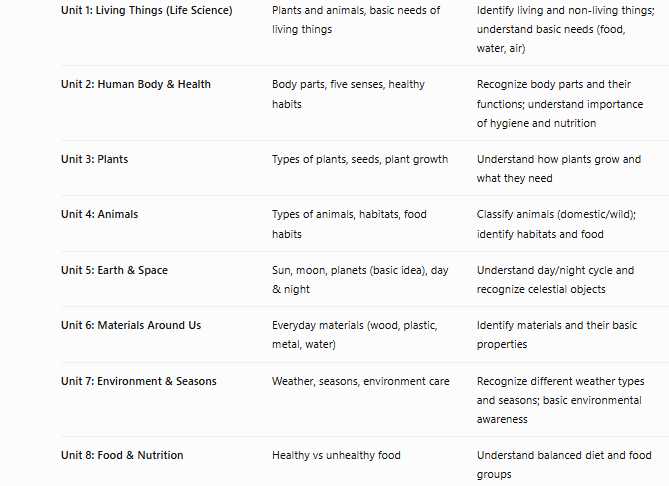
Kuwait Grade 1 Science Curriculum 2026
| Unit / Theme | Topics Covered | Learning Outcomes | Activities / Skills Developed |
|---|---|---|---|
| Unit 1: Living Things (Life Science) | Plants and animals, basic needs of living things | Identify living and non-living things; understand basic needs (food, water, air) | Observation of plants/animals, drawing, classification |
| Unit 2: Human Body & Health | Body parts, five senses, healthy habits | Recognize body parts and their functions; understand importance of hygiene and nutrition | Matching activities, role play, identifying senses |
| Unit 3: Plants | Types of plants, seeds, plant growth | Understand how plants grow and what they need | Seed planting, simple experiments, coloring activities |
| Unit 4: Animals | Types of animals, habitats, food habits | Classify animals (domestic/wild); identify habitats and food | Sorting games, picture identification, storytelling |
| Unit 5: Earth & Space | Sun, moon, planets (basic idea), day & night | Understand day/night cycle and recognize celestial objects | Visual aids, simple models, observation |
| Unit 6: Materials Around Us | Everyday materials (wood, plastic, metal, water) | Identify materials and their basic properties | Touch-and-feel activities, grouping materials |
| Unit 7: Environment & Seasons | Weather, seasons, environment care | Recognize different weather types and seasons; basic environmental awareness | Weather charts, seasonal drawings, discussions |
| Unit 8: Food & Nutrition | Healthy vs unhealthy food | Understand balanced diet and food groups | Food sorting, coloring worksheets, discussions |
| Unit 9: Scientific Skills (Working Scientifically) | Observation, questioning, simple experiments | Develop curiosity, ask questions, record observations | Simple experiments, group activities, oral presentations |
Kuwait Grade 1 Science Syllabus 2026 (Chapter-wise Table)
Unit 1: Me and My Body (Human & Senses)
| Chapter No. | Chapter Name | Key Topics Covered |
|---|---|---|
| 1 | My Body Parts | External body parts, identification and functions |
| 2 | My Senses | Five senses – sight, hearing, smell, taste, touch |
| 3 | Caring for Sense Organs | Hygiene and protection of eyes, ears, nose, tongue, skin |
| 4 | What I See & Hear | Observing surroundings using senses |
| 5 | What I Smell & Taste | Differentiating smells and tastes |
| 6 | Touch and Feel | Texture (soft, hard, rough, smooth) |
These chapters help students understand the human body basics and sensory awareness
Unit 2: Living Things (Plants & Animals)
| Chapter No. | Chapter Name | Key Topics Covered |
|---|---|---|
| 7 | Living and Non-living Things | Differences and examples |
| 8 | Plants Around Us | Types of plants and uses |
| 9 | Parts of a Plant | Roots, stem, leaves, flowers |
| 10 | Animals Around Us | Types of animals and characteristics |
| 11 | Animal Habitats | Land, water, air habitats |
| 12 | Needs of Living Things | Food, water, air, shelter |
Focus on basic life science concepts like plants and animals
Unit 3: Food & Growth
| Chapter No. | Chapter Name | Key Topics Covered |
|---|---|---|
| 13 | Healthy Food | Types of food, balanced diet basics |
| 14 | What Can I Eat? | Edible vs non-edible items |
| 15 | I Grow | Growth stages in humans |
| 16 | Good Habits | Cleanliness, hygiene, healthy lifestyle |
Introduces health, nutrition, and growth awareness
Unit 4: Matter & Physical World
| Chapter No. | Chapter Name | Key Topics Covered |
|---|---|---|
| 17 | Materials Around Us | Types and properties (hard/soft, heavy/light) |
| 18 | States of Matter | Solid, liquid, gas (basic introduction) |
| 19 | Uses of Water | Importance and daily uses |
| 20 | Safety with Water | Safe practices with water |
Covers basic physical science and matter concepts
Unit 5: Earth & Environment
| Chapter No. | Chapter Name | Key Topics Covered |
|---|---|---|
| 21 | Sun and Sky | Sun, day and night |
| 22 | Weather | Hot, cold, rainy, windy |
| 23 | Air Around Us | Importance of air |
| 24 | Caring for the Environment | Cleanliness, saving water and energy |
Emphasizes environmental awareness and sustainability
Key Curriculum Insights
- Total Chapters: ~24 (approx.)
- Major Themes:
- Human body & senses
- Living things
- Food & health
- Matter & environment
- Learning Style:
- Activity-based learning
- Observation & experiments
- Real-life connections
Teaching Methodology
The Kuwait curriculum follows a student-centered approach:
- Activity-based learning
- Experiments and demonstrations
- Group discussions
- Use of visual aids and storytelling
- Integration with other subjects (Math, Language, Social Studies)
Assessment Pattern
Assessment in Grade 1 is continuous and formative, focusing on:
| Assessment Type | Description |
|---|---|
| Classroom Activities | Participation in experiments and tasks |
| Observation | Teacher evaluates curiosity and engagement |
| Worksheets | Simple concept-based exercises |
| Oral Assessment | Question-answer and discussions |
| Projects | Drawing, models, and small activities |
No heavy exams—focus is on concept clarity and participation
Skills Developed
By the end of Grade 1, students develop:
- Observation and questioning skills
- Basic classification ability
- Environmental awareness
- Communication and teamwork
- Early scientific reasoning
Curriculum Highlights 2026
- Updated with modern global standards (NGSS, TIMSS, PISA)
- Focus on practical learning over theory
- Emphasis on environmental sustainability
- Integration of technology and interactive learning
- Alignment with Kuwait Vision 2035 education reforms
Conclusion
The Kuwait Grade 1 Science Curriculum 2026 is designed to make science fun, practical, and meaningful for young learners. Instead of memorization, it encourages children to explore, observe, and understand the world around them. With a strong focus on hands-on learning, environmental awareness, and global standards, the curriculum builds a solid foundation for future scientific education.
Related Articles:
https://syllabus4u.com/kuwait-grade-1-arabic-curriculum/
https://syllabus4u.com/kuwait-grade-1-english-curriculum/
https://syllabus4u.com/kuwait-grade-1-mathematics-curriculum/
https://syllabus4u.com/kuwait-grade-1-science-curriculum/
https://syllabus4u.com/kuwait-grade-1-islamic-education-curriculum/
https://syllabus4u.com/kuwait-grade-1-physical-education-curriculum/
About The Author
