
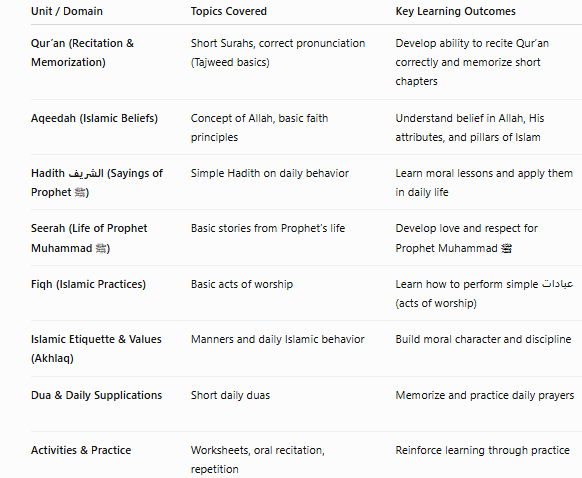
The Kuwait Grade 1 Islamic Education Curriculum 2026 is designed to build a strong moral and spiritual foundation in young learners. Developed by the Ministry of Education, the curriculum focuses on nurturing Islamic values, basic beliefs, and good character through age-appropriate lessons. It follows a competency-based approach, ensuring that students not only learn concepts but also apply them in daily life.
Kuwait Grade 1 Islamic Education Curriculum 2026
| Unit / Domain | Topics Covered | Key Learning Outcomes | Examples (Term 1 & 2) |
|---|---|---|---|
| Qur’an (Recitation & Memorization) | Short Surahs, correct pronunciation (Tajweed basics) | Develop ability to recite Qur’an correctly and memorize short chapters | Surah Al-Fatiha, Al-Ikhlas (Term 1); Al-Falaq, An-Nas, An-Nasr (Term 2) |
| Aqeedah (Islamic Beliefs) | Concept of Allah, basic faith principles | Understand belief in Allah, His attributes, and pillars of Islam | “Allah is my Lord”, Introduction to Five Pillars of Islam |
| Hadith الشريف (Sayings of Prophet ﷺ) | Simple Hadith on daily behavior | Learn moral lessons and apply them in daily life | Hadith on kindness to parents, cleanliness, honesty |
| Seerah (Life of Prophet Muhammad ﷺ) | Basic stories from Prophet’s life | Develop love and respect for Prophet Muhammad ﷺ | Early life stories, good character examples |
| Fiqh (Islamic Practices) | Basic acts of worship | Learn how to perform simple عبادات (acts of worship) | Wudu (ablution), basic prayer concepts |
| Islamic Etiquette & Values (Akhlaq) | Manners and daily Islamic behavior | Build moral character and discipline | Greeting (Salam), respect elders, truthfulness |
| Dua & Daily Supplications | Short daily duas | Memorize and practice daily prayers | Dua before eating, sleeping, entering/leaving home |
| Activities & Practice | Worksheets, oral recitation, repetition | Reinforce learning through practice | Weekly recitation, simple exercises |
Curriculum Structure Highlights
- The syllabus is typically divided into 4 units across ~16 weeks per term.
- Strong focus on memorization + understanding + behavior building.
- Uses stories, repetition, and simple activities suitable for young learners.
- Emphasizes moral development alongside religious knowledge.
Curriculum Structure & Core Areas
The curriculum is divided into multiple learning domains, each targeting specific aspects of Islamic education:
1. Quran (القرآن الكريم)
- Memorization of short Surahs such as Al-Fatiha, Al-Ikhlas, Al-Falaq, An-Nas
- Basic introduction to Tajweed rules
- Listening and correct pronunciation skills
- Developing love and respect for the Quran
2. Aqeedah (Islamic Belief)
- Understanding Allah as the Creator and Sustainer
- Introduction to basic beliefs and attributes of Allah
- Awareness of Pillars of Islam (simplified)
- Building faith through simple real-life examples
3. Hadith (Prophetic Teachings)
- Memorization of short Hadiths
- Lessons on honesty, kindness, cleanliness, and respect
- Understanding moral values through daily-life situations
- Application of Hadith in behavior
4. Fiqh (Islamic Practices)
- Basic Wudu (ablution) steps
- Introduction to Salah (prayer)
- Learning simple acts of worship
- Practicing cleanliness and discipline
5. Seerah (Life of Prophet Muhammad ﷺ)
- Stories from the childhood of Prophet Muhammad ﷺ
- Lessons on love, respect, and following the Prophet
- Key events such as birth of the Prophet
- Emphasis on role-model behavior
6. Islamic Manners & Ethics (تهذيب)
- Respect for parents and elders
- Good manners (eating, speaking, sharing)
- Concepts like truthfulness, helping others, cleanliness
- Social behavior aligned with Islamic teachings
Term-wise Distribution (2026)
The curriculum is generally spread across two semesters, with structured weekly planning:
Semester 1
- Basic Quran memorization (short Surahs)
- Introduction to Allah and simple beliefs
- Short Hadiths on good behavior
- Simple manners and daily practices
Semester 2
- Advanced short Surahs and revision
- Topics like Wudu, Salah, and Islamic values
- Seerah lessons (Prophet’s life events)
- اخلاق (ethics) and social responsibility
The syllabus is organized into 4 main units over ~16 weeks, covering Aqeedah, Fiqh, Hadith, and Seerah systematically.
Learning Outcomes (Student Competencies)
By the end of Grade 1, students are expected to:
- Recite and memorize basic Quranic Surahs
- Understand simple Islamic beliefs
- Practice basic acts of worship
- Demonstrate good manners and اخلاق
- Apply Islamic teachings in daily life
- Show respect, kindness, and discipline
Teaching Methodology
The Kuwait curriculum emphasizes interactive and child-centered learning:
- Storytelling (Seerah-based learning)
- Visual aids and illustrations
- Activity-based learning (role play, practice)
- Repetition and memorization with understanding
- Integration of values into real-life scenarios
Assessment Pattern
Assessment is continuous and includes:
- Oral recitation (Quran & Hadith)
- Observation of behavior and اخلاق
- Class participation
- Simple written or activity-based evaluation
Importance of the Curriculum
- Builds a strong moral foundation at an early age
- Encourages spiritual awareness and discipline
- Promotes positive social behavior
- Aligns with Kuwait’s goal of balanced religious and modern education
Conclusion
The Kuwait Grade 1 Islamic Education Curriculum 2026 is thoughtfully designed to introduce young learners to Islam in a simple, engaging, and practical way. By combining Quranic learning, beliefs, practices, and اخلاق, it ensures holistic development. The curriculum not only focuses on knowledge but also shapes character, preparing students to become responsible and ethical individuals in society.
Related Articles:
https://syllabus4u.com/kuwait-grade-1-arabic-curriculum/
https://syllabus4u.com/kuwait-grade-1-english-curriculum/
https://syllabus4u.com/kuwait-grade-1-mathematics-curriculum/
https://syllabus4u.com/kuwait-grade-1-science-curriculum/
https://syllabus4u.com/kuwait-grade-1-islamic-education-curriculum/
https://syllabus4u.com/kuwait-grade-1-physical-education-curriculum/
About The Author
