
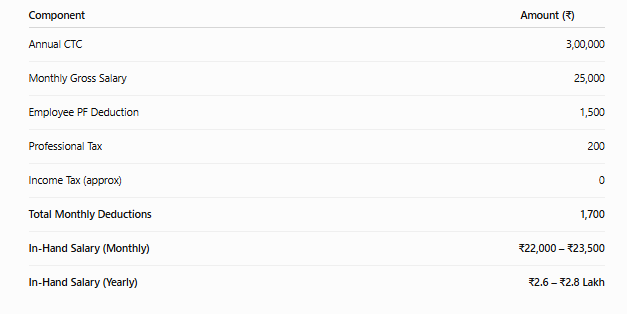
A 3 LPA (₹3,00,000 per annum) package is a common entry-level or fresher salary in India in 2026, especially in non-metro or smaller companies, support roles, or certain non-IT sectors. CTC (Cost to Company) is not the same as what lands in your bank account. Your in-hand (take-home) salary is lower after statutory and other deductions.
3 LPA in Hand Salary 2026: Quick Summary
- Annual CTC: ₹3,00,000
- Monthly CTC: ₹25,000
- Typical monthly gross salary (cash component before employee deductions): ₹22,000–₹24,500
- Typical monthly in-hand salary: ₹20,500 – ₹23,500
- Most common realistic range for standard structures: ₹21,000 – ₹22,500
- Income tax: ₹0 under the new tax regime (default in 2026)
Exact figures depend on your company’s salary structure (basic percentage), state (professional tax), whether ESI applies, and whether the employer contributes PF on the full basic or the capped amount.
3 LPA in Hand Salary 2026: Understanding CTC vs Gross vs In-Hand
- CTC includes everything the company spends on you: basic + allowances + employer PF contribution + gratuity provision + sometimes insurance or other benefits.
- Gross salary is the cash part you see before employee deductions (basic + HRA + special/other allowances).
- In-hand / take-home = Gross – Employee PF – Professional Tax – ESI (if applicable) – any other deductions (and TDS, which is nil here).
Employer PF and gratuity are part of CTC but never hit your monthly bank account as cash.
3 LPA in Hand Salary 2026 Structure
A common mid-size company structure looks like this:
| Component | Annual (₹) | Monthly (₹) | Notes |
|---|---|---|---|
| Basic Salary (40–50%) | 1,20,000–1,50,000 | 10,000–12,500 | Base for PF & gratuity |
| HRA | 50,000–75,000 | 4,000–6,250 | Often 40–50% of basic |
| Special / Other Allowances | 60,000–90,000 | 5,000–7,500 | Balancing figure |
| Employer PF (12% of basic) | 14,400–18,000 | 1,200–1,500 | Part of CTC |
| Gratuity (~4.81% of basic) | ~6,000–7,200 | ~500–600 | Part of CTC (paid after 5 years) |
| Total CTC | 3,00,000 | 25,000 | — |
Resulting monthly gross (cash earnings): usually ₹22,500–₹23,800.
Key Deductions at 3 LPA Level
- Employee Provident Fund (EPF): 12% of basic salary. Typical deduction: ₹1,200–₹1,500 per month. (Statutory wage ceiling remains ₹15,000; many companies still calculate on actual basic for lower salaries.)
- Professional Tax (PT): State-dependent, usually ₹150–₹200 per month (max ₹2,500 per year).
- Common in Maharashtra, Karnataka, West Bengal, Telangana, etc.
- Nil in Delhi, Tamil Nadu (in many cases), and some other states.
- ESI (Employees’ State Insurance): Applies only if monthly gross ≤ ₹21,000. Employee contribution: 0.75% of gross. At typical 3 LPA structures, gross often sits around or just above this threshold, so ESI may or may not apply (₹0–₹180 approx.).
- Income Tax / TDS: Nil. Under the new tax regime (default for FY 2026-27 / Tax Year 2026-27):
- Slabs start with 0% up to ₹4 lakh.
- Section 87A rebate makes taxable income up to ₹12 lakh effectively tax-free.
- Salaried employees also get ₹75,000 standard deduction.
- At only ₹3 lakh, tax liability is zero.
Other possible small deductions: group insurance, canteen, etc. (company-specific).
Sample Monthly Calculation (Typical Mid-Size Company)
Assumptions: Basic ₹12,500 | HRA ₹5,000 | Special Allowance ₹6,000 | Employer PF ₹1,500 | Gratuity ~₹600 → CTC ₹25,000.
| Earnings | Amount (₹) |
|---|---|
| Basic | 12,500 |
| HRA | 5,000 |
| Special Allowance | 6,000 |
| Gross Earnings | 23,500 |
| Deductions | Amount (₹) |
|---|---|
| Employee PF (12% of basic) | 1,500 |
| Professional Tax | 200 |
| ESI | 0 |
| Income Tax (TDS) | 0 |
| Total Deductions | 1,700 |
Net In-Hand / Take-Home: ₹21,800
Range across scenarios:
- Conservative (higher basic + PT + possible ESI / MNC-style): ₹19,500–₹21,000
- Typical: ₹21,000–₹22,500
- Best case (lower basic %, no PT, no ESI, lean startup structure): ₹23,000–₹24,500+
Annual in-hand typically falls in the ₹2.50–2.75 lakh range.
Factors That Change Your Exact Take-Home
- Basic salary percentage: Higher basic → higher PF deduction → lower in-hand.
- City / State: Professional tax varies; metros may have different HRA treatment (though HRA exemption is limited under new regime).
- Company type: Startups often give higher cash component; large MNCs may have more structured benefits and slightly lower cash take-home for the same CTC.
- Variable pay / bonus: If part of the 3 LPA is variable, fixed monthly in-hand drops.
- ESI applicability: Crosses the ₹21,000 gross threshold → ESI stops.
- PF policy: Some employers restrict PF to the ₹15,000 ceiling (₹1,800 max contribution).
Is 3 LPA a Good Salary in 2026?
It is an entry-level / fresher package. Purchasing power depends heavily on location:
- Tier-1 cities (Bengaluru, Mumbai, Delhi-NCR, Hyderabad, Chennai): Challenging for independent living. Shared PG/flat + careful budgeting is usually required. Rent alone can take 30–50% of in-hand.
- Tier-2 / Tier-3 cities: More comfortable. Can support basic independent living with some savings or family support.
Average formal-sector salaries are higher, but 3 LPA remains common for fresh graduates outside premium tech or high-demand roles.
Tips to Maximise Take-Home and Financial Health
- Always ask for the full CTC breakup before accepting the offer.
- Prefer structures with lower basic (within legal limits) if you want higher immediate cash, understanding the long-term PF impact.
- Check your state’s professional tax rules.
- Build an emergency fund and start investing early (even small SIPs) — the PF contribution is already a forced saving.
- Under the new regime, tax planning is simpler at this income level (effectively zero tax).
Note: These are realistic estimates based on standard 2026 payroll practices, EPF/ESI rules, and the new tax regime slabs effective for the relevant financial year. Actual payslips vary by employer. For precise numbers, use your company’s salary structure or consult HR/a payroll expert. Tax rules and statutory ceilings can be updated by notifications — always verify with official sources for the current year.
About The Author
