Vyasa International School CBSE & Cambridge Curriculum Syllabus: Vyasa International School (Bangalore) offers a dual-pathway approach that combines the CBSE curriculum (primarily for middle and senior years) with the Cambridge Primary Programme, aligned with National Education Policy (NEP) 2020 principles of holistic, competency-based, and experiential learning.
Located in the Vidyaranyapura/Yelahanka/Hebbal area of North Bangalore (Kodigehalli Village / Doddabommasandra), the school (CBSE Affiliation No. 830316) has operated since 2008 under the philosophy of drawing “the Best of the West, the Ethos of the East.” It emphasizes thematic, interdisciplinary, value-based, activity-oriented, and skill-based education to prepare confident global citizens while nurturing Indian cultural identity.
The school provides a safe, emotionally secure environment with modular scheduling (six-day week), strong co-curricular integration (arts, sports, life skills, student exchange), and infrastructure including labs, library, sports facilities, and infirmary. Classes run from Pre-K/Nursery through Grade 12. Cambridge is offered at the Primary level as part of the Cambridge Pathway; the core programme remains CBSE through secondary and senior secondary.
Vyasa International School Syllabus 2026 (CBSE & Cambridge)
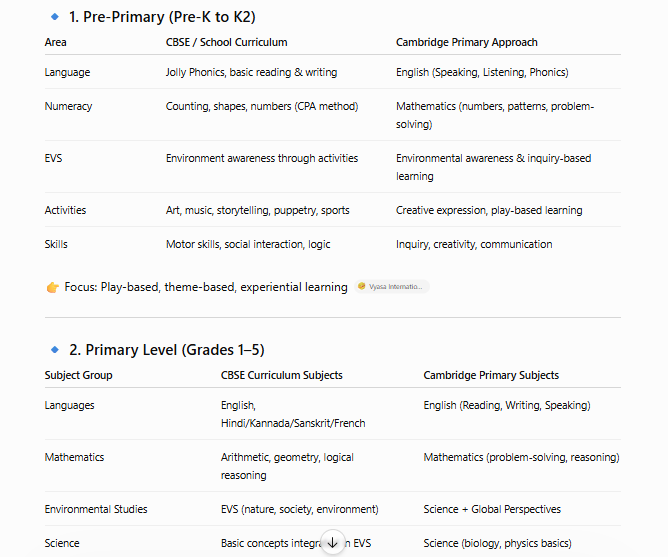
1. Pre-Primary (Pre-K to K2)
| Area | CBSE / School Curriculum | Cambridge Primary Approach |
|---|---|---|
| Language | Jolly Phonics, basic reading & writing | English (Speaking, Listening, Phonics) |
| Numeracy | Counting, shapes, numbers (CPA method) | Mathematics (numbers, patterns, problem-solving) |
| EVS | Environment awareness through activities | Environmental awareness & inquiry-based learning |
| Activities | Art, music, storytelling, puppetry, sports | Creative expression, play-based learning |
| Skills | Motor skills, social interaction, logic | Inquiry, creativity, communication |
Focus: Play-based, theme-based, experiential learning
2. Primary Level (Grades 1–5)
| Subject Group | CBSE Curriculum Subjects | Cambridge Primary Subjects |
|---|---|---|
| Languages | English, Hindi/Kannada/Sanskrit/French | English (Reading, Writing, Speaking) |
| Mathematics | Arithmetic, geometry, logical reasoning | Mathematics (problem-solving, reasoning) |
| Environmental Studies | EVS (nature, society, environment) | Science + Global Perspectives |
| Science | Basic concepts integrated in EVS | Science (biology, physics basics) |
| ICT | Basic computer skills | Digital literacy (ICT skills) |
| Co-curricular | Art, music, sports | Creative arts, physical education |
| Skill Development | Listening, speaking, reading, writing | Communication, inquiry, collaboration |
Focus: Skill-building + activity-based + thematic learning
3. Middle School (Grades 6–8)
| Subject Group | CBSE Curriculum | Cambridge Lower Secondary |
|---|---|---|
| Languages | English + Second Language | English as First/Second Language |
| Mathematics | Algebra, geometry, mensuration | Mathematics (advanced problem-solving) |
| Science | Physics, Chemistry, Biology | Integrated Science |
| Social Science | History, Civics, Geography | Global Perspectives |
| Computer | IT fundamentals | ICT / Digital technologies |
| Arts & Sports | Music, dance, physical education | Creative arts & sports |
| Skill Focus | Analytical thinking, projects | Inquiry-based & cross-curricular learning |
Focus: Concept clarity + project-based learning
4. Secondary Level (Grades 9–10)
| Subject Group | CBSE Subjects | Cambridge IGCSE Subjects |
|---|---|---|
| Core Subjects | English, Maths, Science, Social Science | English, Mathematics, Science |
| Languages | Hindi/Sanskrit/French | Multiple language options (30+ globally) |
| Science | Physics, Chemistry, Biology | Separate or combined sciences |
| Social Science | History, Geography, Civics, Economics | Global Perspectives / Humanities |
| Optional | IT, Physical Education | ICT, Business, Economics, Arts |
| Skill Focus | Board exam preparation | Critical thinking, application-based learning |
Cambridge offers 70+ subject choices & flexible combinations
5. Senior Secondary (Grades 11–12)
| Stream | CBSE Subjects | Cambridge (AS & A Levels) |
|---|---|---|
| Science | Physics, Chemistry, Maths/Biology | Physics, Chemistry, Maths, Biology |
| Commerce | Accountancy, Business Studies, Economics | Business, Economics, Accounting |
| Humanities | History, Political Science, Psychology | Sociology, Psychology, Global Studies |
| Entrance Prep | JEE, NEET, KCET | International university preparation |
| Skill Focus | Exam-oriented + conceptual | Research, analysis, independent learning |
Streams include combinations like PCMB, PCMC, Commerce, Humanities
6. Assessment Pattern
| Level | Assessment System |
|---|---|
| Pre-Primary | Continuous observation-based assessment |
| Grades 1–5 | Periodic tests + term exams + internal assessment |
| Grades 6–10 | CBSE pattern + project-based evaluation |
| Cambridge | Coursework + practicals + final exams |
Continuous and competency-based evaluation system
Key Highlights of Vyasa Curriculum 2026
- Theme-based & interdisciplinary learning
- CBSE + Cambridge dual curriculum options
- Focus on skills, creativity & global exposure
- Strong emphasis on experiential & inquiry-based learning
- Balanced academics + co-curricular activities
CBSE Curriculum Structure and Pedagogy
The CBSE programme at Vyasa is structured for holistic development with play-, discovery-, inquiry-, competency-, creative-, collaborative-, and exploratory-based activities. Thematic learning connects concepts across subjects (including art, music, and dance) so no subject is taught in isolation. It aligns with current NEP norms.
Kindergarten (Pre-Primary) A joyful, multilevel, activity- and inquiry-based, theme-oriented programme moves from known to unknown and concrete to abstract. Key elements include:
- Jolly Phonics (multi-sensory approach to letter-sound awareness and early reading).
- Concrete-Pictorial-Abstract (CPA) methodology for numeracy.
- Environmental Studies (EVS) through real-world interactions and concrete experiences.
- Integration of visual & performing arts, sports, shloka chanting, sand play, storytelling (including puppetry), logical puzzles, and experiential learning. Worksheets support implementation.
Grades 1–5 (Primary) Focus shifts to comprehensive skill-building through thematic course materials, varied activities, and experiential learning:
- Language (English and others): Emphasis on listening, speaking, reading, and writing for effective communication.
- Numeracy: CPA process to develop logical thinking, creativity, practical utility, reasoning, and analytical skills.
- EVS: Exploration and investigation of real surroundings (natural, physical, social, cultural) to build awareness, appreciation, and sensitivity to environmental issues.
- Art integration (visual and performing) and sports integration as bases for concept learning across subjects while nurturing talents.
Grades 6–10 (Middle and Secondary) Students follow the prescribed CBSE curriculum with formal instruction. The programme accelerates academic strength via hands-on and project-based activities and assessments. Cross-curricular and multiple-intelligence approaches integrate knowledge from languages, mathematics, science, and other subjects. Art integration continues to make learning enjoyable. Career counselling begins to help students align choices with talent, interest, and opportunities. This stage builds a strong foundation for secondary education.
Grades 11–12 (Senior Secondary) Streams offered: Science, Commerce, and Arts, with flexible subject combinations based on career goals. Rigorous systematic teaching-learning is supported by well-equipped labs that develop experimentation, research, exploration, and self-learning skills. Career counselling continues. The school reports a tradition of students securing places at strong universities in India and abroad. Students make informed choices suited to their capabilities and future educational needs.
CBSE syllabi nationally follow NCERT frameworks and are updated periodically (e.g., language policy guidelines and computational thinking/AI elements introduced for certain classes around the 2026–27 session in line with NEP and NCF). Individual school implementation at Vyasa prioritizes the thematic and experiential adaptations described above. Parents and students should consult the official CBSE academic website and the school for the precise subject-wise syllabus and assessment patterns applicable in a given year.
Cambridge Primary Curriculum
Vyasa offers the Cambridge Primary Programme (part of the globally recognised Cambridge Pathway) to provide a strong foundation in lifelong learning, critical thinking, and all-round development. It is student-centred and aligns with the school’s ethos.
Approach: The 3E’s – Explore, Engage, Experience These pillars support self-discovery and growth, lifelong learning habits, and empowerment of children to take ownership of their learning journey.
Core Subjects
- English: Language proficiency, communication skills, and creative expression.
- Mathematics: Problem-solving, logical reasoning, and analytical skills.
- Science: Inquiry-based learning that fosters curiosity and deeper understanding of the world.
- ICT (Information and Communication Technology): Essential technology skills for the modern world.
- Global Perspectives: Global awareness and appreciation of diverse cultures and viewpoints.
Co-curricular activities are integrated to build creativity, teamwork, leadership, and social responsibility. The programme aims to develop academically proficient students who are also socially responsible, ethically grounded, globally aware, and equipped with 21st-century skills (critical thinking, problem-solving, creativity). Character development, integrity, and respect for different cultures are emphasised.
Cambridge registration details indicate offerings such as Cambridge Primary English, Mathematics, Science, Digital Literacy, and Global Perspectives (with additional language options including French, Hindi, and Kannada noted in related listings). Assessment typically includes teacher-led evaluation and optional Cambridge Checkpoint-style benchmarking where applicable. The Cambridge Primary stage prepares students for smooth progression; at Vyasa it coexists with the CBSE pathway rather than replacing the full secondary CBSE sequence.
Holistic Elements, Pedagogy, and Student Development
Across both curricula, Vyasa stresses:
- Value-based education blended with modernity.
- Ideal student-teacher ratios and exceptional care.
- Life skills sessions, experiential learning, and student exchange programmes.
- Strong sports infrastructure and vibrant arts/culture programmes.
- Development of critical thinking, problem-solving, decision-making, creativity, collaboration, communication, digital fluency, and social/cultural/global/environmental responsibility.
- Encouragement of debates, quizzes, Model United Nations (MUN), cultural programmes, and nature respect.
The school positions itself as preparing “future industry-ready leaders” and “lifelong learners” in a balanced East-West framework.
Practical Notes for 2026 Academic Planning
- Admissions: Open for sessions including 2026–27 in various classes (Nursery through higher grades). Age criteria (as of a reference date such as 1 June) and required documents (photographs, Aadhaar, birth certificate, previous report cards/TC, etc.) are listed on the school site. Interaction/written tests and parent meetings form part of the process. Contact the admissions team for current openings and exact requirements.
- Syllabus specifics: Detailed year-wise subject lists, textbooks, and assessment schedules are best obtained directly from the school or official CBSE/Cambridge portals, as they can incorporate annual board updates (e.g., language policy refinements, skill subjects, or AI/computational thinking modules).
- Fees and facilities: Vary by class and board stream; fee structures for 2026–27 are published on third-party aggregators and should be verified with the school.
- Progression: Cambridge Primary provides an international foundation that can complement CBSE secondary studies. Senior secondary remains CBSE-focused with standard streams.
Vyasa International School’s dual offering allows families to access a structured CBSE pathway with international primary exposure, thematic integration, and holistic support in a North Bangalore setting. For the most current 2026 syllabus details, assessment calendars, subject combinations, or programme transitions, visit the official website (vyasainternationalschool.org), contact the school admissions office, or consult the CBSE and Cambridge International Education resources. Individual student needs, learning styles, and long-term goals (Indian board exams versus international pathways) should guide curriculum choice.
About The Author
