
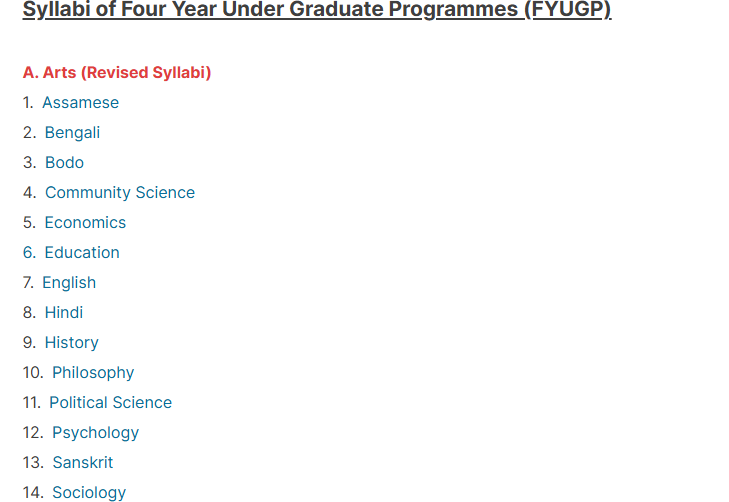
Dibrugarh University (DU), one of Assam’s premier state universities, follows the National Education Policy (NEP) 2020 framework for most undergraduate and integrated postgraduate programmes. The 2026 academic session (primarily 2026-2027) features updated syllabi under the Four-Year Undergraduate Programme (FYUGP), Five-Year Integrated Postgraduate Programme (FYIPGP), and ongoing Choice-Based Credit System (CBCS) structures for traditional PG and certain professional courses. Official syllabi are available on the university website (dibru.ac.in) under Academic Regulations, Syllabi sections, and specific notifications.
This guide covers the structure, key subjects, how to access PDFs, assessment patterns, and practical tips so students can plan effectively.
What Is the Dibrugarh University Syllabus Structure in 2026?
The syllabus outlines the course curriculum, credit distribution, learning outcomes, and evaluation methods for each programme. Under NEP 2020, DU has shifted most UG programmes to the multidisciplinary FYUGP (with multiple entry-exit options) and introduced FYIPGP for seamless UG-to-PG progression. Traditional 2-year PG programmes and professional courses continue under CBCS with periodic revisions, including Indian Knowledge System (IKS) integration from the 2026-2027 session in many subjects.
Syllabi emphasize core (major) courses, minor courses, multidisciplinary generic electives (GEC), ability enhancement courses (AEC), value-added courses (VAC), skill enhancement courses (SEC), and research components in later years.
Why Does the Dibrugarh University Syllabus Matter for Students?
The updated syllabi improve employability through skill-oriented and interdisciplinary content, allow flexible exits (certificate after 1 year, diploma after 2 years, degree after 3/4 years), and incorporate IKS, research methodology, and community engagement. Students gain clearer pathways for higher studies, competitive exams, and careers in academia, government, industry, and research. Freshness signals (IKS updates effective 2026-2027) help with relevance and ranking in search results.
Course Overview: Duration, Format, Credits and Prerequisites
Undergraduate (FYUGP as per NEP 2020)
- Duration: 4 years (8 semesters); exit options at 1, 2, or 3 years.
- Credits: Approximately 160–176 for 4-year Honours/Honours with Research (exact figures follow UGC framework; check specific subject regulations).
- Structure: Major (core), Minor, GEC, AEC (languages), VAC, SEC, internship/community engagement, and research in 4th year.
- Prerequisites: 10+2 or equivalent from a recognized board.
Five-Year Integrated Postgraduate Programme (FYIPGP)
- Duration: 5 years (10 semesters); first 4 years align with FYUGP.
- Credits: Minimum ~200 for the full programme.
- Offered in subjects such as Anthropology, Applied Geology, Applied Psychology, Assamese, Biotechnology and Bioinformatics, Chemistry, Commerce (Banking/Finance/HRM/Marketing), Economics, English, Geography, History, Life Sciences (Botany/Zoology), Mathematics, Physics, Political Science, Sociology, and Statistics.
Traditional Postgraduate (2-year CBCS)
- Duration: 2 years (4 semesters).
- Subjects include MA in Assamese, English, Economics, Education, History, Political Science, Sociology, Philosophy, Performing Arts; MSc in Chemistry, Physics, Life Sciences (updated from 2026-2027), Biotechnology and Bioinformatics, Applied Geology, Mathematics, Anthropology; MCom, MTech (Petroleum, Mechanical, Electronics), MBA, etc.
Other Programmes BCA (Honours/Honours with Research – new structure from 2026-2027 for Semesters I–II), BBA, B.Ed., B.Pharm, B.Tech, LLB, and professional courses have dedicated syllabi.
Admission for 2026 typically involves CUET or university-specific tests/merit as notified on the official admission portal.
Dibrugarh University Syllabus 2026 for UG Courses
FYUGP syllabi are organized by stream and subject. Revised versions with IKS are approved for many disciplines effective 2026-2027.
Arts Stream (Key Subjects)
Major options include Assamese, Bengali, Bodo, Economics, Education, English, Hindi, History, Philosophy, Political Science, Psychology, Sanskrit, Sociology, and Community Science. Each has semester-wise core papers, electives, and skill components. IKS integration appears in Assamese, Bodo, Economics, Education, English, History, Philosophy, Psychology, Political Science, Sociology, and others.
Science Stream
Subjects: Anthropology, Biotechnology and Bioinformatics, Botany, Chemistry, Computer Science, Electronics, Geography, Geology, Mathematics, Physics, Statistics, Zoology, and Community Science. Core papers cover foundational to advanced topics; practicals and SEC (e.g., programming, lab techniques) are emphasized. Updated Life Sciences and Applied Geology syllabi exist for recent sessions.
Commerce Stream
Specializations in Finance, Marketing, Human Resource Management, and Banking & Insurance. Revised 4th-semester and other papers are available; IKS inclusion is notified.
Other UG Programmes
- BCA: New Honours/Honours with Research structure approved for Semesters I–II from 2026-2027.
- BBA, B.Voc, Performing Arts, Social Work, Mass Communication, and integrated law programmes have separate structures.
Students select majors and minors based on availability at university departments or affiliated colleges.
Dibrugarh University Syllabus 2026 for PG Courses
PG syllabi under CBCS typically feature core courses, elective/discipline-specific electives (DSE), and a dissertation or project in the final semester. Examples:
- MSc Life Sciences: Updated syllabus from 2026-2027 session.
- MTech Petroleum Exploration & Production: Revised for 2026-2027.
- MBA (Full Time): Updated from 2026-2027.
- FYIPGP continues FYUGP structure into Years 4–5 with advanced DSC/DSE, research proposal, dissertation, or community project.
Skill Enhancement Courses (examples): Basic IT Tools, Programming using Python, Sattriya Dance foundations, Stage Acting, Seritechnique, Oral History, and more.
UG Syllabus Structure
| Component | Purpose |
|---|---|
| Major/Core | In-depth study of the student’s main discipline |
| Minor | Study of another discipline |
| Multidisciplinary Course | Introductory study across different disciplines |
| Generic Elective | Elective course from an available basket |
| Skill Enhancement Course | Practical and employability-oriented skills |
| Value Added Course | Additional knowledge and skills |
| Internship/Research | Practical or research exposure, where applicable |
The FYUGP framework is designed around the UGC credit framework and NEP 2020.
Dibrugarh University PG Syllabus 2026
Dibrugarh University offers postgraduate programmes in several disciplines. The university’s website provides a dedicated section for PG CBCS regulations and syllabi, along with programme-specific syllabus documents.
Common PG programmes include:
| PG Programme | Major Subject Examples |
|---|---|
| M.A. | Assamese, English, History, Political Science, Education, Economics, etc. |
| M.Sc. | Mathematics, Physics, Chemistry, Botany, Zoology, Statistics, etc. |
| M.Com. | Commerce |
| MCA | Computer Applications |
| Other PG Courses | Programme/department specific |
Students should download the syllabus corresponding to their exact programme, department and admission/session because course structures can differ.
Five-Year Integrated PG Programme
Dibrugarh University also has a Five-Year Integrated Postgraduate Programme (FYIPGP) under the NEP framework. The revised FYIPGP regulations apply from the 2024–25 academic session. The structure allows students to pursue a major discipline and, where applicable, a minor/second-major discipline.
For example, the university has published FYIPGP syllabi for subjects such as Mathematics and History.
Dibrugarh University Syllabus 2026 PDF Download
The safest source for downloading the latest syllabus is the official Dibrugarh University website, where the university maintains sections for FYUGP, PG CBCS, FYIPGP and other academic programmes.
Dibrugarh University Official Website
Useful official syllabus pages include:
- Dibrugarh University FYIPGP Syllabus/Information
- Revised FYUGP Syllabus Notification
- FYUGP Commerce Revised Syllabus
- FYUGP History Syllabus PDF
- FYUGP English Syllabus PDF
- FYUGP Mathematics Syllabus PDF
- FYUGP Education Syllabus PDF
Learning Outcomes and Skills You Will Gain
Completing the syllabus develops subject expertise, critical thinking, research skills, digital literacy, communication, and interdisciplinary awareness. NEP-aligned programmes specifically build employability skills, ethical values (via VAC and IKS), and the ability to pursue higher research or professional careers. Exit options provide progressive credentials.
Assessment Methods, Assignments and Evaluation Criteria
Evaluation follows continuous internal assessment (sessional tests, assignments, practicals, presentations) plus end-semester examinations. Typical weightage includes internal assessment (often 20–40%) and external exams. Research components in Honours with Research or FYIPGP involve proposals, literature reviews, and dissertations. Grading uses the CBCS/CGPA system. Exact patterns appear in the programme-specific regulations and academic calendars.
Dibrugarh University Syllabus 2026 PDF Download
- Visit the official website: dibru.ac.in.
- Navigate to Academic Regulations, Syllabi of UG CBCS, Syllabi of PG CBCS, Four-Year Undergraduate Programmes (FYUGP), or Five-Year Integrated Post Graduate Programme (FYIPGP) pages.
- Select the relevant stream/subject notification or syllabus link (many PDFs are attached to notifications).
- For IKS-updated versions (effective 2026-2027), check recent Academic Council notifications (e.g., January 2026 posts).
- Affiliated colleges may also host or circulate the common course structures.
Always prefer the official site over third-party sources for the latest versions. Academic calendars for 2026 are also published there.
Recommended Resources and Study Tips
- Official PDFs + recommended textbooks listed in each syllabus.
- University library resources, departmental notes, and previous years’ question papers (where available).
- SWAYAM/NPTEL courses for skill components.
- Practical tip: Map your semester plan early, prioritize SEC and VAC for holistic development, and track IKS modules as they are newly integrated.
FAQs
Where can I find the exact syllabus for my subject?
Check the official DU website under the relevant programme page or recent notifications. Contact the department or affiliated college if a link is missing.
Has the syllabus changed for 2026?
Yes—IKS integration in many FYUGP and FYIPGP subjects, revised BCA structure, updated MSc Life Sciences, MTech Petroleum, and MBA from the 2026-2027 session.
What is the difference between FYUGP and traditional CBCS?
FYUGP is multidisciplinary with flexible exits and research options under NEP; older CBCS programmes are more fixed but still credit-based.
Are there multiple entry-exit options?
Yes, under FYUGP/FYIPGP as per NEP 2020 regulations.
How is research handled?
In the 4th year of FYUGP (Honours with Research) and later years of FYIPGP through dedicated methodology and dissertation courses.
About The Author
