
GIMS Staff Nurse Syllabus 2026: The Government Institute of Medical Sciences (GIMS), Greater Noida, an autonomous institute under the Uttar Pradesh government, has released the notification for Staff Nurse recruitment 2026. This offers 100 regular vacancies and provides a strong career opportunity for qualified nursing professionals. Understanding the detailed syllabus, exam pattern, and salary structure is essential for effective preparation and success in the selection process.
The recruitment follows a Computer Based Test (CBT) as the primary selection stage, followed by biometric verification, document checking, and a medical examination. Candidates must prepare thoroughly according to the official syllabus drawn from B.Sc. Nursing, Post Basic B.Sc. Nursing, and GNM curricula. This article covers all key aspects to help aspirants plan their strategy.
Overview of GIMS Staff Nurse Recruitment 2026
GIMS Greater Noida has advertised 100 Staff Nurse posts under Advertisement No. GIMS/2026/Manpower/NT-03/10. Applications opened on 10 August 2026 and close on 7 September 2026. The posts are on a regular basis with Uttar Pradesh state reservation rules applicable.
Category-wise vacancies include 40 Unreserved, 27 OBC, 21 SC, 2 ST, and 10 EWS posts. Horizontal reservations apply for women, ex-servicemen, persons with disabilities, and dependents of freedom fighters as per UP government norms. The official website for applications and updates is gims.ac.in.
Eligible candidates must hold B.Sc. Nursing (4 years), B.Sc. Nursing Post Basic (2 years), or GNM diploma from an INC or State Medical Faculty recognized institute, along with valid RN & RM registration. Age limit is generally 21–40 years (or 18–40 as per some sources) as on the cut-off date, with relaxations for reserved categories.
GIMS Staff Nurse Selection Process 2026
Selection begins with a Computer Based Test consisting of objective questions focused on nursing knowledge. Merit is prepared based on CBT scores, after which shortlisted candidates undergo biometric verification and document scrutiny.
The final stage is a medical examination as per institute rules. No interview is mentioned in the process. Candidates must carry the admit card to the exam centre; entry is not permitted without it. Exam cities include Delhi/NCR, Lucknow, Gorakhpur, and Varanasi.
Qualifying marks are 40% for General/EWS/OBC and 35% for SC/ST categories. The process ensures transparent selection based purely on performance in the written test and subsequent verification stages.
GIMS Staff Nurse Exam Pattern 2026
The examination is conducted in Computer Based Test mode with 100 multiple-choice questions carrying a total of 100 marks. Each correct answer awards 1 mark, while 0.25 marks are deducted for every incorrect response. Unanswered questions attract no penalty.
The paper is bilingual (Hindi and English), with the English version prevailing in case of any discrepancy. Approximately 80% of questions test theoretical knowledge and 20% assess practical knowledge drawn from the nursing curriculum. The detailed structure is shown below.
| Exam Detail | Information |
|---|---|
| Mode | Computer Based Test (CBT) |
| Question Type | Objective (MCQs) |
| Total Questions | 100 |
| Total Marks | 100 |
| Marks per Question | 1 |
| Negative Marking | 0.25 mark per wrong answer |
| Language | Hindi and English |
| Theoretical Knowledge | 80% |
| Practical Knowledge | 20% |
| Qualifying Marks (Gen/EWS/OBC) | 40% |
| Qualifying Marks (SC/ST) | 35% |
Candidates can use the “Mark for Review” option within the allotted time for each section. Proper time management and accuracy are critical due to negative marking.
GIMS Staff Nurse Syllabus 2026 – Section-Wise Details
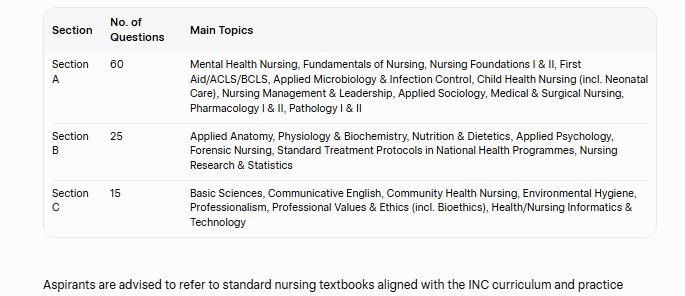
The syllabus is divided into three sections covering core nursing subjects from the B.Sc. Nursing and GNM curriculum. Section A carries the highest weightage with 60 questions, followed by Section B (25 questions) and Section C (15 questions). Questions test both theoretical understanding and practical application.
Section A (60 Questions) focuses on clinical and core nursing subjects. Topics include Mental Health Nursing, Fundamentals of Nursing, Nursing Foundations I & II, First Aid, ACLS and BCLS, Applied Microbiology and Infection Control, Child Health Nursing (including neonatal care), Nursing Management and Leadership, Applied Sociology, Medical & Surgical Nursing, Pharmacology I & II, and Pathology I & II. Candidates should revise patient care procedures, emergency protocols, and disease management thoroughly.
Section B (25 Questions) covers foundational and supportive sciences. Key areas are Applied Anatomy, Physiology and Biochemistry, Nutrition & Dietetics, Applied Psychology, Forensic Nursing, Standard Treatment Protocols used in National Health Programmes, and Nursing Research and Statistics. Emphasis is placed on understanding body systems, nutritional requirements, research methodology, and government health schemes.
Section C (15 Questions) includes broader professional and community aspects. Subjects comprise Basic Sciences, Communicative English, Community Health Nursing, Environmental Hygiene, Professionalism, Professional Values & Ethics (including Bioethics), and Health/Nursing Informatics and Technology. This section evaluates communication skills, ethical practices, community health concepts, and basic computer/nursing technology awareness.
The complete section-wise distribution is summarized in the table below:
| Section | No. of Questions | Main Topics |
|---|---|---|
| Section A | 60 | Mental Health Nursing, Fundamentals of Nursing, Nursing Foundations I & II, First Aid/ACLS/BCLS, Applied Microbiology & Infection Control, Child Health Nursing (incl. Neonatal Care), Nursing Management & Leadership, Applied Sociology, Medical & Surgical Nursing, Pharmacology I & II, Pathology I & II |
| Section B | 25 | Applied Anatomy, Physiology & Biochemistry, Nutrition & Dietetics, Applied Psychology, Forensic Nursing, Standard Treatment Protocols in National Health Programmes, Nursing Research & Statistics |
| Section C | 15 | Basic Sciences, Communicative English, Community Health Nursing, Environmental Hygiene, Professionalism, Professional Values & Ethics (incl. Bioethics), Health/Nursing Informatics & Technology |
Aspirants are advised to refer to standard nursing textbooks aligned with the INC curriculum and practice previous nursing exam papers for better familiarity with question styles.
GIMS Staff Nurse Salary 2026
Selected candidates receive a basic pay of ₹44,900 along with a Grade Pay of ₹4,600 as per the applicable pay matrix. This structure aligns with 7th Pay Commission norms adopted by the Uttar Pradesh government.
In addition to basic pay, staff nurses are entitled to Dearness Allowance (DA), House Rent Allowance (HRA), Transport Allowance, and other benefits as per state government rules. The exact in-hand salary varies depending on posting location, deductions, and current allowance rates.
The post offers job security, career growth opportunities within the institute, and other institutional benefits typical of government medical colleges. Candidates should review the official notification for complete details on pay and allowances.
Preparation Tips
Focus first on high-weightage clinical subjects in Section A while regularly revising anatomy, physiology, and community health topics. Practice mock tests under timed conditions to improve speed and accuracy, keeping negative marking in mind. Stay updated with national health programmes and recent nursing guidelines.
Regular revision of ethics, communication, and informatics topics from Section C can help secure easy marks. Download the official information brochure from gims.ac.in for the most accurate and updated details. Consistent preparation aligned with the given syllabus and exam pattern will significantly improve the chances of selection in GIMS Staff Nurse Recruitment 2026.
About The Author
