
The IOCL Junior Engineer/Officer (Grade E0) recruitment is conducted by Indian Oil Corporation Limited (IOCL) for diploma engineers in disciplines such as Chemical, Mechanical, Electrical, and Instrumentation Engineering. The latest official recruitment cycle available was for 2025, and the recruitment information/results extended into 2026. Therefore, the IOCL JE Syllabus 2026 should be treated as based on the latest official pattern unless IOCL releases a fresh 2026 notification with changes.
Important: IOCL also conducts a separate Engineers/Officers (Grade A) recruitment for B.E./B.Tech graduates. Its CBT pattern is different from the Junior Engineer/Officer exam.
IOCL JE Syllabus 2026 – Overview
| Particulars | Details |
|---|---|
| Organization | Indian Oil Corporation Limited (IOCL) |
| Post | Junior Engineer/Officer, Grade E0 |
| Qualification | Diploma in relevant engineering discipline |
| Disciplines | Chemical, Mechanical, Electrical, Instrumentation |
| Exam Mode | Computer Based Test (CBT) |
| Question Type | Objective/MCQ |
| Technical Paper | Discipline-specific |
| Selection Process | CBT + Skill/Proficiency/Physical Test (as applicable) |
| Pay Scale in latest JE notification | ₹30,000–₹1,20,000 |
The latest official JE/Officer recruitment covered 381 vacancies: 269 Chemical, 50 Electrical, 17 Instrumentation and 45 Mechanical.
IOCL JE Subject-Wise Syllabus 2026
Trade-wise syllabus is given below. Check Important topics.
IOCL JE Chemical Engineering Syllabus
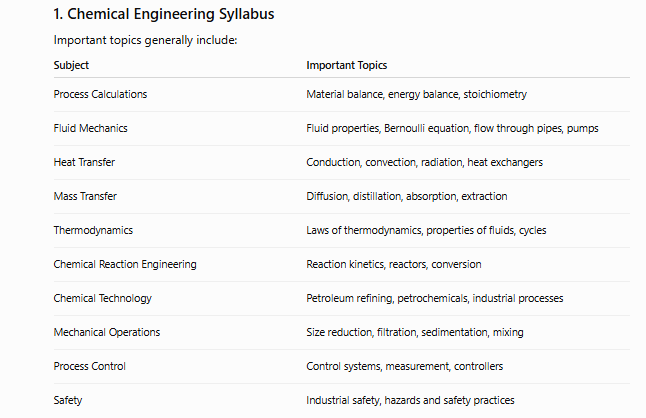
Important topics generally include:
| Subject | Important Topics |
|---|---|
| Process Calculations | Material balance, energy balance, stoichiometry |
| Fluid Mechanics | Fluid properties, Bernoulli equation, flow through pipes, pumps |
| Heat Transfer | Conduction, convection, radiation, heat exchangers |
| Mass Transfer | Diffusion, distillation, absorption, extraction |
| Thermodynamics | Laws of thermodynamics, properties of fluids, cycles |
| Chemical Reaction Engineering | Reaction kinetics, reactors, conversion |
| Chemical Technology | Petroleum refining, petrochemicals, industrial processes |
| Mechanical Operations | Size reduction, filtration, sedimentation, mixing |
| Process Control | Control systems, measurement, controllers |
| Safety | Industrial safety, hazards and safety practices |
The latest recruitment permitted several Chemical-related diploma disciplines, including Chemical Engineering, Chemical Technology, Petrochemical Engineering/Technology and Refinery & Petrochemical Engineering.
IOCL JE Mechanical Engineering Syllabus
| Subject | Important Topics |
|---|---|
| Engineering Mechanics | Force systems, equilibrium, friction |
| Strength of Materials | Stress, strain, bending, torsion |
| Thermodynamics | Laws, cycles, properties of gases and steam |
| Fluid Mechanics | Fluid flow, pumps, turbines |
| Heat Transfer | Conduction, convection, radiation |
| IC Engines | Otto, Diesel and dual cycles |
| Theory of Machines | Mechanisms, gears, governors |
| Machine Design | Design fundamentals, shafts, bearings |
| Manufacturing | Casting, welding, machining |
| Industrial Engineering | Production planning, work study |
| Refrigeration & AC | Refrigeration cycles, psychrometry |
IOCL JE Electrical Engineering Syllabus
| Subject | Important Topics |
|---|---|
| Electrical Circuits | AC/DC circuits, network theorems |
| Electrical Machines | Transformers, DC machines, induction motors |
| Power Systems | Generation, transmission, distribution |
| Power Electronics | Rectifiers, converters, inverters |
| Measurements | Electrical measuring instruments |
| Control Systems | Transfer functions, stability, controllers |
| Electrical Materials | Conductors, insulators, magnetic materials |
| Basic Electronics | Diodes, transistors, amplifiers |
| Protection | Relays, circuit breakers, protection systems |
| Utilization | Electrical drives and applications |
IOCL JE Instrumentation Engineering Syllabus
| Subject | Important Topics |
|---|---|
| Measurement | Measurement systems and errors |
| Sensors & Transducers | Temperature, pressure, flow and level measurement |
| Industrial Instrumentation | Process measurement and control |
| Control Systems | Feedback, stability, controllers |
| Process Control | PID controllers and control loops |
| Analytical Instrumentation | Industrial analytical techniques |
| Electronics | Diodes, transistors, amplifiers |
| Digital Electronics | Logic gates, counters, registers |
| Industrial Automation | PLC, SCADA and basic automation |
| Communication | Basic industrial communication systems |
The latest Grade E0 recruitment specifically included Electrical and Instrumentation disciplines alongside Chemical and Mechanical.
General Aptitude Syllabus
Apart from technical subjects, candidates should prepare the following areas:
Quantitative Aptitude
- Number System
- Percentage
- Ratio and Proportion
- Average
- Profit and Loss
- Simple and Compound Interest
- Time and Work
- Time, Speed and Distance
- Data Interpretation
- Simplification
- Algebra
- Mensuration
Reasoning Ability
- Analogy
- Classification
- Coding-Decoding
- Blood Relations
- Direction Test
- Number/Alphabet Series
- Syllogism
- Statement and Conclusion
- Venn Diagrams
- Puzzles
- Data Sufficiency
English Language
- Grammar
- Vocabulary
- Synonyms and Antonyms
- Sentence Correction
- Error Detection
- Fill in the Blanks
- Reading Comprehension
- Cloze Test
- Idioms and Phrases
General Awareness
- Current Affairs
- Indian Economy
- Indian Polity
- General Science
- Important Government Schemes
- Awards and Honours
- Sports
- Important Days
- Geography
- History
- Science & Technology
IOCL JE Exam Pattern 2026
The CBT is identical in structure for both Junior Engineers (Grade E0) and Engineers/Officers (Grade A). It is an objective multiple-choice test.
| Section | No. of Questions | Marks |
|---|---|---|
| Domain Knowledge (Technical/Discipline-specific) | 50 | 50 |
| Quantitative Aptitude | 20 | 20 |
| Logical Reasoning | 15 | 15 |
| Verbal Ability (English) | 15 | 15 |
| Total | 100 | 100 |
Key Details:
- Mode: Online Computer-Based Test (CBT).
- Duration: 150 minutes (2 hours 30 minutes).
- Question Type: Objective / MCQs.
- Marking Scheme: +1 for every correct answer; –0.25 for every wrong answer (negative marking applies).
- Medium: Bilingual (English & Hindi), except the English Language section.
- Qualifying Marks (based on recent patterns): Generally around 40% overall for General/EWS/OBC (with sectional requirements in some cycles); relaxations for SC/ST/PwBD. Exact cut-offs are released with the detailed notification/handout.
The Domain Knowledge section carries the highest weightage and is based on diploma-level topics for JE (Grade E0) and degree-level for Engineers (Grade A).
IOCL Engineers/Officers Exam Pattern 2026
If by “Engineers Exam” you mean the IOCL Engineers/Officers Grade A recruitment for B.E./B.Tech candidates, the latest official pattern is different.
The 2025 official Grade A advertisement specified 100 MCQs for 100 marks and 150 minutes. The paper contained 50 domain-specific questions and 50 general aptitude questions.
| Section | Questions | Marks |
|---|---|---|
| Domain Knowledge | 50 | 50 |
| Quantitative Aptitude | 20 | 20 |
| Logical Reasoning | 15 | 15 |
| Verbal Ability – English | 15 | 15 |
| Total | 100 | 100 |
Negative marking: 0.25 mark is deducted for every incorrect answer. Duration: 150 minutes.
For the latest Grade A recruitment, the qualifying requirement was 40% in each section and 45% overall for General/EWS/OBC-NCL, while SC/ST candidates required 35% in each section and 40% overall; PwBD candidates had lower qualifying thresholds.
IOCL Engineer Selection Process
The latest Grade A recruitment followed:
CBT → Group Discussion (GD) & Group Task (GT) → Personal Interview (PI)
The final composite score gave 85% weightage to CBT, 5% to GD/GT and 10% to the Personal Interview.
IOCL Engineer/Officer Syllabus 2026
General Aptitude Syllabus
Quantitative Aptitude (key topics): Number system, simplification/approximation, percentages, ratio & proportion, averages, profit & loss, simple & compound interest, time & work, time-speed-distance, data interpretation (tables, graphs, charts), probability, permutation & combination, mensuration basics.
Logical Reasoning: Analogies, coding-decoding, blood relations, series (number/alphabet/non-verbal), syllogism, directions, seating arrangement/puzzles, statement-assumption/conclusion/arguments, decision making, visual memory, similarities & differences, cubes & dice, mirror/water images.
Verbal Ability (English): Reading comprehension, spotting errors, fill in the blanks, synonyms/antonyms, idioms & phrases, sentence rearrangement/para jumbles, subject-verb agreement, articles, prepositions, active-passive voice, narration/direct-indirect speech.
Domain Knowledge / Technical Syllabus (Discipline-wise)
Domain questions test core engineering concepts at approximately GATE level. Official outlines emphasize the following major areas.
Chemical Engineering
- Engineering Mathematics
- Process Calculations & Thermodynamics
- Fluid Mechanics & Mechanical Operations
- Chemical Reaction Engineering
- Instrumentation & Process Control
- Plant Design and Economics
- Heat Transfer
- Mass Transfer
- Chemical Technology
Additional focus areas often include industrial chemistry, momentum transfer, chemical engineering drawing, and project engineering concepts.
Electrical Engineering
- Engineering Mathematics
- Electrical Machines
- Power Systems
- Control Systems
- Electric Circuits
- Electromagnetic Fields
- Signals and Systems
- Electrical and Electronic Measurements
- Analog and Digital Electronics
- Power Electronics
Related topics frequently tested: transformers, switchgear & protection, network analysis, utilisation of electrical energy.
Instrumentation Engineering
- Engineering Mathematics
- Control Systems
- Analog Electronics
- Digital Electronics
- Electricity and Magnetism
- Electrical Circuits and Machines
- Signals and Systems
- Measurements
- Sensors and Industrial Instrumentation
- Communication and Optical Instrumentation
Additional emphasis on transducers, process control, industrial instrumentation, and fundamentals of instrumentation systems.
Other Disciplines (when notified – Mechanical, Civil, ECE, CS/IT, etc.): Syllabus generally mirrors standard GATE paper topics for that branch (e.g., strength of materials, thermodynamics, manufacturing for Mechanical; structural analysis, geotechnical, transportation for Civil). Refer to the specific notification for exact coverage.
IOCL JE vs IOCL Engineer
| Feature | IOCL JE/Officer | IOCL Engineer/Officer |
|---|---|---|
| Grade | E0 | Grade A |
| Qualification | Diploma | B.E./B.Tech |
| Major Technical Level | Diploma | Graduate Engineering |
| Technical Disciplines | Chemical, Mechanical, Electrical, Instrumentation | Latest Grade A: Chemical, Electrical, Instrumentation |
| CBT | Yes | Yes |
| GD/GT/PI | Different selection process | Yes |
| Negative Marking | Check latest notification | 0.25 mark |
| Latest official CBT duration | Notification-specific | 150 minutes |
For preparation, candidates should not mix the JE and Engineer syllabi: JE aspirants should primarily revise diploma-level technical subjects, while Grade A Engineer aspirants should prepare graduate-level engineering concepts along with aptitude.
About The Author
