
Delhi Judiciary Syllabus 2026: The Delhi Judicial Service (DJS) Examination, conducted by the High Court of Delhi, recruits candidates for the post of Civil Judge (Junior Division). The exam is highly competitive and follows a structured three-stage process. The syllabus and scheme are governed by the Delhi Judicial Service Rules (as amended, including updates reflecting the new criminal laws effective from 2023–2024).
The examination is held in successive stages:
- Preliminary Examination (Objective type – screening test)
- Mains Examination (Written – descriptive)
- Viva-Voce (Interview)
Marks obtained in the Preliminary Examination are not counted for the final merit list. Final ranking is based on the aggregate of Mains Examination + Viva-Voce marks.
Delhi Judiciary Exam Pattern Overview
| Stage | Type | Total Marks | Duration | Negative Marking | Qualifying Criteria (General / Reserved) |
|---|---|---|---|---|---|
| Preliminary | Objective (MCQs) | 200 | 2–2.5 hours | 25% (0.25 marks) | 60% / 55% |
| Mains | Descriptive (Written) | 850 | 3 hours per paper | None | 40% in each paper + 50% aggregate / 35% in each + 45% aggregate |
| Viva-Voce | Interview | 150 | — | None | 50% / 45% |
- Number of candidates shortlisted for Mains: Generally not more than 10 times the vacancies in each category.
- Number shortlisted for Viva-Voce: Generally not more than 3 times the vacancies in each category.
- Candidates securing marks equal to the last shortlisted candidate are also included.
Delhi Judiciary Prelims Syllabus 2026
The Preliminary Examination consists of 200 objective-type questions/marks with 25% negative marking. It is designed to test general legal knowledge, legal aptitude, English expression and knowledge of objective legal problems. The examination duration is 2.5 hours.
Subject-wise Prelims Syllabus
| Subject | Important Topics |
|---|---|
| Constitution of India | Fundamental Rights, DPSP, Fundamental Duties, President, Parliament, Supreme Court, High Courts, Centre-State Relations, Constitutional Amendments |
| Code of Civil Procedure, 1908 | Jurisdiction, Res Judicata, Res Sub Judice, Pleadings, Parties, Summons, Written Statement, Interim Orders, Appeals, Review, Revision, Execution |
| Criminal Law | General principles of criminal liability, offences, punishments, exceptions, abetment, attempt and related provisions |
| Indian Contract Act, 1872 | Offer, Acceptance, Consideration, Capacity, Free Consent, Void Agreements, Contingent Contracts, Indemnity, Guarantee, Bailment, Agency |
| Limited Liability Partnership Act, 2008 | Formation, Partners, Designated Partners, Rights and Duties, Liability and Dissolution |
| Arbitration and Conciliation Act, 1996 | Arbitration agreement, appointment of arbitrators, arbitral proceedings, awards, challenge and enforcement |
| Indian Evidence Act, 1872 | Relevancy, Admissions, Confessions, Statements, Burden of Proof, Witnesses, Documentary Evidence |
| Specific Relief Act, 1963 | Specific performance, injunctions, declaratory relief and related remedies |
| Limitation Act, 1963 | Limitation periods, computation, acknowledgement, adverse possession and condonation |
| POCSO Act, 2012 | Sexual offences against children, reporting, investigation, special courts and child-friendly procedures |
| Commercial Courts Act, 2015 | Commercial disputes, jurisdiction, pleadings, case management and procedure |
These subjects are expressly listed in the latest DJS syllabus published by the Delhi High Court.
Prelims Marking Scheme
- Maximum Marks: 200
- Type: Objective/MCQ
- Negative Marking: 0.25 marks for every wrong answer
- Duration: 2 hours 30 minutes
- General Category qualifying marks: 60%
- Reserved categories: 55%
- Prelims marks are not added to final merit.
Delhi Judiciary Prelims Syllabus: Important Topics
Nature: Screening test of qualifying nature. One paper of multiple-choice questions.
Total Questions/Marks: 200 questions for 200 marks.
Marking Scheme: +1 for correct answer; –0.25 for every wrong answer.
Syllabus (as per the latest Appendix to Delhi Judicial Service Rules):
Questions test general legal knowledge, aptitude, power of expression, flair in English, and objective-type legal problems covering:
- The Constitution of India
- The Code of Civil Procedure, 1908
- The Code of Criminal Procedure, 1973 and Bharatiya Nagarik Suraksha Sanhita, 2023
- The Indian Penal Code and Bharatiya Nyaya Sanhita, 2023
- The Indian Contract Act, 1872
- The Limited Liability Partnership Act, 2008
- The Arbitration and Conciliation Act, 1996
- The Indian Evidence Act, 1872 and Bharatiya Sakshya Adhiniyam, 2023
- The Specific Relief Act, 1963
- The Limitation Act, 1963
- The Protection of Children from Sexual Offences Act, 2012 (POCSO)
- The Commercial Courts Act, 2015
Note: The High Court may include additional Acts/laws from time to time. English language, general legal knowledge, and current legal affairs are also tested within the paper.
Delhi Judiciary Mains Syllabus 2026
The Mains Examination consists of four papers carrying a total of 850 marks. Each paper is conducted for three hours.
Paper 1: General Legal Knowledge & Language – 250 Marks
This paper has two sections.
Section I – General Legal Knowledge: 100 Marks
Questions are intended to test the candidate’s knowledge of current legal affairs and general legal developments.
Candidates should prepare:
- Important recent judgments
- Constitutional developments
- Major Supreme Court and High Court decisions
- Important legal amendments
- Current legal affairs
- Important Acts and legislation
- Legal institutions and commissions
- Contemporary issues related to law and justice
Section II – Language: 150 Marks
This section tests the candidate’s English language, expression and writing ability.
It includes:
- Essay Writing
- Precis Writing
- Translation from English to Hindi
- Translation from Hindi to English
- Grammar
- Vocabulary
- Sentence construction
- Effective legal expression
The official scheme specifically provides for two translation passages—one from English to Hindi in Devanagari script and another from Hindi in Devanagari script to English.
Paper 2: Civil Law-I – 200 Marks
The Civil Law-I paper covers the following major laws:
| Law | Major Areas to Prepare |
|---|---|
| Indian Contract Act, 1872 | Contract formation, consideration, capacity, breach, indemnity, guarantee, bailment and agency |
| Sale of Goods Act, 1930 | Sale, conditions and warranties, transfer of property, unpaid seller |
| Transfer of Property Act, 1882 | Sale, mortgage, lease, gift, actionable claims |
| Specific Relief Act, 1963 | Specific performance, injunctions, declarations |
| Hindu Law | Marriage, divorce, succession, adoption, maintenance |
| Mohammedan Law | Marriage, divorce, inheritance, gifts and related principles |
| Delhi Rent Control Act, 1958 | Rent, eviction, tenancy and landlord-tenant disputes |
| Law of Torts | Negligence, nuisance, defamation, strict liability, vicarious liability |
| New Delhi Municipal Council Act, 1994 | Relevant municipal provisions |
| Delhi Municipal Corporation Act, 1957 | Municipal administration and relevant legal provisions |
| Commercial Courts Act, 2015 | Commercial disputes and related procedure |
The above subjects form the officially prescribed Civil Law-I syllabus.
Paper 3: Civil Law-II – 200 Marks
Civil Law-II includes:
Code of Civil Procedure, 1908
Focus on:
- Jurisdiction
- Res Judicata and Res Sub Judice
- Parties to suits
- Pleadings
- Plaint and Written Statement
- Summons
- Discovery and Inspection
- Interim orders
- Judgment and Decree
- Execution
- Appeals
- Review and Revision
Indian Evidence Act, 1872
Prepare:
- Relevancy of facts
- Admissions
- Confessions
- Statements
- Documentary evidence
- Oral evidence
- Burden of proof
- Presumptions
- Witnesses
- Examination and cross-examination
Limitation Act, 1963
- Computation of limitation
- Extension and exclusion of time
- Acknowledgement
- Condonation of delay
- Adverse possession
Other Laws
- Registration Act, 1908
- Arbitration and Conciliation Act, 1996
- Trade Marks Act, 1999
- Copyright Act, 1957
These laws are specifically included under Civil Law-II in the Delhi Judicial Service syllabus.
Paper 4: Criminal Law – 200 Marks
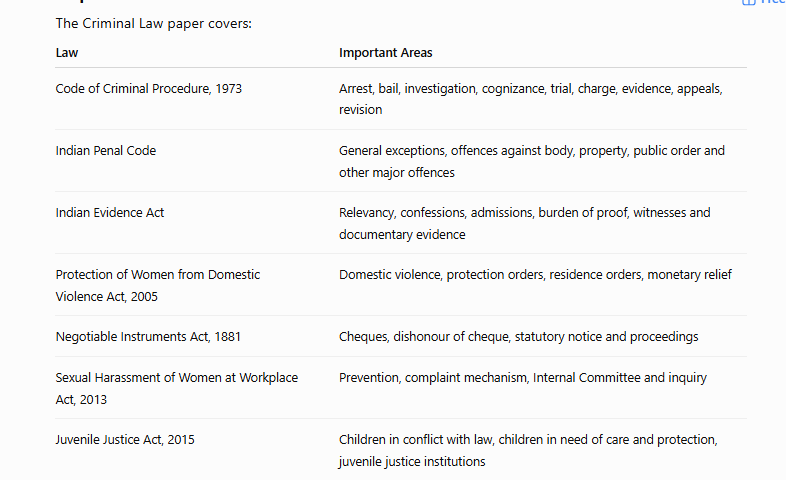
The Criminal Law paper covers:
| Law | Important Areas |
|---|---|
| Code of Criminal Procedure, 1973 | Arrest, bail, investigation, cognizance, trial, charge, evidence, appeals, revision |
| Indian Penal Code | General exceptions, offences against body, property, public order and other major offences |
| Indian Evidence Act | Relevancy, confessions, admissions, burden of proof, witnesses and documentary evidence |
| Protection of Women from Domestic Violence Act, 2005 | Domestic violence, protection orders, residence orders, monetary relief |
| Negotiable Instruments Act, 1881 | Cheques, dishonour of cheque, statutory notice and proceedings |
| Sexual Harassment of Women at Workplace Act, 2013 | Prevention, complaint mechanism, Internal Committee and inquiry |
| Juvenile Justice Act, 2015 | Children in conflict with law, children in need of care and protection, juvenile justice institutions |
Delhi Judiciary Mains Syllabus: Important Topics
Nature: Descriptive written examination consisting of four papers.
| Paper | Subject | Maximum Marks | Duration |
|---|---|---|---|
| I | General Legal Knowledge & Language | 250 | 3 hours |
| II | Civil Law-I | 200 | 3 hours |
| III | Civil Law-II | 200 | 3 hours |
| IV | Criminal Law | 200 | 3 hours |
| Total | 850 | — |
Paper I: General Legal Knowledge & Language (250 Marks)
This paper has two sections:
- Section I – General Legal Knowledge (100 Marks): Tests knowledge of current legal affairs, recent judgments, legal developments, etc.
- Section II – Language (Essay, Translation and Precis Writing) (150 Marks): Tests knowledge and power of expression in English. Credit is given for both substance and expression. Deductions are made for bad expression, faults of grammar, and misuse of words.
- Essay writing
- Precis writing
- Two translation passages:
- One English passage to be translated into Hindi (Devnagri script)
- One Hindi (Devnagri) passage to be translated into English
Paper II: Civil Law-I (200 Marks)
- The Indian Contract Act, 1872
- The Sale of Goods Act, 1930
- The Transfer of Property Act, 1882
- The Specific Relief Act, 1963
- Hindu Law
- Mohammedan Law (Muslim Law)
- The Delhi Rent Control Act, 1958
- Law of Torts
- The New Delhi Municipal Council Act, 1994
- The Delhi Municipal Corporation Act, 1957
- The Commercial Courts Act, 2015
Paper III: Civil Law-II (200 Marks)
- The Code of Civil Procedure, 1908
- The Indian Evidence Act, 1872 and Bharatiya Sakshya Adhiniyam, 2023
- The Limitation Act, 1963
- The Registration Act, 1908
- The Arbitration and Conciliation Act, 1996
- The Trade Marks Act, 1999
- The Copyright Act, 1957
Paper IV: Criminal Law (200 Marks)
- The Code of Criminal Procedure, 1973 and Bharatiya Nagarik Suraksha Sanhita, 2023
- The Indian Penal Code and Bharatiya Nyaya Sanhita, 2023
- The Indian Evidence Act, 1872 and Bharatiya Sakshya Adhiniyam, 2023
- Related special laws (as may be specified; commonly includes POCSO, Negotiable Instruments Act aspects relevant to criminal proceedings, Protection of Women from Domestic Violence Act, Juvenile Justice Act, etc., depending on the year’s notification)
Note: The High Court may include any other Acts/laws in the Preliminary and/or Mains Examination as specified from time to time.
3. Viva-Voce (Interview) – 150 Marks
- Only candidates who secure the prescribed minimum marks in the Mains Examination are called.
- General category: Minimum 40% in each written paper and 50% in aggregate of Mains.
- Reserved categories (SC/ST and eligible PwD): Minimum 35% in each written paper and 45% in aggregate of Mains.
- Minimum marks required in Viva-Voce itself: 50% (General) / 45% (Reserved) to be eligible for recommendation.
- Marks obtained in Viva-Voce are added to Mains marks to determine the final order of merit.
Key Preparation Tips for Delhi Civil Judge Exam
- Focus on New Criminal Laws: Thoroughly study the Bharatiya Nyaya Sanhita (BNS), Bharatiya Nagarik Suraksha Sanhita (BNSS), and Bharatiya Sakshya Adhiniyam (BSA) along with the corresponding old laws (IPC, CrPC, Evidence Act), as questions often test comparative knowledge.
- Local Laws: Give special attention to Delhi-specific statutes (Delhi Rent Control Act, NDMC Act, DMC Act).
- Language Skills: Practice English essay writing, precis, and Hindi–English translations regularly. Expression and accuracy carry significant weight.
- Current Legal Affairs: Stay updated with recent Supreme Court and Delhi High Court judgments, legislative amendments, and legal developments.
- Practice: Solve previous years’ papers and take mock tests under timed conditions. For Mains, focus on structured, analytical answers with proper case law citations.
- Eligibility Snapshot (subject to latest notification): Indian citizen, law graduate, age usually not exceeding 32 years (with relaxations), and practice requirement as per current rules (note recent Supreme Court developments on the 3-year practice rule).
About The Author
