
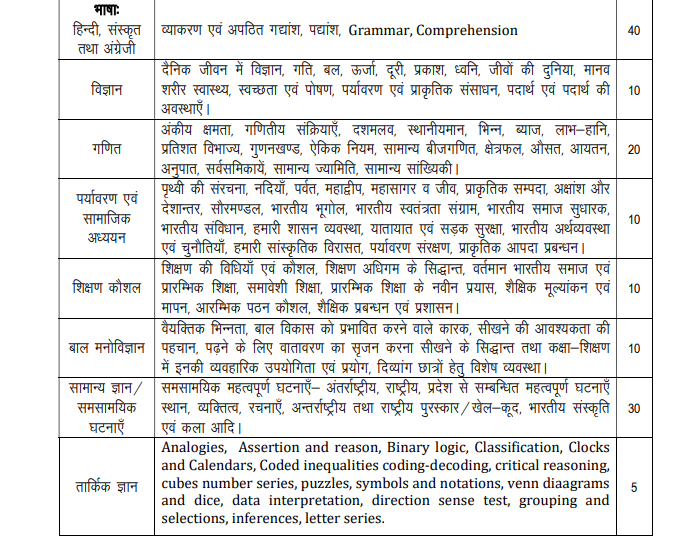
Super TET Junior Syllabus 2026 is important for candidates preparing for the Uttar Pradesh Assistant Teacher recruitment examination for the Junior/Upper Primary level (Classes 6 to 8). Before starting preparation, candidates should understand the latest exam structure, marking scheme and subject-wise syllabus because the Junior-level paper gives substantial weightage to the candidate’s selected teaching subject.
The latest 2026 pattern reported by current sources indicates that the Junior Teacher examination will have 120 multiple-choice questions carrying 360 marks, with a total duration of 2 hours. The paper is divided into two sections: 30 questions from General Knowledge and 90 questions from the selected teaching subject. Each correct answer carries 3 marks, while 1 mark is deducted for an incorrect answer.
Super TET Junior Syllabus 2026: Overview
Candidates can check the basic details of the Junior-level examination in the table below.
| Particulars | Details |
|---|---|
| Exam Name | Super TET Junior / UP Assistant Teacher Recruitment |
| Teaching Level | Junior / Upper Primary |
| Classes | 6 to 8 |
| Question Type | Multiple Choice Questions |
| Total Questions | 120 |
| Maximum Marks | 360 |
| Exam Duration | 120 minutes |
| Marks per Question | 3 marks |
| Negative Marking | 1 mark for each wrong answer |
| Sections | General Knowledge + Selected Teaching Subject |
| General Knowledge Questions | 30 |
| Subject Questions | 90 |
| Paper Medium | Hindi and English, subject to the applicable notification |
Important: Candidates should always match the final exam pattern with the official recruitment notification/admit-card instructions applicable to their recruitment cycle, as Super TET information available online has included different patterns in earlier years.
Super TET Junior Exam Pattern 2026
The Junior Teacher paper is divided into two sections. The first section is common to all candidates, whereas the second section is based on the teaching subject selected by the candidate.
| Section | Subject | Questions | Marks |
|---|---|---|---|
| Section 1 | General Knowledge | 30 | 90 |
| Section 2 | Selected Teaching Subject | 90 | 270 |
| Total | — | 120 | 360 |
The biggest takeaway for candidates is the weightage given to the subject-specific section. Out of 360 marks, 270 marks are allocated to the selected teaching subject. Therefore, simply preparing General Knowledge will not be enough to score well in the Junior Teacher examination.
Super TET Junior Marking Scheme
The marking system makes accuracy particularly important. Candidates should avoid blind guessing because an incorrect response results in a deduction.
- Correct answer: +3 marks
- Incorrect answer: -1 mark
- Unattempted question: 0 marks
- Total questions: 120
- Maximum score: 360 marks
- Exam duration: 120 minutes
For example, if a candidate answers 80 questions correctly and 10 incorrectly, the score would be:
80 × 3 = 240 marks
10 × 1 = 10 marks deducted
Final score = 230 marks
Thus, candidates should develop a balance between speed and accuracy.
Super TET Junior Syllabus 2026: Section 1 General Knowledge
The first section contains 30 General Knowledge questions, carrying 90 marks. This section is compulsory for candidates irrespective of their selected teaching subject.
The major areas that candidates should cover include:
Current Affairs
Candidates should regularly follow important national and international developments. Particular attention should be given to:
- National current affairs
- International events
- Government schemes
- Important appointments
- Awards and honours
- Sports events
- Important days
- Books and authors
- Science and technology developments
- Major national and international organisations
Indian History
Preparation should cover the major stages of Indian history, including:
- Ancient India
- Medieval India
- Modern India
- Indian freedom movement
- Important movements and revolutions
- Important historical personalities
- Major events of the independence struggle
Indian Geography
Important topics include:
- Physical features of India
- Rivers and lakes
- Mountains and plateaus
- Climate
- Agriculture
- Minerals
- Industries
- States and their geographical features
- Population
- Natural resources
Indian Polity
Candidates should revise:
- Constitution of India
- Fundamental Rights
- Fundamental Duties
- Directive Principles
- Parliament
- President and Vice-President
- Prime Minister and Council of Ministers
- Supreme Court and High Courts
- Election system
- Panchayati Raj
- Constitutional bodies
General Science
Basic concepts from Physics, Chemistry and Biology can be useful for this section. Candidates should focus particularly on everyday science and commonly asked concepts.
Uttar Pradesh General Knowledge
Since the recruitment is for Uttar Pradesh, candidates should give special attention to UP-specific topics such as:
- History of Uttar Pradesh
- Geography of Uttar Pradesh
- Rivers and important cities
- Important historical places
- Art and culture
- Festivals
- Government schemes
- State administration
- Important personalities
- Economy and agriculture of Uttar Pradesh
Super TET Junior Section 2: Selected Teaching Subject
The second section contains 90 questions carrying 270 marks. Candidates answer questions according to the teaching subject/stream applicable to their eligibility. Current 2026 sources describe three broad pathways: Language, Social Studies, and Science & Mathematics.
1. Language Teacher
Candidates opting for the language pathway may have the applicable choice among:
- Hindi
- English
- Sanskrit
The exact language choice should be checked against the recruitment notification and the candidate’s eligibility.
Hindi
Important areas can include:
- Hindi grammar
- संधि
- समास
- कारक
- लिंग
- वचन
- काल
- वाक्य शुद्धि
- पर्यायवाची शब्द
- विलोम शब्द
- अनेक शब्दों के लिए एक शब्द
- मुहावरे और लोकोक्तियां
- अपठित गद्यांश
- साहित्य
- रस
- छंद
- अलंकार
- भाषा शिक्षण की methodology
English
Important areas may include:
- Parts of Speech
- Tenses
- Articles
- Prepositions
- Active and Passive Voice
- Direct and Indirect Speech
- Subject-Verb Agreement
- Vocabulary
- Synonyms and Antonyms
- Sentence Correction
- Reading Comprehension
- Grammar
- English language teaching methodology
Sanskrit
Candidates should prepare:
- Sanskrit grammar
- शब्द रूप
- धातु रूप
- संधि
- समास
- कारक
- विभक्ति
- वाक्य निर्माण
- गद्य एवं पद्य
- संस्कृत साहित्य
- अपठित गद्यांश
- Sanskrit teaching methodology
2. Social Studies
Candidates choosing the Social Studies pathway should prepare topics from History, Geography, Civics and related social-science areas.
History
- Ancient Indian civilisation
- Medieval India
- Mughal period
- Modern India
- British rule
- Revolt of 1857
- Indian National Movement
- Important freedom fighters
- Post-independence India
Geography
- Earth and its structure
- Continents and oceans
- Indian geography
- Climate
- Natural vegetation
- Soil
- Agriculture
- Water resources
- Minerals
- Industries
- Population
- Transport and communication
Civics and Political Science
- Indian Constitution
- Democracy
- Government
- Parliament
- Judiciary
- Elections
- Fundamental Rights
- Local government
- Panchayati Raj
- Citizenship
Economics and Social Issues
Candidates should also revise basic economic concepts, development, employment, poverty, agriculture, industries and important social issues.
3. Science and Mathematics
The Science & Mathematics pathway is particularly important for candidates preparing for teaching these subjects at the upper-primary level.
Mathematics
Major areas include:
- Number system
- Whole numbers
- Integers
- Fractions
- Decimals
- Ratio and proportion
- Percentage
- Profit and loss
- Simple and compound interest
- Algebra
- Linear equations
- Geometry
- Mensuration
- Data handling
- Statistics
- Average
- Time and work
- Time, speed and distance
- Basic commercial mathematics
Candidates should not only learn formulas but also practise questions regularly because numerical accuracy can significantly affect the final score.
Science
Science preparation should cover the fundamental concepts generally taught at the upper-primary level.
Physics
- Motion
- Force
- Work and energy
- Light
- Sound
- Electricity
- Magnetism
- Heat
- Measurement
Chemistry
- Matter
- Elements and compounds
- Mixtures
- Atoms and molecules
- Acids and bases
- Metals and non-metals
- Physical and chemical changes
- Everyday chemistry
Biology
- Cell
- Plants
- Animals
- Human body
- Nutrition
- Respiration
- Reproduction
- Diseases
- Environment
- Ecosystem
- Natural resources
Subject-Wise Weightage in Super TET Junior 2026
The distribution of marks makes it easier to decide where preparation time should be spent.
| Section | Questions | Marks | Weightage |
|---|---|---|---|
| General Knowledge | 30 | 90 | 25% |
| Selected Teaching Subject | 90 | 270 | 75% |
| Total | 120 | 360 | 100% |
This table clearly shows why the selected teaching subject should remain the centre of the preparation strategy.
A candidate who has strong command over the chosen subject has an opportunity to score heavily in the 270-mark section.
How to Prepare for Super TET Junior Syllabus 2026?
Preparing for Super TET Junior is not just about completing the syllabus once. Candidates need repeated revision and question practice.
Step 1: Understand the syllabus
Start by dividing the syllabus into small topics. Mark topics as easy, moderate or difficult. This prevents preparation from becoming overwhelming.
Step 2: Give priority to the 270-mark section
The selected teaching subject carries three-fourths of the total marks. Spend the largest portion of daily study time on this section.
Step 3: Build a daily GK routine
Instead of trying to complete General Knowledge in a few days, study it consistently. Read current affairs and revise static GK regularly.
Step 4: Practise MCQs
The actual examination is objective in nature, so reading theory alone is not sufficient. Solve topic-wise and mixed MCQs.
Step 5: Take mock tests
Mock tests help candidates understand whether they are able to complete 120 questions within 120 minutes. They also reveal topics where accuracy is low.
Step 6: Analyse mistakes
After every mock test, maintain a small error notebook. Write down questions you got wrong and revise the underlying concept.
Step 7: Revise repeatedly
A good revision cycle can be:
First revision → after completing a topic
Second revision → after completing the subject
Third revision → through mock tests and previous questions
Super TET Junior Preparation Strategy
A practical daily schedule can look like this:
| Study Area | Suggested Time |
|---|---|
| Selected Teaching Subject | 3–4 hours |
| General Knowledge/Current Affairs | 1 hour |
| MCQ Practice | 1 hour |
| Revision | 1 hour |
| Mock Test/Analysis | 30–60 minutes |
Candidates who have limited preparation time should not try to read every available book. It is generally better to use a limited number of reliable sources and revise them multiple times.
Super TET Junior Syllabus 2026: Important Tips
Keep the following points in mind while preparing:
- Do not ignore General Knowledge. It accounts for 90 marks.
- Give maximum attention to your selected subject, which carries 270 marks.
- Practise calculations regularly if preparing for Mathematics and Science.
- Revise grammar rules repeatedly for language subjects.
- Follow Uttar Pradesh-specific current affairs.
- Solve previous-style questions to understand the level and wording of questions.
- Take full-length mock tests under the actual 120-minute time limit.
- Avoid excessive guessing because incorrect answers carry negative marking.
- Maintain short revision notes for factual subjects.
- Check the final official notification before the examination because recruitment authorities can revise the pattern or syllabus.
Super TET Junior Syllabus 2026 vs Primary Teacher Syllabus
The Junior and Primary-level examinations should not be treated as identical.
| Feature | Primary Teacher | Junior Teacher |
|---|---|---|
| Teaching Classes | 1–5 | 6–8 |
| Total Questions | 120 | 120 |
| Maximum Marks | 360 | 360 |
| Duration | 120 minutes | 120 minutes |
| Main Structure | Multiple subjects | GK + selected subject |
| GK | 25 questions in the reported 2026 pattern | 30 questions |
| Subject Section | Distributed across subjects | 90 questions from selected pathway |
| Negative Marking | 1 mark | 1 mark |
The latest reported Junior pattern therefore puts considerably more emphasis on the candidate’s selected teaching subject.
Frequently Asked Questions
What is the Super TET Junior Syllabus 2026?
The Junior-level syllabus covers General Knowledge along with a selected teaching subject. The teaching-subject pathways reported for 2026 include Language, Social Studies, and Science & Mathematics.
How many questions are there in Super TET Junior 2026?
The reported 2026 Junior Teacher pattern contains 120 questions.
How many marks is Super TET Junior 2026?
The examination carries 360 marks, with 3 marks awarded for every correct answer.
Is there negative marking in Super TET Junior?
Yes. The current 2026 pattern reported by multiple sources includes 1 mark deducted for each incorrect answer.
What is the duration of Super TET Junior Exam 2026?
Candidates get 120 minutes, or 2 hours, to attempt the 120-question paper.
How many questions are asked from General Knowledge?
The Junior Teacher pattern has 30 General Knowledge questions, carrying 90 marks.
How many marks are allotted to the subject section?
The selected teaching subject contains 90 questions for 270 marks, making it the most important section of the paper.
Which subjects are available for the Junior Teacher examination?
Current 2026 reporting broadly identifies three pathways: Language Teacher, Social Studies Teacher, and Science & Mathematics Teacher. The applicable subject/discipline should be verified in the final recruitment notification.
Is Super TET the same as CTET or UPTET?
No. TET examinations such as CTET/UPTET primarily establish teacher eligibility, whereas Super TET is associated with the teacher recruitment process in Uttar Pradesh. Candidates must satisfy the eligibility requirements specified for the relevant recruitment.
About The Author
