
The APPSC Group 2 examination is one of the most sought-after competitive exams in Andhra Pradesh, offering prestigious Executive and Non-Executive posts across state government departments. The Andhra Pradesh Public Service Commission (APPSC) conducts this recruitment annually to select qualified candidates for various Group 2 services, including Municipal Commissioner Grade-III, Sub-Registrar, Deputy Tahsildar, Assistant Section Officer, and Senior Auditor positions.
With the official notification expected to be released on September 15, 2026, approximately 750 vacancies will be announced as part of the government’s Yuvagalam Job Calendar 2026. This comprehensive guide provides the updated APPSC Group 2 Syllabus 2026 and Exam Pattern to help aspirants plan their preparation strategy effectively.
APPSC Group 2 Exam Pattern 2026: Structure and Marking Scheme
Understanding the exam pattern is the first step toward strategic preparation. The APPSC Group 2 selection process consists of three distinct stages:
-
Preliminary Examination (Screening Test) – Qualifying Stage
-
Mains Examination – Merit Deciding Stage
-
Computer Proficiency Test (CPT) – Qualifying Test
Selection Process Overview
| Stage | Type | Marks | Purpose |
|---|---|---|---|
| Prelims | Screening (Objective) | 150 | Shortlisting for Mains |
| Mains | Merit (Objective) | 300 | Final ranking basis |
| CPT | Qualifying (Practical) | 100 | Minimum qualifying marks required |
Important Note: Prelims marks are not counted in the final merit list. The final selection is based solely on Mains marks combined with the Computer Proficiency Test (qualifying nature).
APPSC Group 2 Prelims Exam Pattern 2026
The Preliminary Examination serves as a screening test to shortlist candidates for the Mains examination. It consists of a single objective paper with multiple-choice questions.
| Section | No. of Questions | Marks | Duration |
|---|---|---|---|
| General Studies & Mental Ability | 150 | 150 | 150 minutes |
Key Highlights of Prelims Pattern:
-
Question Type: Objective Multiple Choice Questions (MCQs)
-
Total Marks: 150
-
Duration: 2 hours 30 minutes
-
Marking Scheme: 1 mark per correct answer
-
Negative Marking: ⅓ mark deducted for each wrong answer
APPSC Group 2 Mains Exam Pattern 2026
The Mains examination is the deciding factor for final merit. It comprises two papers, each carrying equal weightage.
| Paper | Subject Areas | No. of Questions | Marks | Duration |
|---|---|---|---|---|
| Paper 1 | Social History of Andhra Pradesh & Indian Constitution | 150 | 150 | 150 minutes |
| Paper 2 | Indian & AP Economy & Science & Technology | 150 | 150 | 150 minutes |
| Total | 300 | 300 |
Key Highlights of Mains Pattern:
-
Question Type: Objective MCQs
-
Difficulty Level: Bachelor’s Degree Standard
-
Marking Scheme: 1 mark per correct answer
-
Negative Marking: ⅓ mark deduction per wrong answer
APPSC Group 2 Computer Proficiency Test (CPT)
The Computer Proficiency Test is a practical, qualifying examination designed to assess candidates’ computer skills.
| Test Component | Marks | Duration | Qualifying Marks |
|---|---|---|---|
| Office Automation & Computer Software Proficiency | 100 | 60 minutes | SC/ST/PH: 30; BC: 35; OC: 40 |
The CPT evaluates proficiency in:
-
Part A: Computer fundamentals, operating systems, internet concepts, and email basics
-
Part B: MS Office/LibreOffice applications, including word processing, spreadsheets, and presentations
APPSC Group 2 Syllabus 2026: Detailed Subject-wise Breakdown
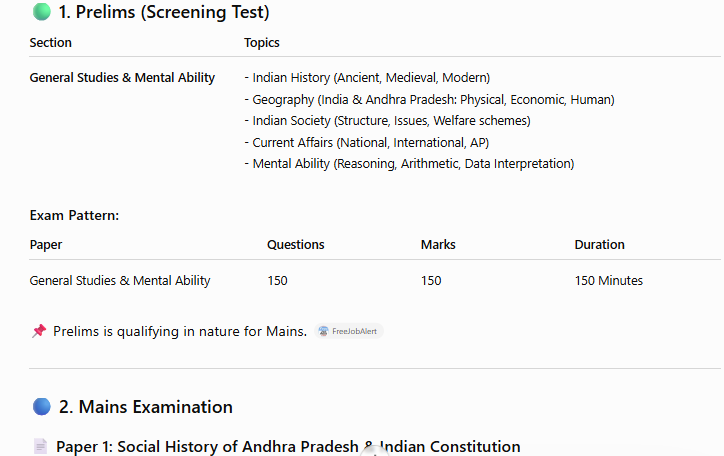
1. Prelims (Screening Test)
| Section | Topics |
|---|---|
| General Studies & Mental Ability | – Indian History (Ancient, Medieval, Modern) – Geography (India & Andhra Pradesh: Physical, Economic, Human) – Indian Society (Structure, Issues, Welfare schemes) – Current Affairs (National, International, AP) – Mental Ability (Reasoning, Arithmetic, Data Interpretation) |
Exam Pattern:
| Paper | Questions | Marks | Duration |
|---|---|---|---|
| General Studies & Mental Ability | 150 | 150 | 150 Minutes |
Prelims is qualifying in nature for Mains.
Paper 1: Social History of Andhra Pradesh & Indian Constitution
| Section | Topics |
|---|---|
| Social & Cultural History of AP | – Ancient dynasties (Satavahanas, Ikshvakus, Chalukyas, etc.) – Medieval Andhra history – British rule & freedom movement in Andhra – Socio-cultural movements – Formation of Andhra Pradesh |
| Indian Constitution | – Preamble & features – Fundamental Rights & Duties – Directive Principles – Legislature, Executive, Judiciary – Centre-State relations – Constitutional & statutory bodies |
Paper 2: Indian & AP Economy + Science & Technology
| Section | Topics |
|---|---|
| Indian & AP Economy | – Economic development of India – AP economy & policies – Planning, poverty, unemployment – Agriculture, industry, service sector |
| Science & Technology | – General Science – Recent developments in Science & Tech – IT, Space, Biotechnology – Environmental issues & sustainability |
APPSC Group 2 Prelims Syllabus
The Prelims syllabus covers five major areas: Indian History, Geography, Indian Society, Current Affairs, and Mental Ability. Here is the complete subject-wise breakdown:
1. Indian History (30 Marks)
Ancient History:
-
Salient features of the Indus Valley Civilisation and the Vedic Age
-
Emergence and spread of Buddhism and Jainism
-
Mauryan Empire: Administration, socio-economic conditions, art, and architecture
-
Gupta Empire: Administration, religious conditions, literature, and cultural achievements
-
Harshavardhana and his contributions
Medieval History:
-
Chola Administrative System and contributions
-
Delhi Sultanate: Administration, socio-economic conditions
-
Mughal Empire: Administration, socio-economic, and religious conditions
-
Bhakti and Sufi Movements and their impact
-
Rise of the Maratha Empire under Shivaji
-
The advent of Europeans in India
Modern History:
-
1857 Revolt: Causes, consequences, and impact
-
Rise and consolidation of British Power in India
-
Social and Religious Reform Movements in the 19th and 20th centuries
-
Indian National Movement: Various stages and important contributors
-
Post-Independence consolidation and reorganization
2. Geography (30 Marks)
General and Physical Geography:
-
Earth in our Solar System, the interior of Earth
-
Major landforms and their features
-
Climate: Structure and composition of the atmosphere
-
Oceanography: Tides, waves, currents
-
India and Andhra Pradesh: Physiographic features, climate, drainage systems, soils, and vegetation
-
Natural hazards and disaster management
Economic Geography of India and Andhra Pradesh:
-
Natural resources and their distribution
-
Agriculture and agro-based activities
-
Distribution of major industries and industrial regions
-
Transport, communication, tourism, and trade
Human Geography of India and Andhra Pradesh:
-
Human development and demographics
-
Urbanisation and migration patterns
-
Racial, tribal, religious, and linguistic groups
3. Indian Society (30 Marks)
Structure of Indian Society:
-
Family, marriage, kinship, caste, and tribe
-
Ethnicity, religion, and women’s issues
-
Social stratification and diversity
Social Issues:
-
Casteism, communalism, and regionalization
-
Crimes against women, child abuse, and child labour
-
Youth unrest and agitation
Welfare Mechanism:
-
Public policies and welfare programmes
-
Constitutional and statutory provisions for SC, ST, Minorities, BCs, Women, Disabled, and Children
4. Current Affairs (30 Marks)
Major current events and issues pertaining to:
-
International affairs
-
National events
-
Andhra Pradesh-specific developments
5. Mental Ability (30 Marks)
Logical Reasoning:
-
Deductive, inductive, and abductive reasoning
-
Statement and assumptions, arguments, conclusions
-
Statement and courses of action
Mental Ability:
-
Number series, letter series, odd man out
-
Coding-decoding problems
-
Problems relating to relations, shapes, and sub-sections
Basic Numeracy:
-
Number system and order of magnitude
-
Averages, ratio and proportion, percentage
-
Simple and compound interest
-
Time and work, time and distance
Data Analysis:
-
Tables, bar diagrams, line graphs, and pie charts
APPSC Group 2 Mains Syllabus
The Mains syllabus is divided into two papers, each containing two sections.
Paper 1 – Section A: Social and Cultural History of Andhra Pradesh (75 Marks)
Pre-Historical and Ancient Dynasties:
-
Pre-historical cultures, Satavahanas, and Ikshvakus
-
Socio-economic and religious conditions
-
Literature, art, and architecture
-
Vishnukundinas, Vengi Eastern Chalukyas, and Telugu Cholas
Medieval Andhra (11th-16th Centuries):
-
Various major and minor dynasties
-
Socio-religious and economic conditions
-
Growth of the Telugu language and literature
-
Art and architecture of the period
Modern Andhra:
-
The advent of Europeans and trade centres
-
Andhra under Company rule and the impact of the 1857 Revolt
-
Socio-cultural awakening and Justice Party/Self-Respect Movements
-
Nationalist Movement in Andhra (1885-1947)
-
Role of Socialists, Communists, and Anti-Zamindari Movements
-
Growth of Nationalist poetry, revolutionary literature, and women’s participation
Andhra Movement:
-
Origin and growth of Andhra Movement
-
Role of Andhra Mahasabhas and prominent leaders
-
Events leading to the formation of Andhra State (1953)
-
Role of Press, Newspapers, and Library Movement
-
Folk and tribal culture
Formation of Andhra Pradesh:
-
Visalandhra Mahasabha and States Reorganisation Commission
-
Gentlemen’s Agreement and its significance
-
Important social and cultural events between 1956 and 2014
Paper 1 – Section B: Indian Constitution (75 Marks)
Nature and Features:
-
Constitutional development and salient features
-
Preamble and its significance
-
Fundamental Rights, Directive Principles, and their relationship
-
Fundamental Duties
Government Structure:
-
Types of legislature, executive, and judiciary
-
Unicameral and bicameral systems
-
Parliamentary and presidential executive forms
-
Judicial review and judicial activism
Centre-State Relations:
-
Distribution of legislative and executive powers
-
Legislative, administrative, and economic relations
-
Powers and functions of Constitutional Institutions: UPSC, State PSCs, CAG, Finance Commission
Reforms and Committees:
-
Rajmannar Committee, Sarkaria Commission, MM Punchhi Commission
-
Electoral Reforms and Anti-Defection Law
-
Recognition of National and State Parties
-
Party system in India
Decentralization:
-
Centralisation vs decentralisation debate
-
Community Development Programme
-
Balwant Rai Mehta and Ashok Mehta Committees
-
73rd and 74th Constitutional Amendment Acts and implementation
Paper 2 – Section A: Indian and Andhra Pradesh Economy (75 Marks)
Indian Economy:
-
National income and planning
-
Economic growth and the 1991 reforms
-
NITI Aayog and its role
-
Money, banking, and financial institutions
-
RBI, monetary policy, and GST
-
Fiscal policy, budget, balance of payments, and FDI
Sectors of the Economy:
-
Agriculture: MSP, agricultural marketing, and pricing
-
Industry: Industrial policies, disinvestment, MSMEs
-
Services: IT and ITeS sectors
-
Infrastructure development
Andhra Pradesh Economy:
-
GSDP, state revenue, expenditure, and debt
-
State budgets and fiscal management
-
Agriculture, horticulture, fisheries, and forests
-
Industries, MSMEs, and IT policy
-
State-specific economic development programmes
Paper 2 – Section B: Science and Technology (75 Marks)
Technology Development:
-
Science and Technology policy
-
Space technology and ISRO achievements
-
Defence research and DRDO
-
ICT, cyber security, and nuclear energy
Energy Resources:
-
Renewable and non-renewable energy sources
-
National energy policies and schemes
-
Solar, wind, and nuclear energy programmes
Environment and Ecology:
-
Ecology, biodiversity, and wildlife conservation
-
Biosphere reserves and protected areas
-
Solid waste management and eco-friendly technologies
-
Pollution control mechanisms
Health and Sustainability:
-
Climate change and global warming
-
Sustainable development goals
-
Public health challenges and initiatives
-
Health programmes in India and Andhra Pradesh
APPSC Group 2 Prelims Syllabus 2026: Important Topics
The Prelims syllabus focuses on General Studies and Mental Ability.
Key Topics:
1. History
- Ancient, Medieval & Modern India
- Indian National Movement
2. Geography
- Physical Geography of India
- Andhra Pradesh Geography
- Climate, Natural Resources
3. Indian Polity
- Constitution
- Governance & Public Policy
4. Economy
- Indian Economy basics
- Budget, Planning, Development
5. Science & Technology
- General Science
- Recent technological developments
6. Current Affairs
- National & International events
- Andhra Pradesh current affairs
7. Mental Ability
- Logical reasoning
- Data interpretation
- Analytical skills
These topics are part of the Prelims GS paper
APPSC Group 2 Mains Syllabus 2026
The Mains exam is more conceptual and analytical.
Paper 1: Social History & Constitution
Social History of Andhra Pradesh
- Socio-cultural movements
- Freedom struggle in AP
- Formation of Andhra Pradesh
Indian Constitution
- Fundamental Rights & Duties
- Directive Principles
- Structure of Government
- Judiciary & Governance
Paper 2: Economy & Science
Indian & AP Economy
- Economic development
- Agriculture, Industry, Services
- Government schemes
Science & Technology
- Space, IT, Biotechnology
- Environmental issues
- Recent innovations
Mains focuses on AP-specific + national-level concepts
Marking Scheme & Important Points
- Each question carries 1 mark
- Negative marking: 1/3rd marks deducted
- All papers are objective type (MCQs)
- Duration: 150 minutes per paper
APPSC Group 2 2026: Important Dates and Vacancy Details
As per the Yuvagalam Job Calendar 2026 released by the Andhra Pradesh government, the APPSC Group 2 notification is scheduled for release on September 15, 2026, with approximately 750 vacancies to be filled.
Total APPSC Recruitment 2026 (All Groups): 10,060 posts across various departments
| Department | Notification Date | Vacancies |
|---|---|---|
| Higher Education | May 15, 2026 | 1,500 |
| APPSC Group 1 | August 15, 2026 | 91 |
| Home Department | August 15, 2026 | 2,778 |
| Other Departments | August 15, 2026 | 928 |
| APPSC Group 2 | September 15, 2026 | 750 |
| Engineering Department | September 15, 2026 | 503 |
| Other Departments | September 15, 2026 | 506 |
Preparation Strategy for APPSC Group 2 2026
Based on the detailed syllabus, here are strategic recommendations for aspirants:
1. Focus on AP-Specific Topics
The Social and Cultural History of Andhra Pradesh and AP Economy carry significant weightage. Dedicate extra time to understanding Andhra Pradesh’s dynasties, movements, and economic development.
2. Master the Mental Ability Section
The 30-mark Mental Ability section can be a score booster with consistent practice. Focus on logical reasoning, data analysis, and basic numeracy.
3. Current Affairs Integration
Stay updated with International, National, and AP-specific current affairs through daily newspaper reading and monthly magazines.
4. Practice with Mock Tests
Take regular mock tests to understand the exam pattern, improve time management, and identify weak areas.
5. Understand the Marking Scheme
With a ⅓ negative marking, avoid blind guessing. Attempt questions only when reasonably confident.
6. Syllabus Prioritisation
Cover all topics but prioritise areas with higher weightage and high-scoring potential, such as Modern Indian History and the Indian Constitution.
Frequently Asked Questions (FAQs)
Q1: What is the APPSC Group 2 syllabus for 2026?
The syllabus covers General Studies & Mental Ability in Prelims, and two Mains papers covering Social History of Andhra Pradesh & Indian Constitution, and Indian & AP Economy & Science & Technology.
Q2: Is Prelims marks counted in the final merit list?
No, the Prelims is only a screening test. Final merit is based on Mains marks and the Computer Proficiency Test.
Q3: When will the APPSC Group 2 notification be released?
The notification is tentatively scheduled for September 15, 2026, with approximately 750 vacancies.
Q4: What is the difficulty level of the APPSC Group 2 exam?
The exam is of degree (bachelor’s) standard with a strong emphasis on AP-specific knowledge and current affairs.
Q5: What is the negative marking in APPSC Group 2?
One-third (⅓) mark is deducted for every wrong answer in both Prelims and Mains examinations.
Q6: Is the Computer Proficiency Test mandatory?
Yes, the CPT is mandatory and qualifying in nature. Candidates must secure the minimum qualifying marks based on their category.
Conclusion
The APPSC Group 2 Syllabus 2026 covers a comprehensive range of subjects from History, Geography, Indian Society, and Constitution to Economy, Science & Technology, and Mental Ability. A well-structured preparation strategy, focusing on both conceptual understanding and regular practice, is essential for success.
With the notification expected in September 2026, aspirants have sufficient time to prepare systematically. Understanding the exam pattern and syllabus thoroughly is the first step toward achieving success in this competitive examination.
About The Author
