
The Rajasthan Rajya Vidyut Utpadan Nigam Limited (RVUNL) Junior Engineer (JE) examination represents a significant opportunity for engineering graduates seeking a stable and rewarding career in Rajasthan’s power sector. Success in this competitive exam demands a thorough understanding of both the syllabus and exam pattern. This guide provides a detailed breakdown of the RVUNL JE Syllabus 2026 and exam structure to help candidates prepare strategically.
Overview of the RVUNL JE Examination
The RVUNL JE exam is a state-level recruitment test designed to select qualified candidates for Junior Engineer positions across various engineering disciplines, including Civil, Electrical, Electronics, Control & Instrumentation, and Communication. The selection process typically includes a written competitive examination followed by document verification and an interview .
The written exam is structured to assess candidates on two primary dimensions: their professional knowledge in their respective engineering field and their general aptitude, which includes reasoning, mathematics, and language skills .
RVUNL JE Exam Pattern 2026
Understanding the exam pattern is crucial for effective preparation and time management. The RVUNL JE exam follows a well-defined structure, as detailed in the table below.
Exam Pattern Breakdown
| Part | Subject | Number of Questions | Maximum Marks | Duration |
|---|---|---|---|---|
| Part A | Professional Knowledge (Core Engineering) | 60 | 120 | 2 Hours |
| Part B | Reasoning and Mental Ability | 8 | 8 | |
| General Knowledge (Rajasthan) | 36 | 36 | ||
| General Knowledge (World, India, Everyday Science) | 12 | 12 | ||
| General Hindi | 8 | 8 | ||
| General English | 8 | 8 | ||
| Mathematics | 8 | 8 | ||
| Grand Total | 140 | 200 |
Source: Compiled from multiple RVUNL JE exam pattern notifications .
Key Points on the Exam Pattern
-
Marking Scheme: The total marks for the exam are 200. Part A, focusing on Professional Knowledge, carries the most weight at 120 marks, while Part B contributes 80 marks .
-
Negative Marking: A crucial aspect to remember is that there is a penalty for incorrect answers. For every wrong answer, 0.25 marks are deducted. This necessitates careful and accurate answering, especially in sections where candidates are less confident .
-
Time Duration: Candidates are given a total of 120 minutes (2 hours) to complete the paper .
-
Question Type: All questions are objective-type, requiring candidates to select the correct answer from multiple choices .
Detailed RVUNL JE Syllabus 2026
The syllabus is designed to test both the core engineering knowledge and the general aptitude of the candidates. Below is a subject-wise breakdown of the topics.
Part A: Professional Knowledge (Core Subject)
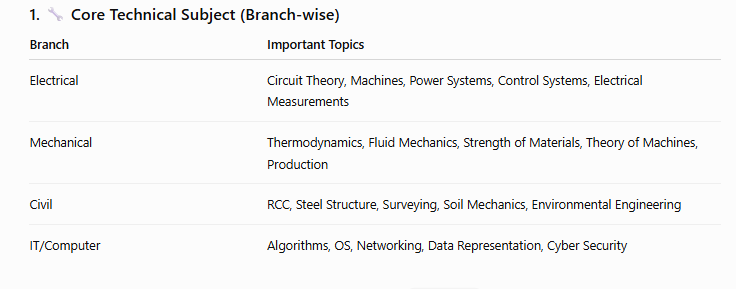
The syllabus for the Professional Knowledge section is at the level of a degree in engineering in the respective discipline . The exact topics vary by branch, and the detailed syllabus is often released with the official notification. Based on previous patterns, here are the major subjects for different disciplines:
-
For Civil Engineering: Building Technology, Construction Management, Fluid Mechanics, Surveying, Estimating & Costing, Irrigation & Water Resources, Theory of Structures & Strength of Materials, Structural Analysis, Soil Mechanics & Foundation Engineering, and Design of Steel and RCC Structures .
-
For Electrical Engineering: Network Theory, Electrical Machines, Power Systems, Control Systems, Power Electronics and Drives, Analog and Digital Electronics, Measurements and Instrumentation, and Basic Electrical Engineering Concepts .
-
For Electronics/Control & Instrumentation/Communication Engineering: This is a broad category covering Network Theory, Electronic Devices, Analog and Digital Circuits, Signals and Systems, Control Systems, Communication Systems, Electromagnetics, and Electrical & Electronic Measurements, Sensors, and Industrial Instrumentation .
Part B: General Aptitude
This section evaluates the candidate’s broader intellectual and language skills. It comprises six key areas:
1. Reasoning and Mental Ability (8 Marks)
This section tests logical thinking and problem-solving skills. Key topics include:
-
Data Sufficiency
-
Puzzles and Series Tests
-
Analogies and Coding-Decoding
-
Direction and Distance
-
Blood Relations
-
Statement and Assumptions/Arguments
-
Logical Deduction
-
Input/Output and Alphabet/Figure Series
-
Classification
2. Mathematics (8 Marks)
The mathematics section covers standard topics from high school and basic engineering mathematics. Important topics are:
-
Permutation and Combinations
-
Calculus and Binomial Theorem
-
Profit and Loss, Simple and Compound Interest
-
Percentage, Ratio and Proportion, Mixture and Alligations
-
Time and Distance, Probability
-
Number Series, Mensuration, and Geometry
3. General Knowledge and Everyday Science (48 Marks)
This is the highest-scoring section in Part B, split into two parts:
-
GK Related to Rajasthan (36 Marks): This carries significant weight. Candidates must focus on current affairs, history, geography, politics, economy, and culture of Rajasthan .
-
GK Related to World, India, and Everyday Science (12 Marks): This covers national and international current events, Indian history, polity, geography, economics, sports, and basic scientific concepts .
4. General English (8 Marks)
This section assesses basic English language proficiency. Common topics include:
-
Vocabulary and Grammar
-
Active and Passive Voice, Direct and Indirect Speech
-
Comprehension Passages
-
Para Jumbles and Sentence Completion
-
Idioms and Phrases
-
Articles and Parts of Speech
5. General Hindi (8 Marks)
The Hindi section tests understanding of the language at a standard level. Topics often include:
-
Grammar (संज्ञा, सर्वनाम, क्रिया, विशेषण, कारक, काल)
-
Synonyms and Antonyms (पर्यायवाची एवं विपरीतार्थी शब्द)
-
One-word Substitution (अनेक शब्दों के लिए एक शब्द)
-
Idioms and Proverbs (मुहावरे और लोकोक्तियाँ)
-
Spellings and Sandhi/Compound words (संधि विच्छेद, समास)
RVUNL JE Syllabus 2026 (Subject-wise Important Topics)
1. Professional Knowledge (Core Engineering)
Civil Engineering
- Building Construction & Materials
- Structural Analysis
- Soil Mechanics & Foundation
- Fluid Mechanics
- Surveying & Engineering Mechanics
- RCC & Steel Design
- Irrigation Engineering
- Environmental Engineering
- Construction Management
Electrical Engineering
- Electrical Machines
- Power Systems
- Control Systems
- Network Theory
- Power Electronics
- Measurements & Instrumentation
- Analog & Digital Electronics
Mechanical Engineering
- Thermodynamics
- Strength of Materials
- Theory of Machines
- Fluid Mechanics
- Heat Transfer
- Manufacturing Engineering
- Industrial Engineering
2. Reasoning & Mental Ability
- Coding-Decoding
- Blood Relations
- Series & Analogy
- Direction & Distance
- Seating Arrangement
- Puzzles
- Data Interpretation
- Logical Deduction
3. Mathematics
- Percentage
- Profit & Loss
- Ratio & Proportion
- Time & Work
- Time, Speed & Distance
- Probability
- Geometry & Mensuration
- Algebra (P&C, Binomial Theorem, etc.)
4. General Knowledge & Everyday Science
- Current Affairs
- Rajasthan GK (History, Culture, Geography)
- Indian Polity
- Economy
- Science & Technology
- Government Schemes
- Basic Computer Knowledge
5. General Hindi
- Grammar (Class 10 level)
- Vocabulary
- Sentence Formation
6. General English
- Vocabulary
- Grammar
- Active & Passive Voice
- Direct & Indirect Speech
- Comprehension
- Idioms & Phrases
Preparation Strategy
-
Prioritize Professional Knowledge: With 60% of the total marks, your core engineering subjects are the most critical. Dedicate a significant portion of your study time to revising key concepts and solving technical problems .
-
Focus on Rajasthan GK: As the state-specific GK section carries 36 marks, it is a high-yield area. Follow daily current affairs and study specialized resources on Rajasthan’s history, geography, and polity.
-
Practice with Mock Tests: Simulate exam conditions by taking online mock tests. This helps improve speed, accuracy, and familiarity with the exam pattern. It is also the best way to practice managing the negative marking.
-
Master the Fundamentals: The General Aptitude sections (Reasoning, Maths, English, Hindi) are based on standard concepts. Regular practice with these fundamental topics can help secure the remaining marks.
Conclusion
Aspiring candidates for the RVUNL JE 2026 must meticulously analyze the syllabus and exam pattern to build a strategic preparation plan. The exam clearly prioritizes professional knowledge but also requires a strong performance in general aptitude, especially Rajasthan-specific general knowledge. By focusing on the core subjects, consistently practicing with mock tests, and staying updated with current affairs, candidates can significantly enhance their chances of qualifying for this prestigious position in Rajasthan’s power sector.
About The Author
