
BSNL JTO Syllabus: The BSNL JTO (Junior Telecom Officer) 2026 exam is one of the most sought-after opportunities for engineering graduates aiming to join the telecom sector. Conducted by Bharat Sanchar Nigam Limited (BSNL), this exam tests candidates on core engineering concepts along with general ability.
Understanding the latest BSNL JTO Syllabus and exam pattern is crucial to cracking the exam efficiently. This article provides a complete breakdown of the BSNL JTO Syllabus 2026 along with the updated exam pattern.
BSNL JTO 2026: Overview
| Particulars | Details |
|---|---|
| Organization | Bharat Sanchar Nigam Limited (BSNL) |
| Post Name | Junior Telecom Officer (JTO) |
| Exam Mode | Computer-Based Test (CBT) |
| Selection Process | CBT + Document Verification + Medical |
| Exam Duration | 3 Hours |
| Total Questions | 120 |
| Total Marks | 480 |
The recruitment process mainly depends on performance in the online CBT exam.
BSNL JTO Exam Pattern 2026
The exam consists of objective-type MCQs divided into three sections.
Exam Pattern Table
| Section | Subject | No. of Questions | Marks |
|---|---|---|---|
| Section I | Engineering Stream I | 50 | 200 |
| Section II | Engineering Stream II | 50 | 200 |
| Section III | General Ability | 20 | 80 |
| Total | — | 120 | 480 |
Key Highlights
- Duration: 3 Hours
- Marking Scheme:
- +4 marks for correct answer
- –1 mark for wrong answer
- All questions are MCQs
- Sections I & II carry maximum weightage (technical subjects)
BSNL JTO Syllabus 2026
We have mentioned a tabular style, a detailed topic-wise syllabus for all three sections included in the BSNL JTO Exam.
| Section | Topics |
| Section I – Engineering Stream | Materials and Components (conductors, semiconductors, magnetic materials, passive components, etc.) |
| Physical Electronics, Electron Devices & ICs (diodes, BJTs, FETs, SCRs, CMOS, opto-electronics) | |
| Network Theory (network theorems, transient/steady state, transmission lines) | |
| Electromagnetic Theory (waveguides, transmission lines, antennas) | |
| Electronic Measurements & Instrumentation (errors, measuring instruments, transducers, telemetry) | |
| Power Electronics (thyristors, converters, inverters, SMPS, PWM) | |
| Section II – Engineering Stream | Analog Electronic Circuits (amplifiers, oscillators, OP-AMP, power supplies) |
| Digital Electronic Circuits (Boolean algebra, logic gates, flip-flops, counters, memories, A/D & D/A) | |
| Control Systems (feedback, stability, root locus, frequency response, controllers) | |
| Communication Systems (modulation, multiplexing, optical fiber, satellite communication) | |
| Microwave Engineering (waveguides, microwave devices, antennas, MASER/laser, propagation) | |
| Computer Engineering (data representation, programming, architecture, memory, I/O systems) | |
| Microprocessors (architecture, instruction set, interfacing, telecom applications) | |
| Section III – General Ability Test | English comprehension, grammar and basic communication |
| Current affairs and general knowledge | |
| Every day, science and observation | |
| Indian history and geography | |
| Telecom-related awareness and basic scientific events |
BSNL Junior Telecomm Operator Syllabus 2026 (Important Topic Section-wise)
The syllabus is based on the engineering degree level of Indian universities.
Section I – Engineering Stream I Syllabus
This section focuses on fundamental electronics and electrical engineering concepts.
Important Topics:
- Materials & Components
- Physical Electronics
- Electron Devices & ICs
- Network Theory
- Electromagnetic Theory
- Electronic Measurements & Instrumentation
- Power Electronics
These topics test the basic theoretical understanding of electronics and communication systems.
Section II – Engineering Stream II Syllabus
This section covers advanced and applied engineering concepts.
Important Topics:
- Analog Electronic Circuits
- Digital Electronic Circuits
- Control Systems
- Communication Systems
- Microwave Engineering
- Computer Engineering
- Microprocessors
This section is high-scoring but concept-heavy, especially communication and digital electronics.
Section III – General Ability Test
This section evaluates general awareness and language skills.
Important Topics:
- General English (Grammar, Vocabulary, Comprehension)
- Current Affairs
- General Knowledge
- Everyday Science
- Indian History & Geography
- Telecom Industry Awareness
Though smaller in weightage, this section often becomes a deciding factor in final merit.
BSNL JTO Syllabus Analysis 2026
detailed BSNL JTO Syllabus Analysis 2026 in tabular form, based on the latest exam topic-wise weightage.
Section I – Engineering Stream (Core Electronics)
| Subject | Important Topics | Weightage Analysis | Difficulty Level |
|---|---|---|---|
| Materials & Components | Conductors, Semiconductors, Magnetic materials | Low–Moderate | Easy |
| Physical Electronics | Energy bands, electron motion | Moderate | Medium |
| Electronic Devices & ICs | Diodes, BJT, FET, CMOS | High | Medium–Hard |
| Network Theory | Theorems, circuits, transient analysis | High | Medium |
| Electromagnetic Theory | Waveguides, antennas, transmission lines | High | Hard |
| Measurements & Instrumentation | Errors, transducers, measuring devices | Moderate | Medium |
| Power Electronics | Thyristors, converters, SMPS | Moderate | Medium |
Analysis:
- Focus on EMT, Network Theory, Devices (high scoring but conceptual).
- Numerical-based questions expected.
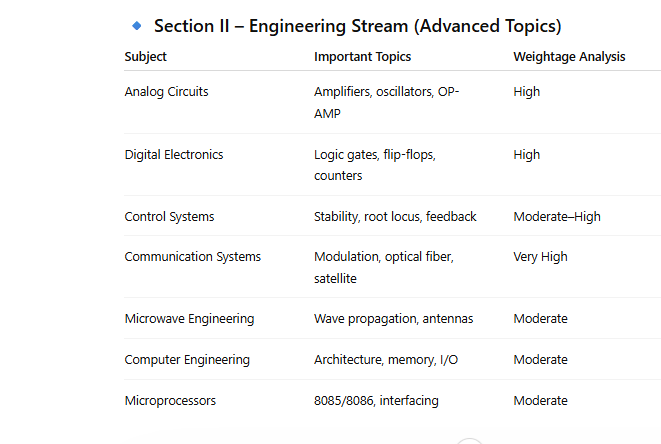
Section II – Engineering Stream (Advanced Topics)
| Subject | Important Topics | Weightage Analysis | Difficulty Level |
|---|---|---|---|
| Analog Circuits | Amplifiers, oscillators, OP-AMP | High | Medium |
| Digital Electronics | Logic gates, flip-flops, counters | High | Easy–Medium |
| Control Systems | Stability, root locus, feedback | Moderate–High | Medium |
| Communication Systems | Modulation, optical fiber, satellite | Very High | Medium–Hard |
| Microwave Engineering | Wave propagation, antennas | Moderate | Hard |
| Computer Engineering | Architecture, memory, I/O | Moderate | Easy–Medium |
| Microprocessors | 8085/8086, interfacing | Moderate | Medium |
Analysis:
- Communication Systems + Digital Electronics = most important
- Conceptual + theoretical mix questions
Section III – General Ability
| Subject | Topics | Weightage | Difficulty |
|---|---|---|---|
| General English | Grammar, vocabulary, comprehension | Moderate | Easy |
| General Knowledge | Current affairs, static GK | Moderate | Easy |
| Everyday Science | Basic physics, chemistry, biology | Low–Moderate | Easy |
| Indian History & Geography | Basic concepts | Low | Easy |
| Telecom Awareness | Latest telecom developments | Important | Medium |
Analysis:
- Scoring section → helps boost rank
- Focus on current affairs + telecom sector
Overall Weightage Analysis
| Section | Marks | Weightage | Preparation Priority |
|---|---|---|---|
| Engineering I | 200 | ⭐⭐⭐⭐ | Very High |
| Engineering II | 200 | ⭐⭐⭐⭐ | Very High |
| General Ability | 80 | ⭐⭐ | Moderate |
Key Insight:
- 80% paper = Technical (Engineering subjects)
- 20% = General Ability
Preparation Strategy (Based on Analysis)
| Priority Level | Focus Area |
|---|---|
| High Priority | Communication Systems, Network Theory, Digital Electronics |
| Medium Priority | Control Systems, Analog Circuits, Microprocessors |
| Low Priority | GK, History, Geography |
| Must Do | Previous Year Questions + Mock Tests |
BSNL JTO Selection Process 2026
The selection process includes the following stages:
- Computer-Based Test (CBT)
- Document Verification
- Medical Examination
Candidates must qualify for both the sectional and overall cut-offs to proceed further.
Preparation Tips for BSNL JTO 2026
1. Focus on Core Engineering Subjects
- 400 out of 480 marks come from technical sections
- Prioritize Electronics & Communication topics
2. Practice Previous Year Papers
- Helps in understanding question trends
- Improves speed and accuracy
3. Avoid Negative Marking
- Attempt only confident questions
- Accuracy is more important than attempts
4. Strengthen General Awareness
- Read daily current affairs
- Focus on telecom-related updates
5. Take Mock Tests Regularly
- Simulate real exam conditions
- Improve time management
Best Books for BSNL JTO Preparation
- Engineering Mathematics – B.S. Grewal
- Network Theory – Van Valkenburg
- Communication Systems – Simon Haykin
- Electronic Devices – Sedra & Smith
- Objective General English – S.P. Bakshi
BSNL JTO Exam Minimum Qualifying Marks
The minimum qualifying marks for the BSNL JTO Exam (latest pattern – 2026) are as follows:
Section-wise Minimum Qualifying Marks
- UR / OBC (Creamy Layer): 40% in each section
- SC / ST / OBC (NCL) / EWS / PwBD: 35% in each section
Overall Minimum Qualifying Marks (Aggregate)
- UR / OBC (CL): 50% overall
- SC / ST / OBC (NCL) / EWS / PwBD: 45% overall
Important Points
- You must clear both sectional AND overall qualifying marks.
- Even after qualifying, final selection depends on the cut-off (merit), which is usually higher.
- Marks are calculated out of 480 total marks (CBT exam).
Conclusion
The BSNL JTO Syllabus 2026 is primarily focused on engineering concepts, making it ideal for candidates with a strong technical background. With a clear understanding of the exam pattern, proper strategy, and consistent practice, aspirants can significantly improve their chances of selection.
To crack the exam:
- Focus on concept clarity
- Practice regularly
- Maintain accuracy and time management
About The Author
