
The Delhi Subordinate Services Selection Board (DSSSB) conducts the Special Educator recruitment exam for TGT/PRT posts. Understanding the latest syllabus and exam pattern is crucial for effective preparation.
The DSSSB Special Educator Exam 2026 is designed to assess both general aptitude and professional teaching knowledge related to special education.
DSSSB Special Educator Syllabus (Primary)
The DSSSB Special Educator Syllabus 2026 (Primary / PRT) is presented in a clear tabular format based on the latest pattern and syllabus structure.
- Exam Mode: Online (CBT)
- Total Questions: 200
- Total Marks: 200
- Sections: Part A (General) + Part B (Subject Specific)
| Section | Subject | Topics Covered |
|---|---|---|
| Part A | General Awareness | Current Affairs, National & International Events, Awards, Books & Authors, Sports, Important Days, Government Schemes, Science & Technology |
| General Intelligence & Reasoning | Coding-Decoding, Blood Relations, Series, Analogy, Direction Sense, Puzzles, Syllogism, Ranking, Data Sufficiency | |
| Arithmetical & Numerical Ability | Simplification, Number Series, Average, Profit & Loss, Time & Work, Speed Distance Time, SI & CI, Data Interpretation | |
| Hindi Language & Comprehension | Grammar, Vocabulary, Synonyms/Antonyms, Idioms & Phrases, Comprehension, Sentence Correction, Translation | |
| English Language & Comprehension | Reading Comprehension, Error Detection, Fill in the Blanks, Cloze Test, Sentence Rearrangement, Vocabulary |
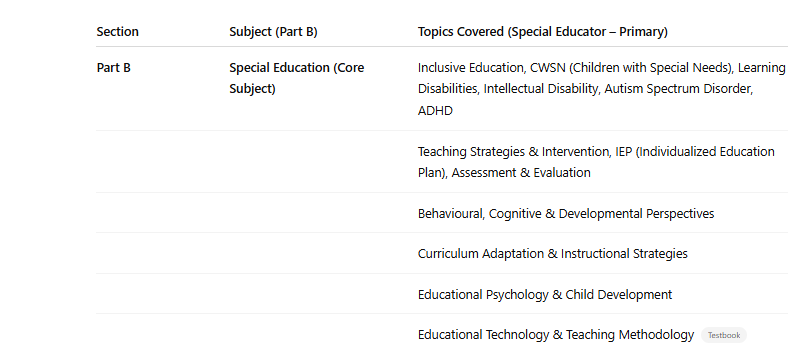
| Section | Subject (Part B) | Topics Covered (Special Educator – Primary) |
|---|---|---|
| Part B | Special Education (Core Subject) | Inclusive Education, CWSN (Children with Special Needs), Learning Disabilities, Intellectual Disability, Autism Spectrum Disorder, ADHD |
| Teaching Strategies & Intervention, IEP (Individualized Education Plan), Assessment & Evaluation | ||
| Behavioural, Cognitive & Developmental Perspectives | ||
| Curriculum Adaptation & Instructional Strategies | ||
| Educational Psychology & Child Development | ||
| Educational Technology & Teaching Methodology |
Important Points
- Part A = 100 Marks (Common for all posts)
- Part B = 100 Marks (Subject-specific – Special Education)
- Negative Marking: 0.25 marks per wrong answer (as per DSSSB pattern)
DSSSB Special Educator Selection Process 2026
The selection process includes:
- Written Examination (Tier-I)
- Document Verification
Candidates must qualify the written exam to move to the next stage.
DSSSB Special Educator Exam Pattern 2026
The exam follows an objective-type (MCQ) format.
Key Highlights:
- Mode: Online / OMR-based
- Total Questions: 200
- Total Marks: 200
- Duration: 2 Hours
- Negative Marking: 0.25 marks deducted for each wrong answer
Section-wise Exam Pattern
| Section | Subject | Questions | Marks |
|---|---|---|---|
| Part-A | General Awareness | 20 | 20 |
| Reasoning Ability | 20 | 20 | |
| Numerical Ability | 20 | 20 | |
| Hindi Language | 20 | 20 | |
| English Language | 20 | 20 | |
| Part-B | Subject Concerned (Special Education) | 100 | 100 |
| Total | 200 | 200 |
Important Insight:
Part-B carries 50% weightage, making it the most crucial section.
DSSSB Special Educator Syllabus 2026 (Detailed)
The syllabus is divided into Part-A (General Section) and Part-B (Professional Subject).
Part-A Syllabus (General Section)
1. General Awareness
- Current Affairs (National & International)
- Indian History & Geography
- Indian Polity & Constitution
- Economics
- Science & Technology
- Sports, Culture, Awards
- Important Organizations
2. General Intelligence & Reasoning
- Analogies, Coding-Decoding
- Series (Number & Alphabet)
- Blood Relations
- Syllogism
- Venn Diagrams
- Direction Sense
- Data Sufficiency
- Decision Making
- Analytical Reasoning
3. Arithmetical & Numerical Ability
- Number System
- Percentage, Profit & Loss
- Ratio & Proportion
- Time & Work, Time & Distance
- Simple & Compound Interest
- Algebra, Geometry, Mensuration
- Data Interpretation
- Statistics basics
4. Hindi Language & Comprehension
- व्याकरण (Grammar)
- संधि, समास
- पर्यायवाची, विलोम
- वाक्य शुद्धि
- मुहावरे एवं लोकोक्तियाँ
- गद्यांश आधारित प्रश्न
5. English Language & Comprehension
- Reading Comprehension
- Cloze Test
- Error Detection
- Vocabulary (Synonyms/Antonyms)
- One Word Substitution
- Grammar & Sentence Formation
Part-B Syllabus (Special Educator – Core Subject)
This section is most important and focuses on teaching and special education concepts.
Key Topics:
- Child Development & Pedagogy
- Learning Theories (Piaget, Vygotsky, etc.)
- Teaching-Learning Process
- Individual Differences
- Intelligence & Personality
- Inclusive Education
- Understanding Children with Special Needs (CWSN)
- Learning Disabilities
- Autism, ADHD, Intellectual Disability
- Behavioural & Cognitive Approaches
- Assessment & Evaluation
- Educational Technology
- Curriculum Development
- Right to Education (RTE) Act 2009
- Action Research
Important Weightage Analysis
| Section | Weightage | Difficulty Level |
|---|---|---|
| Part-A | 100 Marks | Easy to Moderate |
| Part-B | 100 Marks | Moderate to Difficult |
| Overall | 200 Marks | Moderate |
As per analysis, Part-B is the game changer, and strong subject knowledge significantly increases selection chances.
Preparation Strategy for DSSSB Special Educator 2026
1. Focus on Part-B First
- Covers 50% marks
- Requires conceptual clarity
2. Strengthen Basics of Part-A
- Practice reasoning and maths daily
- Revise static GK + current affairs
3. Solve Previous Year Papers
- Understand question trends
- Improve speed & accuracy
4. Mock Tests
- Attempt full-length tests regularly
- Analyze weak areas
Key Points to Remember
- Negative marking can affect final score
- Balanced preparation of all sections is required
- Subject knowledge (Special Education) is crucial for selection
Conclusion
The DSSSB Special Educator Syllabus 2026 is well-structured, combining general aptitude with professional teaching knowledge. Candidates should prioritize Part-B (Special Education) while maintaining consistency in Part-A subjects.
A strategic approach with concept clarity + practice + revision is the key to cracking this exam.
About The Author
