
The DSSSB (Delhi Subordinate Services Selection Board) conducts the Domestic Science Teacher (Home Science Teacher) exam to recruit qualified candidates for government schools in Delhi. Understanding the latest syllabus and exam pattern for 2026 is crucial for effective preparation.
DSSSB Domestic Science Teacher Syllabus 2026
The DSSSB Domestic Science Teacher Syllabus 2026 is presented in a clear tabular format based on the latest official & standard syllabus pattern (Section A + Section B).
Section A – General Subjects (100 Marks)
| Subject | Topics Covered |
|---|---|
| General Awareness | Current Affairs, Indian History, Polity, Geography, Economics, Environment, Science, Books & Authors, Awards, Sports |
| General Intelligence & Reasoning | Analogies, Coding-Decoding, Series, Classification, Syllogism, Blood Relations, Problem Solving, Decision Making |
| Numerical Ability | Number System, Percentage, Ratio, Profit & Loss, Time & Work, Speed & Distance, SI & CI, Average, Data Interpretation |
| Hindi Language | Vocabulary, Grammar, Synonyms/Antonyms, Idioms, Sentence Correction, Comprehension |
| English Language | Vocabulary, Grammar, Error Detection, Fill in the Blanks, Idioms & Phrases, Comprehension |
Section A tests basic aptitude + language skills common to all DSSSB posts.
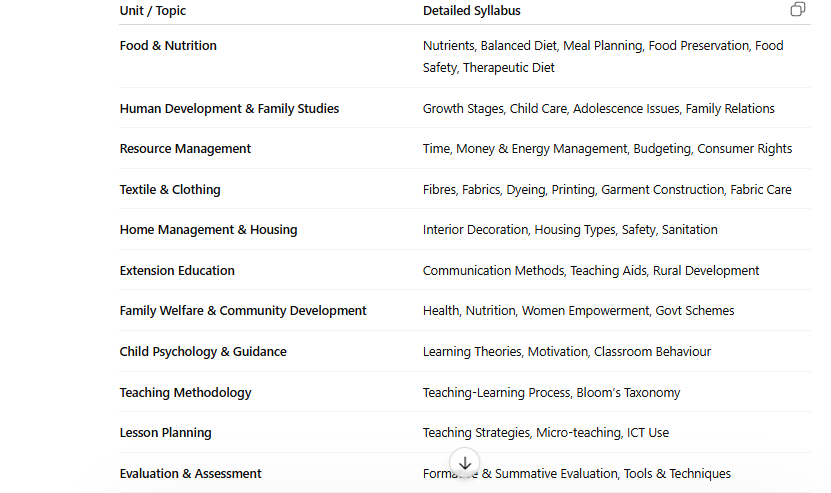
Section B – Subject & Teaching (100 Marks)
| Unit / Topic | Detailed Syllabus |
|---|---|
| Food & Nutrition | Nutrients, Balanced Diet, Meal Planning, Food Preservation, Food Safety, Therapeutic Diet |
| Human Development & Family Studies | Growth Stages, Child Care, Adolescence Issues, Family Relations |
| Resource Management | Time, Money & Energy Management, Budgeting, Consumer Rights |
| Textile & Clothing | Fibres, Fabrics, Dyeing, Printing, Garment Construction, Fabric Care |
| Home Management & Housing | Interior Decoration, Housing Types, Safety, Sanitation |
| Extension Education | Communication Methods, Teaching Aids, Rural Development |
| Family Welfare & Community Development | Health, Nutrition, Women Empowerment, Govt Schemes |
| Child Psychology & Guidance | Learning Theories, Motivation, Classroom Behaviour |
| Teaching Methodology | Teaching-Learning Process, Bloom’s Taxonomy |
| Lesson Planning | Teaching Strategies, Micro-teaching, ICT Use |
| Evaluation & Assessment | Formative & Summative Evaluation, Tools & Techniques |
| Inclusive Education | Special Needs Education, Differentiated Teaching |
| Educational Psychology | Learning Styles, Intelligence, Development |
| Classroom Management | Discipline, Time Management, Positive Environment |
| Curriculum Development | NCF, Curriculum Design, Value Education |
| Pedagogy of Home Science | Teaching Methods of Home Science, Practical Work |
Section B focuses on Home Science + Teaching Skills (most important part).
The exam mainly consists of a single-tier Computer-Based Test (CBT) that evaluates both general aptitude and subject-specific knowledge.
DSSSB Domestic Science Teacher Selection Process 2026
The selection process includes:
- Written Examination (CBT)
- Document Verification
The final merit list is prepared based on the marks obtained in the written exam.
DSSSB Domestic Science Teacher Exam Pattern 2026
The exam pattern is straightforward and follows a structured format.
Key Highlights:
- Mode: Online (CBT)
- Type: Objective (MCQs)
- Duration: 2 Hours
- Total Questions: 200
- Total Marks: 200
- Negative Marking: 0.25 marks per wrong answer
Section-wise Exam Pattern
| Section | Subject | Questions | Marks |
|---|---|---|---|
| Section A | General Awareness | 20 | 20 |
| Reasoning Ability | 20 | 20 | |
| Numerical Ability | 20 | 20 | |
| Hindi Language | 20 | 20 | |
| English Language | 20 | 20 | |
| Section B | Domestic Science (Subject + Teaching Methodology) | 100 | 100 |
| Total | 200 | 200 |
Section A tests general aptitude, while Section B is the most important (50% weightage).
DSSSB Domestic Science Teacher Syllabus 2026: Important Topics
The syllabus is divided into Section A (General Subjects) and Section B (Subject-Specific + Teaching Skills).
Section A Syllabus (General Aptitude)
1. General Awareness
- Current Affairs (National & International)
- Indian History & Freedom Movement
- Geography (India & World)
- Indian Constitution & Polity
- Economy & Social Development
- Environmental Science
- Awards, Books, Sports, Important Days
- General Science & Static GK
2. Reasoning Ability
- Analogies & Classification
- Coding-Decoding
- Series (Verbal & Non-verbal)
- Syllogism & Logical Reasoning
- Blood Relations
- Problem Solving & Decision Making
- Visual Memory & Observation
3. Numerical Ability
- Number System
- Percentage, Ratio & Proportion
- Profit & Loss, Discount
- Time & Work, Time-Speed-Distance
- Simple & Compound Interest
- Average
- Mensuration
- Data Interpretation
- Basic Algebra & Geometry
4. Hindi Language
- व्याकरण (Grammar)
- पर्यायवाची/विलोम
- मुहावरे एवं लोकोक्तियाँ
- वाक्य शुद्धि
- अपठित गद्यांश
- संधि, समास
- शब्दावली
5. English Language
- Vocabulary
- Grammar
- Synonyms & Antonyms
- Error Detection
- Cloze Test
- Comprehension
- Voice & Speech
- Idioms & Phrases
Section B Syllabus (Domestic Science / Home Science)
This section is the core of the exam and carries maximum weight.
1. Food & Nutrition
- Nutrients & Balanced Diet
- Meal Planning
- Food Preservation
- Food Safety & Adulteration
- Therapeutic Diets
2. Human Development & Family Studies
- Growth & Development Stages
- Adolescence Issues
- Parenting & Childcare
- Family Relationships
3. Resource Management
- Time & Energy Management
- Budgeting & Household Accounts
- Consumer Rights
4. Textile & Clothing
- Fibres & Fabrics
- Dyeing, Printing & Finishing
- Garment Construction
- Fabric Care
5. Home Management & Housing
- Interior Decoration
- Furniture & Design Principles
- Housing Needs
- Safety & Hygiene
6. Extension Education
- Communication Skills
- Teaching Aids
- Rural & Urban Development Programs
7. Family Welfare & Community Development
- Health & Nutrition Programs
- Women Empowerment
- Government Schemes
8. Child Psychology & Guidance
- Learning Theories
- Motivation
- Classroom Behaviour
- Counseling
9. Teaching Methodology (Very Important)
- Teaching-Learning Process
- Lesson Planning
- Bloom’s Taxonomy
- Evaluation Techniques
- Inclusive Education
- Classroom Management
- Curriculum Development
- Pedagogy of Home Science
Important Points for Preparation
Section B (Subject) carries 50% weightage – focus more here
Questions are objective & fact-based
Practice previous year papers & mock tests
Strengthen teaching methodology + pedagogy
Revise NCERT Home Science concepts thoroughly
Preparation Strategy for DSSSB Domestic Science Teacher 2026
1. Focus on Subject Knowledge
- Cover Home Science topics deeply
- Use NCERT + B.Ed notes
2. Balance Section A
- Daily practice of reasoning & maths
- Read current affairs regularly
3. Practice Mock Tests
- Improve speed & accuracy
- Reduce negative marking
4. Revise Teaching Methodology
- Important for scoring high in Section B
Conclusion
The DSSSB Domestic Science Teacher Exam 2026 is a balanced test of general aptitude and subject expertise. While Section A ensures basic competency, Section B plays a decisive role in selection.
A well-planned strategy focusing on:
- Home Science concepts
- Teaching methodology
- Regular practice
can significantly improve your chances of success.
About The Author
