
DSSSB TGT Computer Science Syllabus 2026: The Delhi Subordinate Services Selection Board (DSSSB) conducts the TGT (Trained Graduate Teacher) Computer Science exam to recruit teachers in Delhi government schools. Candidates preparing for DSSSB TGT Computer Science 2026 must clearly understand the exam pattern, marking scheme, and subject-wise syllabus to score well.
As per the latest pattern, the exam is conducted in Computer-Based Test (CBT) mode with objective-type questions.
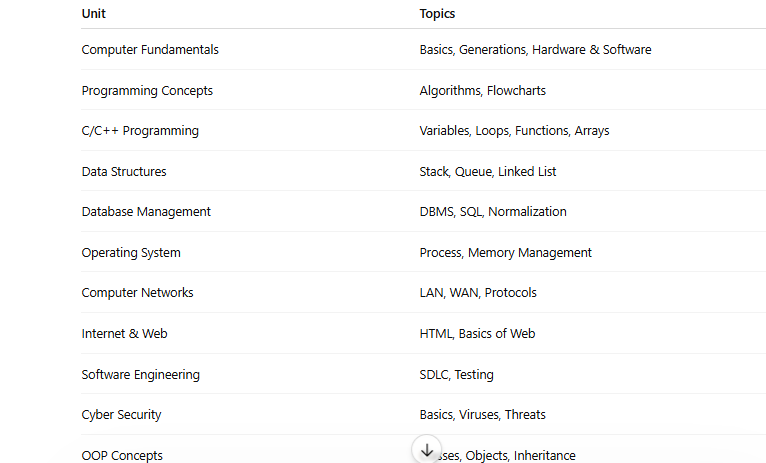
DSSSB TGT Computer Science Syllabus: Important Topics
| Unit | Topics |
|---|---|
| Computer Fundamentals | Basics, Generations, Hardware & Software |
| Programming Concepts | Algorithms, Flowcharts |
| C/C++ Programming | Variables, Loops, Functions, Arrays |
| Data Structures | Stack, Queue, Linked List |
| Database Management | DBMS, SQL, Normalization |
| Operating System | Process, Memory Management |
| Computer Networks | LAN, WAN, Protocols |
| Internet & Web | HTML, Basics of Web |
| Software Engineering | SDLC, Testing |
| Cyber Security | Basics, Viruses, Threats |
| OOP Concepts | Classes, Objects, Inheritance |
| Teaching Methodology | Pedagogy, B.Ed concepts |
The subject section carries maximum weightage (100 marks) and is crucial for selection.
DSSSB TGT Computer Science Exam Pattern 2026
The exam consists of 200 questions for 200 marks, and the duration is 2 hours.
Exam Pattern Overview
| Section | Subject | Questions | Marks |
|---|---|---|---|
| Part A | General Awareness | 20 | 20 |
| General Intelligence & Reasoning | 20 | 20 | |
| Arithmetic & Numerical Ability | 20 | 20 | |
| Hindi Language | 20 | 20 | |
| English Language | 20 | 20 | |
| Part B | Computer Science (Subject Concerned) | 100 | 100 |
| Total | 200 | 200 |
Key Highlights
- Mode: Online (CBT)
- Type: Objective (MCQs)
- Marking Scheme:
- +1 for correct answer
- -0.25 negative marking
- Weightage:
- Part A: 100 marks
- Part B (Computer Science): 100 marks
Important: The Computer Science section plays a decisive role, as it carries 50% weightage.
DSSSB TGT Computer Science Syllabus 2026
The syllabus is divided into two major parts:
Part A: General Section Syllabus
1. General Awareness
- Current Affairs (National & International)
- Indian History, Polity, Economy
- Geography
- Science & Technology
- Awards, Books, Important Days
2. General Intelligence & Reasoning
- Analogies, Coding-Decoding
- Series (Number & Alphabet)
- Logical Reasoning
- Venn Diagrams
- Statement & Conclusion
- Non-verbal reasoning
3. Numerical Ability
- Percentage, Profit & Loss
- Ratio & Proportion
- Time & Work, Time & Distance
- Simple & Compound Interest
- Data Interpretation
- Mensuration
4. English Language
- Grammar (Tenses, Articles, Prepositions)
- Synonyms & Antonyms
- Error Detection
- Reading Comprehension
5. Hindi Language
- व्याकरण (संधि, समास, कारक)
- वाक्य शुद्धि
- पर्यायवाची, विलोम
- अपठित गद्यांश
Part B: Computer Science Syllabus (Core Section)
This section includes core Computer Science + Teaching Methodology.
1. Programming & Data Structures
- C/C++ Programming
- Variables, Data Types, Operators
- Control Structures (if, loop)
- Arrays, Strings
- Functions, Recursion
- Pointers
- Stack, Queue, Linked List
2. Database Management System (DBMS)
- Database Concepts
- ER Model
- Relational Model
- Normalization
- SQL Queries (DDL, DML, DCL)
- Keys, Constraints
3. Operating System (OS)
- Process & Threads
- CPU Scheduling
- Memory Management
- Deadlock
- File System
4. Computer Networks
- OSI Model
- TCP/IP
- Network Devices
- Internet Concepts
- Protocols (HTTP, FTP)
5. Software Engineering
- SDLC Models
- Testing Techniques
- Software Design Concepts
6. Computer Organisation & Architecture
- Input/Output Devices
- Memory (RAM, ROM, Cache)
- CPU Organization
- Number System
7. Web Technology
- HTML, CSS Basics
- Internet & Web Concepts
8. Teaching Methodology (Important)
- Teaching Aptitude
- Pedagogy of Computer Science
- Classroom Management
- Evaluation Techniques
- Learning Theories
Note: Teaching methodology questions are frequently asked and are high scoring.
Preparation Tips for DSSSB TGT Computer Science 2026
- Focus more on Part B (Computer Science) as it has higher weightage
- Practice MCQs + previous year papers regularly
- Strengthen DBMS, Programming, and OS, as these are core areas
- Don’t ignore Teaching Aptitude, it can boost your score
- Maintain speed + accuracy to avoid negative marking
Conclusion
The DSSSB TGT Computer Science Syllabus 2026 is a mix of general aptitude and core technical knowledge. With 100 marks dedicated to Computer Science, candidates must prioritise technical subjects along with teaching methodology. A structured preparation strategy, regular revision, and mock tests are key to cracking the exam.
About The Author
