
The 2026 FIFA World Cup—co-hosted by the United States, Canada, and Mexico—features a record-breaking prize pool, reflecting the tournament’s expansion to 48 teams and massive global revenue.
In this detailed guide, you’ll find exact FIFA World Cup prize money for the winner, runner-up, and third-place teams, along with the full payout structure and key insights.
FIFA World Cup Prize Money for Top 3 Teams (2026)
According to official FIFA financial distribution, here’s how much the top teams earn:
| Position | Prize Money (USD) | Approx. INR (₹) |
|---|---|---|
| Winner (1st Place) | $50 million | ₹415+ crore |
| Runner-up (2nd Place) | $33 million | ₹275+ crore |
| Third Place | $29 million | ₹240+ crore |
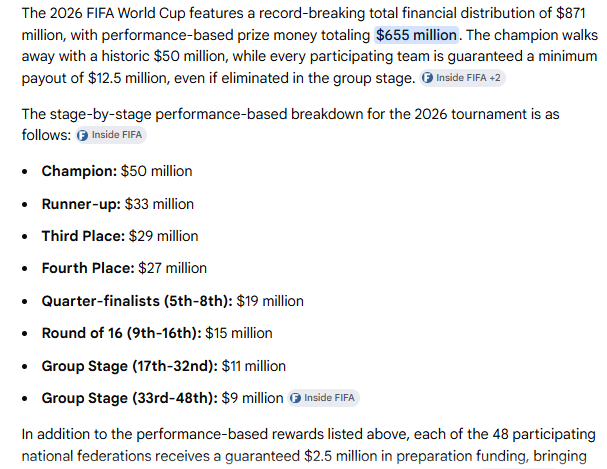
FIFA has officially confirmed these figures as part of a $655 million performance-based prize pool for the tournament.
Key Highlights of 2026 Prize Money
- Winner gets $50 million – the highest ever in World Cup history.
- Runner-up earns $33 million, a significant reward even without winning.
- The third-place team receives $29 million, showing strong incentives even beyond the final.
- Total prize money increased by 50% compared to 2022.
- The overall tournament distribution (including participation payments) exceeds $800 million+.
Full FIFA World Cup 2026 Prize Breakdown
Here’s how FIFA distributes prize money across all stages:
| Stage | Prize Money (USD) |
|---|---|
| Champions | $50 million |
| Runners-up | $33 million |
| Third place | $29 million |
| Fourth place | $27 million |
| Quarterfinals (5th–8th) | $19 million each |
| Round of 16 (9th–16th) | $15 million each |
| Round of 32 (17th–32nd) | $11 million each |
| Group Stage (33rd–48th) | $9 million each |
Even teams eliminated early still earn millions, ensuring financial support for all participating nations.
What’s New in 2026 Prize Money?
1. Expansion to 48 Teams
- More teams = more matches = bigger revenue
- Prize pool increased significantly to match scale
2. Higher Earnings Across All Rounds
- Every stage offers better payouts than 2022
- Even group-stage teams earn at least $9 million
3. Additional Payments
Apart from performance-based money:
- Each team gets qualification fees (~$10 million)
- Preparation funding (~$2–2.5 million)
Why Prize Money Matters
- Boosts football development in smaller nations
- Helps federations invest in infrastructure and youth systems
- Motivates teams to compete even for third-place finish
For example, even the third-place winner earns nearly ₹240 crore, making the playoff match highly competitive.
Comparison with the Previous World Cup (2022)
| Position | 2022 Prize | 2026 Prize | Increase |
|---|---|---|---|
| Winner | $42M | $50M | +$8M |
| Runner-up | $30M | $33M | +$3M |
| Third place | $27M | $29M | +$2M |
Clearly, 2026 offers the highest payouts in FIFA history.
FIFA World Cup Winner & Runner-Up: Prize, Rewards, and Benefits Explained
FIFA World Cup Trophy & Celebration
Winning the FIFA World Cup is the highest achievement in football. Along with global fame, the champion and runner-up receive huge prize money, medals, trophies, and long-term benefits.
Prize Money (2026 FIFA World Cup)
The 2026 edition has the biggest prize pool in history.
Winner (Champion)
- $50 million (₹400+ crore approx.)
- Additional earnings (qualification + preparation funds) can push total beyond $63 million
Runner-Up (Finalist)
- $33 million (₹270+ crore approx.)
Other Top Teams (for comparison)
- 3rd Place: $29 million
- 4th Place: $27 million
Even teams eliminated early earn millions, with at least $9–10.5 million guaranteed for participation
What the Winner Receives
1. FIFA World Cup Trophy
- Made of 18-carat gold, weighing about 6.1 kg
- The winning team does not keep the original permanently
- They receive a gold-plated replica after the tournament
2. Gold Medals
- Each player and team staff receives gold medals
- Usually around 40–50 medals are awarded
3. Championship Rings (New in 2026)
- First time in history: winners receive Super Bowl–style rings
- Custom-designed and symbolic of victory
4. Global Recognition & Prestige
- The team becomes World Champion for 4 years
- Players gain:
- Sponsorship deals
- Brand endorsements
- Higher market value
5. Financial Bonuses (Players & Staff)
- Prize money is paid to national football associations, not directly to players
- Players usually receive bonuses decided by their federation
What the Runner-Up Receives
1. Silver Medals
- All players and staff receive silver medals
2. Prize Money
- Around $33 million for finishing second
3. Recognition & Ranking Boost
- Considered second-best team in the world
- Improves FIFA ranking and global reputation
4. Commercial Benefits
- Increased:
- Sponsorship deals
- Player transfers and contracts
- Fan following worldwide
Additional Benefits for Both Winner & Runner-Up
1. Global Fame
- Massive worldwide attention (billions of viewers)
2. Economic Boost for Country
- Tourism, branding, and sports development increase
3. Player Career Growth
- Players often:
- Move to top clubs
- Earn higher salaries
4. Federation Funding
- Prize money helps:
- Develop youth academies
- Improve infrastructure
Comparison: Winner vs Runner-Up
| Feature | Winner | Runner-Up |
|---|---|---|
| Prize Money | $50 million | $33 million |
| Trophy | Yes (original temporarily + replica) | No |
| Medals | Gold | Silver |
| Rings (2026) | Yes | No |
| Title | World Champion | Finalist |
| Global Recognition | Highest | Very High |
Key Takeaways
- The FIFA World Cup winner receives the trophy, gold medals, ~$50M prize money, and global fame.
- The runner-up still earns ~$33M, silver medals, and major recognition.
- Both teams benefit financially, commercially, and historically.
- The tournament is not just about money—it’s about legacy, prestige, and national pride.
Final Thoughts
The FIFA World Cup 2026 prize money structure reflects the tournament’s growing scale and commercial success.
- Winner: $50 million
- Runner-up: $33 million
- Third place: $29 million
With increased rewards at every level, the competition is not just about glory—but also massive financial gains for national teams.
About The Author
